Special Topics

Schooled in Love: Fun Valentine's Day Facts From College Campuses

Valentine’s Day is next week, and we’re celebrating the holiday of love college-style! Read on to learn about famous college sweethearts, romantically-themed college classes, and more!

Romantic campus traditions

Do you hope to find a partner before college graduation? Do you want to make your crush love you back? Well, then you better follow these romantic college campus traditions!

(Side note: We are not proponents of trying to find your life partner in college - quite the contrary, actually! But in the spirit of Valentine’s Day we are playing along..❤️❤️❤️ )

At William and Mary, the Crim Dell bridge can determine the fate of a student's love life. According to legend, those who walk across the bridge alone will remain solo forever. And those who cross with a lover must stop for a kiss in the middle of the bridge to ensure their happy ending. If they ever break up, the couple must return to the bridge and throw one partner off of it (no, we’re not making this up!).

At Syracuse, students don’t have to push anyone off of a bridge. They just need to sit on the kissing bench. This resting spot is supposed to bring marriage to couples who kiss here. But beware if you are single! It’s believed that if a single person sits on the bench, they’ll be alone for life. 

Hopeful couples looking for a happily ever after at Texas A&M head to the iconic Century Tree. It was one of the first trees planted on campus and is steeped in legend. Supposedly, if a couple walks under the tree together, they will marry. And any couple who becomes engaged under the tree will have a successful, lifelong marriage.

LOVE in the city of brotherly love

Are you in search of love? If so, you’re sure to find it at the University of Pennsylvania. Situated in the city of brotherly love, UPenn is home to an iconic bright red LOVE sculpture. According to the university’s almanac, pop artist Robert Indiana first designed the LOVE logo in the 1960s. The stacked L-O-V-E letters had such appeal that Indiana eventually turned the logo into a sculpture in the early 70s. Since then, sculptures of LOVE have been reproduced all over the world, even appearing in different languages. A rendition of the famous sculpture currently stands in the heart of UPenn’s campus, thanks to a donation from art dealer Jeffrey Loria. So if you’re looking for love this Valentine’s Day, head to 36th and Locust Walk.

College sweethearts

College campuses have long been the setting for great love stories. In fact, several celebrities met their future spouses as students. While attending Harvard University- and creating Facebook in his spare time- Mark Zuckerberg reportedly met his future wife at a fraternity party in 2003. They were together nearly a decade before officially changing their relationship status to ‘married.’ 

Bill and Hillary Clinton met while both taking a class on political and civil rights at Yale Law School. The former president was too hesitant to introduce himself, so Hillary made the first move one day in the library. According to Clinton, his future wife approached him with a memorable line: “Look, if you’re gonna keep staring at me and now I’m staring back, we at least ought to know each other’s name.” 

Perhaps the most famous college sweethearts in the world are Prince William and Princess Catherine. The two met at the University of St. Andrew’s in Scotland where they developed a close friendship. Eventually they became platonic flatmates, and as Prince William described in their engagement interview, “It just sort of blossomed from there, really.”

Schooled in Love

To some, love is just a feeling, but it happens to be a topic of serious study at several colleges and universities across the country. In recent years, a number of classes analyzing the psychology of love, as well as the state of modern relationships have appeared in course catalogs. At Northwestern University, undergraduates interested in developing their relationship skills can take Dr. Alexandra Solomon’s highly publicized class, Building Loving and Lasting Relationships: Marriage 101. Over the course of a semester, students study the art of dating, bonding, and partnering across cultures. This class has been such a hit that it’s received media coverage in major news outlets.

NYU has found its own success with love-themed classes. In Love Actually, students explore what love actually is from psychological, cultural and artistic perspectives. If you’re interested in seeing why this course has become so popular (and the topics it covers), check out the course book list. And for students who want to learn more about the college dating scene, NYU offers 100 Years of Courting, Dating, and Hooking Up on College Campuses. In this class, undergrads take a look at the changing behaviors of college students over the past century and examine how universities have responded. 

Some of our lesser-known favorites over the past five years include Love, Mating, and the Brain (UT Austin); Love in the Time of Tinder (Lehigh University); and The Art of Loving (Princeton University). 

sweet tooth

No Valentine’s Day is complete without a delicious heart-shaped box of chocolates. And we have Penn State to thank for these sweet treats! The College of Agricultural Sciences at Penn State is known throughout the world for its quality chocolate research over the past fifty years. Teams of faculty, graduate students, and fellows have worked to enhance crop production and the overall quality and taste of chocolate. Specific research topics include cacao production, chocolate making processes, and plant improvement. In an effort to share their passion with others, The College of Agricultural Sciences offered a Chocolate Short Course in the summer of 2022 for professionals in the chocolate industry. 

A Lovely Entrepreneur 

When Esther Howland graduated from Mount Holyoke College in 1847, she had no idea that she would fall in love with business or become the “mother of the American valentine.”  Inspired by the Valentine’s greeting cards her father sold in his stationery shop, Esther decided to create her own. She imported speciality materials from England and created an elaborate signature look for her Valentine’s greetings. The cards were often decorated with lace, silk, and satin! What began as a small project in the family home eventually transformed into a successful business: the New England Valentine Company. Howland ended up earning hundreds of thousands of dollars in the 1800s— a time when women weren’t supposed to work outside the home, let alone run a business. Since then Howland has become a true legend. Her entrepreneurial spirit is a reminder of Mount Holyoke's long-standing reputation for educating powerful female leaders.

HAPPY VALENTINE’S DAY!

Whether you’re celebrating with your galentines, palentines or valentines, we hope you have a wonderful week and get to eat lots of yummy treats!

Four Plans High School Juniors Should Make This Month

Hey Juniors, we’ve got plans for you this month! February is an important time to “get the ball rolling” on your college admissions process. In fact, there are a few sneaky deadlines creeping up that we don’t want to pass you by. To help you get organized, we’ve put together a list of four big college plans you should make this month. So break out your Google calendar and to-do lists, and get to work!

plan #1: sat or act registration

It might feel like only yesterday that you took the PSAT, but now it’s time to sign up for the real deal. Don’t let February slip by without registering for the SAT or ACT. There are a few testing dates available throughout the spring and early summer. Registration typically closes 4-5 weeks prior to a test, so make sure to sign up early! 

As you consider your options, weigh your academic responsibilities and extracurricular commitments. For example, will you have to study for five AP exams this spring? Then maybe the May 6th SAT isn’t the best date for you. Are you already enrolled in a soccer camp that conflicts with the June 10 ACT? Well, then you better sign up for the April test.

Still not convinced you need to register now? Then check out this reality check. The registration deadline for the March SAT is Friday, February 10: that’s only eight days away! 

plan #2: standardized testing study schedule

Once you’ve got your SAT or ACT testing date on the calendar, take some time this month to devise your study plan. You might even want to gather some friends and start a study group. If you need help getting yourself organized, the College Board has information on how to set up an SAT study group and provides a sample study plan. For those planning to take the ACT, there are free study resources available here. We also love Khan Academy, which offers plenty of guidance for both tests. 

If you are interested in adding a prep course or tutor to your study plan, research your options now! Classes and tutors book up quickly during the spring, and we are happy to recommend tutors and courses that have been helpful to our students in the past (private tutoring is without question the best way to prepare if it’s in the budget!).

plan #3: spring break college Visits

So many families wait until summer to begin touring colleges, but did you know that spring break is an ideal time for campus visits? With school still in session, you’ll be able to experience the “hustle and bustle” of college life at the height of the semester. The crowds of students in the quad, the vibrant classrooms, the events in the Student Center- they can all give you a good sense of campus culture and environment. 

College visits can also be useful as you continue to build and refine your college list. When you experience campuses for yourself, you get a better idea of what you like - and don’t like- and which factors are most important to you in a school. 

There is also no question that students who go on in-person visits have a much easier time (yes, that’s italicized and underlined for a reason) with their “Why this school” essays! Michigan and Wisconsin might seem the same from online info sessions, and while those can be very useful in their own right, it can be hard to capture a sense of place - or in teenage speak, “a vibe” - from that type of programming. On the other hand, in-person visits will help you discover the nuances of different environments. There’s nothing like walking through the tunnel onto the field at The Big House or enjoying Babcock ice cream while watching the sun set across Lake Mendota!

Don’t worry, though, if you don’t have much time or can’t coordinate a long-distance trip. You can always schedule a spring tour at a local college. It might not be at the top of your list (or maybe not on your list at all), but the school can still provide valuable points of comparison for the future.

plan #4: Summer opportunities

Now that the idea of college is starting to feel really real, you’ll want to think about how you can use your summer to prepare for the future. Whether you want to gain experience doing medical research in a lab or explore the field of journalism, there’s an opportunity for just about every interest. Visit our database for comprehensive lists of teen internships, volunteer projects, and pre-college programs available for Summer 2023.

Some of our most recent postings include an opportunity to work for NASA and to conduct research on psychological traumas. Pretty cool, huh? The only problem is that deadlines are approaching fast. Many programs will close their applications in mid to late February, so get to work on those summer plans! 

What’s On Your Shelfie? A Look Into Our Current Favorite Reads

What are you reading? Our team of English majors at DC College Counseling LOVES this question. We look for any excuse to talk about our favorite books and recommended reads. And this week we have the perfect excuse, as we celebrate National Library Shelfie Day. Every fourth Wednesday in January, book lovers take selfies to honor all-things reading, whether it’s capturing a beloved novel; showing off bedroom bookshelves; or sharing a visit to a local library. Want to see for yourself? Search #libraryshelfie on social media platforms, and you’ll find thousands of literary images. 

We’re honoring National Library Shelfie Day with a glimpse into what we’re currently reading, as well as some suggested titles for teens and parents. And of course no shelfie day would be complete without selfies!

COLLEEN’S SHELFIE

Every time someone asks what I'm reading, I get a little sad because this is definitely a habit that I've let go over the years. I used to absolutely love reading and now as a mom and business owner it's hard to justify the time when it feels like there is always something urgent that I need to be doing instead. I mentioned in our New Year's wrap-up that I really enjoyed reading The Premonition: A Pandemic Story by Michael Lewis this past year and it's definitely one that I'd recommend to anyone! I love when non-fiction books are so interesting that they read like fiction, and this was definitely in that category. 

Over the holidays I started to read Rising Strong: How the Ability to Reset Transforms the Way We Live, Love, Parent and Lead by Brene Brown, and I like it a lot so far. She explains that the human mind is wired to create stories when presented with information, and so in the face of any type of difficult situation we naturally create a story or explanation in our mind about what’s happening and why. But here’s the thing - our stories are usually WRONG!

When we let ourselves jump to conclusions like this, we start assigning negative intent to others and all sorts of problematic things happen. Since I started reading the book, I have really tried to stop and ask myself about whether I’m making unfair assumptions every time I get upset about something. Full disclosure, my bad habits are not fully broken yet - but as you can see, this is really making me think!

I am also sort of on and off reading Rodham by Curtis Sittenfeld, which I started a while ago. I love Curtis Sittenfeld!

Back when I used to read more, I tracked everything on my Goodreads page. I am trying to get back into reading more this year, so feel free to friend me on Goodreads so we can share recommendations! I like how Goodreads lets you sync your Amazon account so you don't forget what you read, even if you're delinquent with your updates like I was for a while!

A few books I hope to read over the next few months are:

Bittersweet: How Sorrow and Longing Make Us Whole by Susan Cain - she is also the author of Quiet: The Power of Introverts in a World That Can't Stop Talking, which I actually read after a student wrote about it in one of her essays!

(That’s a very powerful read in its own right, by the way, and is one of those books that I still think about all the time because I learned so much from it. If you are an extrovert with introverts in your life, this is a must - it will help you identify your unconscious biases and understand their personalities so much better.)

Tomorrow, and Tomorrow, and Tomorrow by Gabrielle Zevin - I will admit that I am not super excited about the plot but so many people have raved about it that I am willing to give it a try!

SHANNON’S SHELFIE

As an academic coach, I had to add Stolen Focus: Why You Can’t Pay Attention - and How to Think Deeply Again by Johann Hari to my bookshelf. Hari takes a close look at why we have trouble focusing - and the reasons for our short attention spans might surprise you. It turns out that food, health care, and even algorithms could be to blame. 

This book will help you understand why it’s so easy for your phone to distract you (no, it’s not just lack of willpower) and what you can do to reclaim your attention. I know that I’ll be using some of Hari’s advice in my academic coaching sessions this year! 

Another book I really enjoyed (and would recommend to anyone interested in psychology or kinesiology) is Move: How the New Science of Body Movement Can Set Your Mind Free by Caroline Williams. I’ve been working toward my 500-hour yoga certification this past year, which has made me interested in the mind-body connection. Most of us are stuck behind our desks all day, and all of that sitting has a big effect on our brains and our happiness. Williams breaks down the science of movement, explaining why it’s so important to incorporate it into our daily lives. Even a quick walk can improve memory, increase productivity, and boost your mood. 

STACI’S SHELFIE

I just finished all 480 pages of The Mosquito Bowl: A Game of Life and Death in World War IIDon’t let the length scare you away from reading this book, especially if you love World War II history like I do! It was a surprisingly quick read about a group of soldiers who created a memorable football rivalry while training in the pacific. I’ve always been fascinated by World War II (thank you high school history field trip to Germany!) and was so excited to find a story I had never heard about before. If you’re a history buff or are a big football fan, definitely add this title to your shelf! 

Another new addition to my book collection is A Man Called Ove by Fredrik Backman. The novel was published a decade ago, but I didn’t crack it open until I recently learned that it was being adapted into a movie. I figured that before watching Tom Hanks star as Ove on the big screen, I needed to read the book. And it’s a good one! Ove is a cranky old man who reminds me a lot of my grandfather. He doesn’t like being around people, and people don’t like being around him–until he meets his new neighbors. The English major in me loves the character development and the feel-good theme of friendship. 

Now I’m waiting for Saving Time: Discovering a Life Beyond the Clock by Jenny Odell to be released. This book is supposed to offer a new perspective on how we think about time and spend our time. I’m hoping that Odell can help me slow down and appreciate the things I do every day–moment by moment.

WHAT’S ON YOUR SHELFIE?

We’re always looking for recommendations. Share some of your favorite titles or recommended reads with us!

Trend Watch: Careers on the Rise

“What do you want to be when you grow up?” When you were six years old, this question was probably fun to answer. Maybe you wanted to be an astronaut, professional athlete, or a movie star. There were no limits! As you get older, though, the answer isn’t so simple. You start to weigh the practicalities of a career path, from salary potential to job security. 

If you are exploring career options, then today’s blog post is for you! We’re sharing ten careers that are on the rise in 2023 and are projected to keep growing. Take a look and see what your future could be!

NURSE

Nurses have always been in demand, but more so in recent years. With a rise in chronic conditions and an aging population in the United States, nurses are needed to fill hospitals, assisted living facilities, long-term care facilities, and more. Although nursing can certainly be challenging, the field is known for having good job security and flexible schedules. 

For those who don't mind the additional schooling and training, you may want to consider becoming a nurse anesthetist or nurse practitioner. According to the U.S. Bureau of Labor Statistics, these fields are predicted to increase over 40% in the next decade. And while it’s not all about money, know that nurse anesthetists in the DC area make about $200k per year on average. Not too shabby!

Pharmacologist

Six out of ten American adults suffer from a chronic disease, such as diabetes, cancer, or Alzheimer’s disease. With the rise in these conditions, the medical world is more focused than ever on finding treatments and cures. That’s where pharmacologists come in! These medical scientists specialize in researching and developing new medications to help patients. If you’ve always dreamed of discovering a cure for cancer or find yourself interested in medical research, this field could be for you! Just get ready for lots of schooling: pharmacologists are required to earn an advanced degree such as a Ph.D. or Pharm.D. 

Physical Therapist

All of this medical talk brings us to physical therapy. The increase in chronic conditions (yes, again!) and the fifty million Americans over the age of 65 are just two factors contributing to the 20% growth in this profession. Physical therapists often work with a range of clients, and it’s their job to help patients recover from injuries, manage pain, and ideally avoid surgeries. The field offers a lot of flexibility in terms of where and with whom you can work. Perhaps even more importantly,  physical therapy is one of the most satisfying professions, according to recent surveys and studies. After all, who wouldn’t want to spend their days helping others get stronger and better?

Medical and Health Service Managers

With great demands in the healthcare world comes greater demand for healthcare leaders. Managers are needed to oversee medical facilities, including hospital departments, physicians’ offices, and clinics. This field is projected to grow almost 30% over the next decade and could be a good match for those interested in the business of healthcare. We have also seen a significant increase in undergraduate programs dedicated specifically to preparing students for a career combining business and health - pretty cool!

Financial Manager

If the medical field isn’t for you, consider helping the health of a business organization. Financial managers are responsible for overseeing the “financial sustainability” of a company. They help plan, direct, and organize operations through a number of tasks: data analysis, investments, profit planning, and risk management. With so many economic fluctuations and a growing global market, this field is expected to grow 17% in the coming years. 

Data Scientist

These days, every company and organization has a wealth of data. But what do they do with it? That’s actually why so many places are hiring data scientists, who help the organization make sense of datasets. It’s their job to analyze, identify patterns, and even build models for predictions. Ultimately, data scientists help companies solve complex problems, make important decisions, and develop new strategies. This field is extremely popular and offers professionals the flexibility to work in just about any industry, from business to technology to healthcare. It’s also an area where we see more and more academic programs popping up each year!

Machine Learning Engineer

The popularity of data science has created an increased demand for machine learning engineers, not just data scientists. Machine learning engineers often work as part of a bigger team of data analysts and scientists to help build AI systems that hold huge data sets and can make predictions. Machine learning engineering could be the right fit for those who enjoy programming just as much as data analysis.

Information Security Analyst

According to the U.S. Government, cyber attacks are on the rise, and the risks to IT systems are increasing. This is bad news for most people, but not if you’re interested in a career in cybersecurity! Information security analyst roles are becoming increasingly popular in all industries, where these experts are needed to help secure computer networks and prevent cyber attacks. In fact, the U.S. Bureau of Labor Statistics predicts that this field will expand 35% by 2031.

Software Developer

It’s probably no surprise to see software development on the list of growing careers. With our reliance on technical systems to perform jobs and daily tasks, professionals are needed to design the programs and apps that keep our lives running efficiently! Software developers can find jobs in just about any industry if they have the right skills. In addition to programming and other technical expertise, a developer must also have superior problem solving skills, creativity, and the ability to work on big teams. 

Veterinarian

Over the past three years, pet ownership has significantly increased, and pet industry sales have soared to over $100 billion. Clearly, people are willing to spend on their pets, whether it’s food, accessories, or even healthcare. These factors are likely contributing to the increased demand for veterinarians, a career that is anticipated to expand by 19% over the next decade. Of course, there’s a lot of schooling involved if you want to become a veterinarian, but U.S. News and World Report ranks it number twelve in its list of best jobs. 

Exciting Summer 2023 Opportunities for Teens

We’re coming up on a three-day holiday weekend, and if you are a high school student looking for something to do, we’ve got the perfect idea: plan for summer 2023! We know it may seem way too early to start thinking about what you’ll be doing in July. But believe it or not, there are many summer opportunities with winter deadlines. If you don’t start researching and applying now, you might miss out on a great internship, academic program, or volunteer experience.

the advantages of a summer opportunity

Discover new subjects…and maybe a potential college major: Summer programs are notorious for offering unique classes and subjects you might never get the chance to explore at your high school. For example, Brown’s Pre-College Program offers courses in nanotechnology, Netflix, and mood disorders. And Georgetown’s Summer Academies introduce students to subjects like national security, election campaigns, and AI. A summer program might just lead you to discover your college major or career path.

Demonstrate your interest in a specific subject: Colleges love to see students getting deeply involved in the areas about which they are most passionate. This is your chance to delve into a particular field of interest. In the past, our students have spent their summers publishing psychological research; designing major engineering projects; and producing short films. Don’t pass up the chance to invest in something you love! 

Develop soft skills: More than ever, universities and employers are looking for people who can work well with others. And in order to work well with others, you need to develop soft skills, such as communication, empathy, and problem solving. Because so many summer opportunities involve lots of hands-on activities and collaborative projects, they provide the perfect environment to improve your skills. Bonus: you show off these skills in your college applications and interviews!

Build your resume: A summer experience can be a great addition to your resume and college applications. Plus, it could end up being a topic for one of your admissions essays! 

Have fun: Do you imagine yourself bored in class all summer listening to lectures? Well, get that image out of your mind! Summer opportunities aren’t meant to be stressful or passive. Quite the opposite! Most programs are designed to give you real-world experiences: field trips, interactions with industry experts, hands-on projects, competitions, and more. We promise that you can have fun while learning. 

WHERE AND HOW TO APPLY

So have we convinced you to start applying for a summer experience? If so, take the next step and visit our database. We’ve curated extensive lists of local, national, and virtual opportunities for teens. Each week, we update the database with new programs and organizations. While many academic programs charge a fee, there are plenty of free courses and volunteer roles available. 

Here are just a few of the exciting opportunities you’ll find in our database:

When you are ready to apply for an opportunity, be sure to carefully and thoroughly complete your application materials. If you need support writing application essays, building your resume, or preparing for an interview, book a session with us

ADD AN OPPORTUNITY TO OUR DATABASE

If you are an employer or organization looking for teen interns or volunteers, we’d love to add your information to our database. Please email staci@dccollegecounseling.com with your information.

20 New Year's Resolution Ideas For High Schoolers

“Should auld acquaintance be forgot, and auld lang syne…” (insert my terrible singing voice here). “Auld Lang Syne” has long been the anthem of the new year, as we reflect on times gone by and celebrate what’s to come. But even with a silly hat and a classic tune, no new year would be complete without a list of resolutions. We’ve already had time to think about some of our 2023 resolutions, which we shared on the blog last week, and now we’re encouraging high schoolers to do the same.

There’s no better time to create new goals and habits that can help set you up for future success. So today we’re offering 20 resolution ideas to help make 2023 your best year yet (and a great stepping stone to college).

  1. Join a new activity: Do you secretly dream of taking center stage in the school musical? Are you curious to see what kind of golfer you could be? Whatever your interest or curiosity, try it out!  You never know. You could end up with a new hobby, a unique talent, or even a career path.

  2. Master a skill: Ironing dress shirts, coding a robot, debating a current event: there are so many skills you can learn this year. Choose one that interests you- or might help you become more self-sufficient- and practice, practice, practice. 

  3. Use a planner: Whether it’s a fancy Papier notebook or a simple calendar app on your phone, vow to take charge of your schedule. Track your activities, tests, and other commitments to help alleviate stress and better manage your time. 

  4. Talk to your teachers: This year, trade in the quick hellos and ‘help me’ emails to your teachers for actual conversations. More face time can help you develop strong relationships, which is important for academic success. Plus, these connections can lead to much better recommendation letters when it’s time to apply to colleges.

  5. Take on a passion project: You probably have plenty of school projects to complete, but what about your own passions? Think about the things that mean the most to you and design a project around your interests. We’ve been so inspired by some of our past students who’ve done everything from building boats to designing clothing to creating nonprofit organizations. Dream big in 2023! 

  6. Step into a leadership role: Leadership skills are important for the future, so why not start practicing now? Look for opportunities to lead, whether you’re working on a group project in science class or helping teammates on the field. You don’t need an official title or role to be a great leader. You just need to be positive and motivated! 

  7. Find a mentor: We’re usually so busy that we don’t stop to realize that there are a lot of great teachers around us. And no, we’re not just talking about those adults at the front of the classroom. Whether it’s an upperclassman in your Robotics Club, your volleyball coach, or a friend’s parent, look around for those who can teach you something. Be open to hearing their perspectives and asking for advice. You might be surprised by what you learn! 

  8. Become a mentor: You don’t have to hit a certain age or join an official program to become a mentor. All you have to do is look for the person sitting alone in the cafeteria or the player struggling during practice. Recognize those in need of a confidence boost and be that positive force for them. 

  9. Speak up in class: Did you spend 2022 hiding in the back of the classroom? Or feeling too intimidated to raise your hand? Well, don’t be so shy in 2023. Make it your goal to engage in class and take on more of an active role. We promise that you’ll end up learning more and maybe even having fun. 

  10. Create an actual study space: Swap the kitchen counter or your bedroom floor for a dedicated study space. Design an area at home where you can work comfortably and without distractions. And don’t forget to decorate! 

  11. Sleep more: Seriously! 

  12. Drink water: According to studies, over 75% of people are chronically dehydrated, which can make us tired and affect our ability to learn. Luckily, though, there’s a simple fix: drink more water! If you’re someone who tends to forget about water intake throughout the day, invest in a water bottle with hours/ounces marks and sip away.

  13. Switch on airplane mode: Have you ever checked to see how much time you spend on your phone each week? The numbers may shock you! This year, make better use of airplane mode. Consider ‘unplugging’ after 9pm or maybe even doing a digital detox once a month. We know it’s really hard to detach from your phone, but small changes could add up to better sleep and fewer wasted hours.

  14. Create a cool summer plan: With thousands of summer academic and extracurricular opportunities for high school students, why not take advantage of one (or more) of them this year? Explore your options and start planning an unforgettable summer! 

  15. Clean up: Now is the perfect time to get rid of the old! Whether it’s your locker, bedroom, or backpack, take some time to clean out and clean up. Refine your organizational system while you’re at it, and commit to spending 5 minutes everyday maintaining it.

  16. Update an old routine: Are you sick of eating the same old breakfast every morning? Is your study schedule not working as well now that you’ve joined the track team? Reflect on your routines and revamp one that feels boring or inefficient. 

  17. Do less: If you’re feeling overwhelmed and overcommitted, think about doing less in 2023. Take stock of your priorities and consider letting go of something to create more balance. Although you might feel like you’re losing, you actually might be gaining. Don’t underestimate the power of more rest. 

  18. Fail: No, not your tests and classes! We’re encouraging you to overcome your fear of failure this year and take a risk. Audition for that play; try out for the varsity team; enter the competition; submit your creative writing sample. Whatever it is, take a chance! Even if you don’t make the team or win the award, you’ll feel good knowing you put yourself out there. 

  19. Make a new friend: It’s easy to stick to the same routines AND the same friend group. But you could be missing out on some pretty awesome people. Let 2023 be the year where you sit at a different lunch table; talk to the new player on the team; and attend an event, even if your friends aren’t going. 

  20. Choose your own adventure: Sure, it would be fun to backpack through Europe or hike the Appalachian Trail. But if you can’t get overseas or don’t love the idea of scaling mountains, you can still create your own adventures. This year, plan a fun road trip or explore a place you’ve never visited right in your hometown. Sign up for a cooking class or challenge your parents to a game of tennis at the local park. Exciting activities come in all shapes and sizes!

Our 2022 Year in Review

Before we ring in a new year, we want to send off 2022 properly. After all, it’s been quite a year! The past twelve months have brought us many adventures, proud achievements, and some amazing milestones. So today we’re taking a look back at 2022 and sharing some of our favorite memories with all of you.

My year can be summed up in one word: Busy

A good habit I developed: I started getting consistent about vitamins - I take them every single morning now and managed to stay relatively healthy all year long. 

The best time management hack I discovered: using IGK “Good Behavior” spray on my hair before drying it - it is life changing and saves me so much time! Thank you, TikTok!

Memorable reads: The Premonition: A Pandemic Story by Michael Lewis and The Family Firm: A Data-Driven Guide to Better Decision Making in the Early School Years by Emily Oster.

Podcast favorites:  My daughter and I listen to podcasts together most nights and our long-time favorite is Curious Kid Podcast. We also got into Newsy Pooloozi and just finished Six Minutes, which one of her teachers recommended and it was such a hit! We are in the market for another ongoing one like that - sort of a kid-friendly version of Serial if anyone has any recommendations. 

When I am by myself I usually listen to business podcasts - some of my favorites are BizChix and the sister podcast Stacking Your Team; HBR IdeaCast; Pivot; and The Indicator from Planet Money. 

My new skills of 2022 include: Home maintenance tasks- I ordered a new part and repaired my dishwasher, identified and repaired some kind of blockage in my dryer, and even fixed an issue with my garage door with the help of YouTube and video chats with girlfriends! 

The best piece of advice I received: I am paraphrasing here but Robert Kennedy, my Goldman Sachs 10KSB lead faculty member, told my cohort of entrepreneurs that if you have even a tiny suspicion that something might be going “wrong” in your business, it’s likely that something actually IS wrong and you need to pay attention to your intuition. I think this advice can be applied to many different aspects of life, and it stuck with me. 

Favorite moments: Finding out in an Uber one night that I was en route to a Billy Joel concert at Madison Square Garden. I had mentioned a year earlier that seeing him there was on my bucket list and never said anything about it again, so I was blown away at the surprise! The concert was amazing but the thoughtfulness was even better. My runner-up would be when my kids and I decided at the last minute to fly down to see Miami play UVA and ended up courtside. So much fun! 

My big achievement: Hitting submit on my 10KSB final growth plan on December 4, which represented the end of the intensive part of the program. Balancing that commitment with our busy season at work while still being an involved and engaged parent was the hardest thing I have ever done by a long shot! 

New Year's resolutions: My perpetual resolution for at least the last decade - learning how to put contacts in my eyes. I want to make them work so badly and have had all the help you can imagine, but nothing works - my instinct to blink is just too strong, and I can’t get the contact in. Free college counseling to anyone who can help me overcome this!

In 2023, I’m looking forward to: I have some fun travel planned, and this may sound lame but I am actually super excited to introduce a new type of application status chart for our Class of 2024 students. I had an epiphany about how to improve the tracking process, which continues to become more complex by the year, and I think it’s going to be a big hit that will make our students’ lives easier!

My year can be summed up in one word: Hectic

A good habit I developed: This sounds boring, but I have been struggling with a back injury for over a year now and making an effort to slow down and focus on healing (rather than throwing myself into all my favorite workouts!). 

The best efficiency tool I discovered: “Open” and “Closed” to-do lists! I use an “open” list as a brain dump to get down literally everything I have to do, and then the “closed” list is limited to 3-4 items I will focus on. The key is that I can’t move anything from my open list to the closed list until I complete something that is on it! I’ve enjoyed this method because it lets me do the all-important brain dump to make sure I know what needs to happen, but also helps me prioritize (since I can’t do 100 things in a day, no matter how hard I try :)) 

Memorable reads: Stolen Focus: Why You Can’t Pay Attention and How to Think Deeply Again by Johann Hari; Move: How the New Science of Body Movement Can Set Your Mind Free by Caroline Williams (P.S:  I’d recommend this book for any juniors hoping to study something like kinesiology or psychology - great to mention in an essay or interview!). 

Podcast favorites: If Books Could Kill - a new podcast from one of my favorite podcasters this year that debunks some of the most popular ideas from books like Freakonomics, Outliers, and more!

I gained confidence in: Flying! I struggle to sleep on airplanes and was always afraid of long flights, but this year I took a couple 18-hour-plus flights with no problem. 

The best piece of advice I received: Let other people help you when you need it (they want to!).

Favorite memories: I traveled to India this December for my cousin’s wedding. It was such a wonderful experience both to see a part of the world I’ve never visited before and to spend time with my extended family. 

My big achievement: I dove into getting my 500-hour yoga certification this year, which is something I’ve considered for a long time. I’ll graduate in March!

New Year's resolutions: I want to start taking piano lessons. I LOVE music, but I have never played a musical instrument. 

In 2023, I’m looking forward to: Continuing to travel and spend time with family and friends. Being able to do this post-pandemic is something that I will really never take for granted :) 

My year can be summed up in one word: Active

A good habit I developed: Not checking my phone immediately when I wake up in the morning. It’s part of the morning routine I created after reading The 5am Club: Own Your Morning. Elevate Your Life by Robin Sharma. I still haven’t mastered the 5am workout or hearty breakfast, but I’m getting there! 

The best time management hack l I discovered: Allison Bornstein’s TikTok series on closet editing and organization. Her system has saved me so much time and money.  Bonus: I finally found the jeans I’ve been missing since 2019!

Memorable reads:  By far my favorite book this year was The Watermen: The Birth of American Swimming and One Young Man's Fight to Capture Olympic Gold by Michael Loynd. I love a good underdog story! Honorable mentions go to Lessons in Chemistry by Bonnie Garmus- a fun, easy read- and The Motivation Code by Todd Henry - a dense book but an interesting take on what it takes to get motivated.  

Podcast favorites: Currently hooked on Betty in the Sky With a Suitcase! - a great mix of funny travel tips and stories from a long-time flight attendant. Runners- up include Stuff You Missed in History Class and You’re Wrong About.

I gained confidence in: my French language proficiency and my grilling skills.

The best piece of advice I received: “Make the day. Don’t let it make you.” - from a very wise Instagram post I stumbled upon. 

Favorite memories: Hiking along the coast of southern California; reuniting with one of my best friends after three long COVID years; welcoming a new niece; watching one of my former students star on Broadway. 

My big achievement: Surviving a 2-day, 17 mile winter hike in Shenandoah and earning my personal training certification.

New Year's resolutions: I am determined to keep up with my French lessons and read one fun book per month. 

In 2023, I’m looking forward to: Traveling to Spain for my best friend’s wedding.

Happy New Year to all of you!

We wish everyone a very happy and healthy 2023, and we look forward to a new year and new cycle of college admissions!


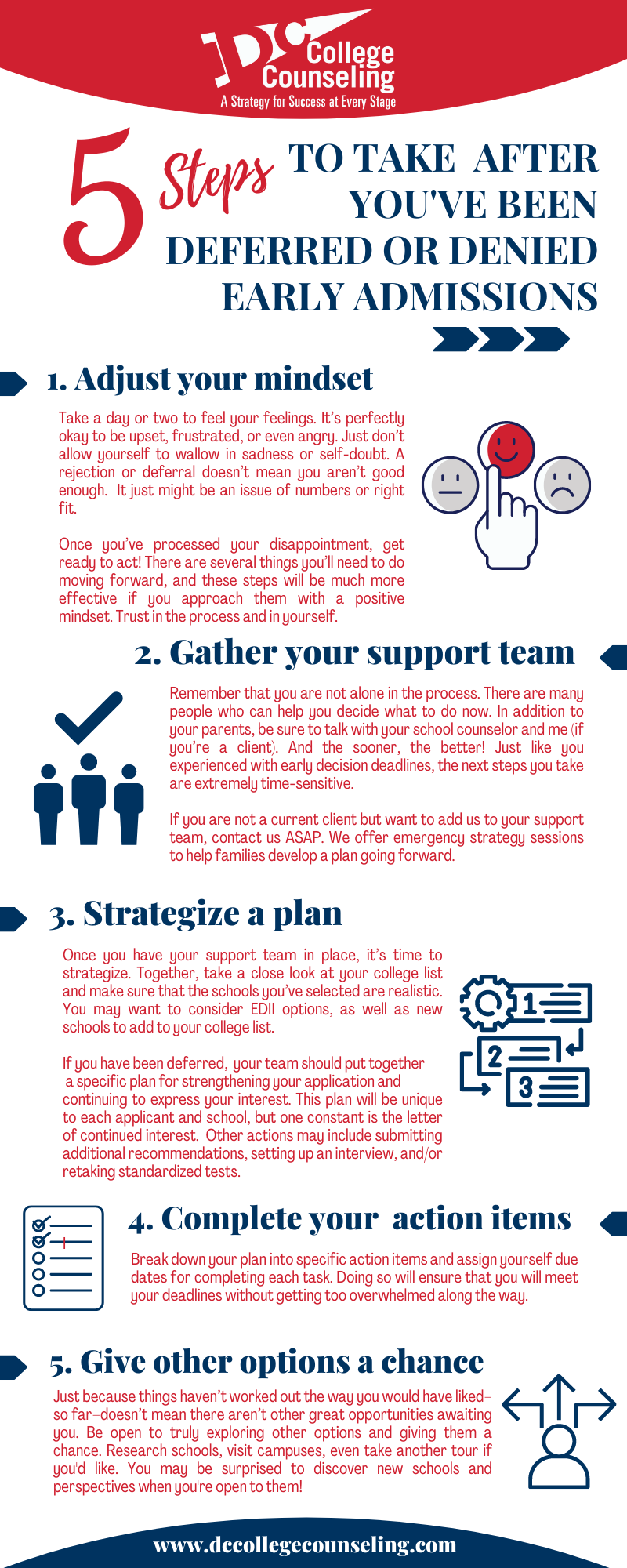
5 Steps to Take After Being Deferred or Denied Early Admission

Last week was the one that so many high school seniors were waiting for–early decision releases! The news came flooding in, and we were anxious all week long! If you’re still waiting, remember that you can check this website to see the official list of release dates and times. It’s updated almost daily!). 

We are absolutely thrilled to see that so many students have been accepted into their first choice schools. Thanks to all of our families who emailed us to share the news! If you were admitted early decision, make sure you carefully read our recent blog post for ED admits. We outlined 5 crucial steps you need to take now that you’ve been accepted

But what happens if you didn’t receive the decision you were hoping for? Well, first of all, don’t get down on yourself. There's been a HUGE increase in applications over the past two years, and it looks like that trend will continue. As of November 1, college applications for Fall 2023 were up 41% from the 2019-2020 cycle. All of these numbers add up to inevitable disappointment for some students. 

If you didn’t get the news you wanted or were expecting, don’t panic! This is NOT the end of your college admissions journey. Take a look at these 5 steps for managing deferrals and denials.

Do you need help navigating a deferral or denial?

Book a session with us by clicking here. We offer strategy sessions and writing support.

For More Information:

If you are looking for more information on details we mentioned above, we encourage you to read some of our blog posts from past cycles:

How to Turn a Deferral into an Acceptance

Writing an Effective Letter of Continued Interest: Instructions and Samples

Trend Watch: The Rise of Metaversities

This week Morehouse College made headlines when it announced its new Black History course, set to launch in Spring 2023. Why all of the hype, you might ask? Well, this isn’t a case of a controversial curriculum. It’s an innovative leap into the future of higher education. 

Students who enroll in “History of the African Diaspora Since 1800” will have the opportunity to attend the March on Washington with Martin Luther King, Jr. and visit soldiers on the civil war battlefields. That’s because the course takes place in the metaverse–an immersive online environment that defies all limits of time and space. With the aid of virtual reality headsets and avatars, students will transport themselves into key historical events, gaining a perspective like never before. 

This is just one of the courses Morehouse offers in the metaverse. There are currently nine others, spanning across several academic departments. And Morehouse isn’t the only college where undergraduates can strap on a headset and experience an entirely new kind of learning. Currently ten schools across the country are experimenting with metaverse courses, and many are predicting that such classes- and even “metaversitites”- will be the future of higher education.

Understanding the metaverse

Last year when Facebook rebranded itself as Meta, the term “metaverse” began popping up all over the internet. If you conduct a quick Google search, you’ll find that there is no standard definition of the term. In fact, most admit that we don’t know exactly what the metaverse entails just yet; there are still many unknown possibilities. But in simple terms, the metaverse is a network of 3D interactive environments where users can work, socialize, and yes, even go to school. 

The metaverse is still in early stages of experimentation, and colleges like Morehouse are acting as case studies for how the metaverse can enhance students’ educational experiences.

The birth of metaversities 

This past April, virtual reality specialists VictoryXR and EngageXR teamed up to create a virtual university pilot program for ten participating schools, including West Virginia University and University of Maryland Global Campus. These “metaversities” are digital campuses that replicate the exact look and feel of the physical school setting. With the aid of a headset, undergrads can do just about everything they’d do if they were right on campus: walk through the quad; engage in class discussions; work on group projects. But the technology also allows students to experience a type of learning that just wouldn’t be feasible IRL (in real life). For example, students dissecting a heart in a biology lab can shrink their avatars and walk through the ventricles. And those studying astronomy can get up close and personal with the stars. 

potential advantages and drawbacks of metaversities

Not only do metaverse courses eliminate the barriers of time and space; they can also address other educational challenges. The metaverse does away with the traditional classroom structure, creating a more exciting and personalized learning experience for students. Proponents of metaversities believe that such courses will increase student retention, especially for those who struggle in a typical classroom environment.  And for students with learning differences, the metaverse could be a real game-changer. 

Additionally, several have commented on the potential for metaverse classes to improve student engagement. Forget boring lectures! Classes in the metaverse rely on student-centered learning experiences where participants are constantly exploring, creating, and building. And because the metaverse takes students outside the constraints of geography and time, there are endless possibilities for constructing and connecting.

Of course, no new technology is without its critics. Logistical concerns are at the forefront of the metaversity debate. After all, the metaverse can get expensive! Schools not only have to purchase virtual reality headsets for all students, which can cost anywhere from $400-1,500 per pair, but they spend thousands in metaverse platform subscriptions each year. Plus, universities will have to expand their IT departments to maintain the technology and invest in extensive professor training.  Students themselves can accrue unexpected costs as well. Metaverse courses put a big strain on internet services, requiring some to ‘up’ their internet packages. And what about those who don’t have access to high-speed connections? Who knows? 

Furthermore, many are concerned about the psychological and social ramifications of virtual education. This is our biggest concern, too. Will students have difficulty distinguishing reality from fantasy? How will they develop healthy relationship-building habits and socialization skills? How will they .. have fun? And how will the metaverse prepare them to succeed in real life? What impact could this shift have upon future generations and the world as we know it? Only time will tell. 

Looking into the future

Given that metaversities are in their infancy, it is difficult to predict where these worlds will ultimately steer higher education. For now colleges experimenting with metaversities can continue collecting and assessing data. The numbers on course enrollments, student attendance, and assessments will hopefully start to tell us more about the risks and rewards and the world of possibilities for the future. 

Thanksgiving Traditions: College Campus Style

This week, college students headed home for Thanksgiving. While many families have their own holiday traditions- from grandma’s homemade apple pie to post-dinner naps with dad- we can’t forget that colleges and universities have some important Thanksgiving traditions of their own.

Here are some of our favorite ways colleges across the country are giving thanks and celebrating the spirit of the holiday. 

Host a family gathering

We often think of Thanksgiving as the ultimate family gathering, but there are plenty of college students and faculty who can’t make it home for the holidays. But who wants to spend Thanksgiving on an empty campus? That’s why many colleges and universities provide a “family” style gathering for members of their school community. 

At Eckerd College, for example, the Dean of Students hosts a formal meal for students and staff who remain on campus. After dinner, there are games, crafts, and of course football. As for the 1600 Buckeyes remaining at Ohio State, they’re all at the university’s annual Thanksgiving dinner. This free event is put on by several campus offices and has become a favorite tradition. Things look a bit different at Yale, though. Students, faculty, and staff can be found at the Omni Hotel feasting on an elaborate lunch buffet. This is the second year the event is being held, and by all accounts, the spread of traditional fixings is delicious!

Finally, several schools have created unique programs to support their international students during this quintessential American holiday. Prior to the pandemic, schools such as Smith, Temple, and Northwestern called upon the campus and local communities to host international students over the break. Unfortunately, the majority of these programs were suspended in 2020 and 2021, but we’re hoping families can begin to open their doors once again.

Give back to the community in creative ways

During the holiday season, there’s a bigger demand than ever for volunteers and donations at nonprofit organizations across the country. Colleges and universities offer a lot of community support thanks to creative charity events. 

The Campus Kitchen at Washington and Lee hosts Turkeypalooza every year- a series of events to help fight against food insecurity. Our favorites include the quirky “Bring Your Turkey to Work Day” for staff and faculty, as well as the punny Pumpkin Pieve 5k fundraiser. 

Students at University of Maryland School of Medicine have been supporting the community of West Baltimore for 33 years! Project Feast- a student run organization- organizes an annual meal to feed those in need. In addition to food, the organization also connects people to community resources and distributes clothing and toiletries when available. 

But Project Feast isn’t the only group giving back at the University of Maryland. Each year student-athletes take part in Terpsgiving, a month-long donation drive. Sports teams compete to see who can collect the most donations to support a particular cause. This year, the teams were in a race to decrease food insecurity on campus and in the local area. 

Sullivan University put a creative spin on traditional food donations and serving. Their Culinary Arts Program has partnered with the Salvation Army to prepare and distribute holiday meals. Throughout the semester, students learn the essential skills to cook a Thanksgiving feast. We’re sure recipients appreciate their curriculum!

Play Some Football!

College football became synonymous with Thanksgiving in 1876 when Yale and Princeton played in the first major Thanksgiving football game. It was one of the few days of the year when most people were off from work and could actually watch the game! Since then, Thanksgiving bowls and classic rivalries have become an essential part of the holiday weekend. 

If you’re looking to watch a game this weekend, tune into the Iron Bowl and witness the classic rivalry between Auburn and Alabama. This rivalry actually dates back to the late 1800s when the schools first played one another. But as with many intense rivalries, things got a little too heated. Rumors swirled about strategy debates and game violence after the 1907 game. Unbelievably, the two teams didn’t meet again until forty-some years later. However, since then the game has been an annual tradition (even during the pandemic). Last year’s meeting was a real nailbiter, with Alabama claiming their win in overtime. Let’s see what excitement this year’s game brings! 

However, we can’t forget that there’s another major November rivalry, a rivalry so infamous it’s referred to simply as “the game.” For 118 years, the Michigan-Ohio State game has garnered attention for its intensity of competition, passionate fans, and high-stakes results. Interestingly, the teams are close in terms of overall wins over the past century, but Ohio has beat out Michigan in 17 of the past 20 games. Michigan picked up momentum once again in 2021, and we can’t wait to see what happens this year!

Responding to Campus Emergencies: How to Prepare and Empower Yourself

This week we were devastated to learn of a campus shooting at UVA. We have worked with so many students who attend UVA, and this incident just hits way too close to home. Although we absolutely hate thinking about this topic, we feel it’s important to share active shooter tips this week.

Knowledge is power, and it is better to know what to do if you find yourself in a situation like this someday.

Familiarize yourself with the Run Hide Fight model

The majority of colleges (and many high schools) across the country employ the Run Hide Fight model as part of their emergency protocols. Learning these steps can help you better assess an active shooter situation and make potentially life-saving decisions.

RUN:

  • Assess the scene and determine possible escape routes

  • If there is a safe path, run

  • Leave belongings behind and do not attempt to move those who are seriously injured

HIDE:

  • If escape is not possible, hide out of sight

  • Lock doors, block entryways, and turn off lights

  • Silence your phone and stay in place

FIGHT:

  • As a last resort, fight against the threat 

  • Mobilize the people around you

  • Use surrounding objects for attack and self-defense

Not sure you’ll remember these steps during an emergency? That’s okay! You can print or download a pocket card from the US Department of Homeland Security to keep with you. 

Learn about your school’s emergency protocols

Although the Run, Hide, Fight model is widely used, there may be additional procedures that your school employs in emergency situations. That’s why it’s important to visit your school’s campus safety website. Look for information on these topics:

  • How to report suspicious activities and emergency situations

  • Emergency communication channels and phone numbers

  • Evacuation plans

  • Emergency preparedness training courses and workshops offered on campus

Get connected

While looking at your school’s campus safety website, take a few minutes to program important numbers in your phone. Typically colleges have a campus safety office number, as well as an emergency line. Add both to your contacts! It’s also good practice to create one other new contact in your phone: ICE (in case of emergency). This may just be a copy of a family member’s number, but it will signal to officials who they should call if you’re not able to communicate. 

And don’t put your phone away just yet! Check to see if your school has a mobile safety app or texting system for campus alerts. If they do, get connected. That way you’ll be notified of emergency situations right away.

Take a preparation class

Your school’s campus safety office may provide valuable training courses in first aid and emergency preparedness. Take a look at their offerings and sign up for a class. 

Students can also earn their CPR/AED and First Aid certifications through the Red Cross. Visit their website to see a comprehensive list of courses and training dates. 

For those who reside in northern Virginia, Fairfax County CERT offers emergency preparedness training throughout the year. Their Stop the Bleed and Basic Training classes are open to students ages 13 and up. 

Finally, The Virginia Department of Criminal Justice Services offers a free Zoom course on Civilian Response and Casualty Care. The next class is on November 29. You can register here.

Share a tip

If you would like to share an active shooter tip or resource for students, please comment below.

5 Questions to Ask Your Ninth Grader Right Now

Do you know what you’ll be doing 1200 days from now? Well, if you’re the parent of a current ninth grader, you’ll probably be sitting at your child’s high school graduation. Although thoughts of caps and gowns and college may seem light years away, it’s never too early to start planning for the future. In fact, ninth grade is a critical time to set your student up for college success. 

But how do you know if your ninth grader is on the path to success? Ask! Today we’re sharing 5 questions that will help you ‘check in’ with your freshman and create important college-building conversations. 

1. How are you feeling about your classes?

What did you get on that test? Did you do your homework? Well, have you asked your teacher for help? Let’s face it, sometimes parenting can feel more like project management. You may find yourself inquiring into due dates and scores just to stay ‘in the know.’ While this information is certainly handy, it might not tell you the whole academic story about your ninth grader.

Rather than framing questions that only result in a yes, no or eye roll, try a more open-ended framework. “How are you feeling about x…” is a great way to create a conversation and help your child reflect on the academic transition to high school. For example, a simple “how are you feeling about your homework load” could lead to productive discussions about time management, the need for a math tutor, or changes to after-school commitments.

2. What’s sparking your interest?

Ninth grade is a discovery year, as students begin to take new electives and get involved with activities that may not have been available to them in middle school. Check in with your child to see which subjects, clubs, and causes are engaging them. And then encourage them to explore these areas even more! For example, if your child enjoys talking about politics in their government class, suggest that they try out the debate team or attend a Model U.N. meeting.

3. How are you getting to know your teachers?

We know, we know. Some teenagers don’t even like having conversations with their parents, let alone with adults at school. However, establishing strong relationships with teachers is extremely important. Not only are these relationships proven to increase a student’s academic performance, they can be downright inspirational. We hear stories all the time from students who credit particular high school teachers for their career paths and leadership skills. 

Building connections is a great skill for students to develop early on in high school. Talk to your ninth grader about habits that can make for strong teacher relationships: participating in class, asking questions, reaching out for help, visiting teachers during study halls and free periods. These small efforts to engage go a long way!

4. What’s on your high school bucket list?

Ask a ninth grader about their goals for the next three and half years, and you’ll probably get a bewildered look in return--or an abrupt reply concerning grades. But there’s much more to the high school experience than just GPAs. Help your child start to think about the ways in which they want to get involved in the community. Have they always wanted to take center stage in a school play or learn how to play lacrosse? Can they see themselves running for student council or maybe creating a fundraiser to help their favorite cause? We love the bucket list question because it can help students get out of their comfort zones and picture the many possibilities for their high school experience.

5. What would you like to do this summer?

This may seem like a strange question to ask when we are just coming up on Thanksgiving, but hear us out. Summer is an ideal time for rising sophomores to explore their interests and begin developing the skills they’ll need for college. Luckily, there are hundreds of opportunities for 15 year olds to choose from: international excursions, enrichment courses, volunteer projects, and yes, even some internships. 

Start exploring options with your child now. Many summer programs will begin accepting applications as early as December. If you’re not sure where to look, check out the DC College Counseling Database. We regularly update our site with exciting summer experience opportunities. 

How to Minimize Supplemental Essay Stress

With early decision college application deadlines looming, high school seniors may find themselves knee-deep in supplemental essays right now. In addition to the 650-word Common Application essay (or comparable personal statement), many universities ask applicants to write supplemental essays. These responses vary greatly in number and complexity. Some schools may only require one additional short answer while others have upwards of ten supplemental essays. And the responses range from quick 50-word creative questions to elaborate 750-word ‘why this school’ essays. What do all of these factors add up to? A lot of stress! 

While some lucky applicants are tasked with writing 5-10 supplemental essays, most of the students with whom we work ultimately write 20+ (and often closer to 40), depending on the number of schools to which they apply and how many essays each school has. Although these numbers may seem staggering, they don’t have to overwhelm you. There are strategic ways to manage the process and avoid essay overload. 

Read on to learn more about our expert tips to minimize supplemental essay stress.

Get organized

We know, we know. “Get organized” might seem like the most basic piece of advice we could offer. But truly, there’s nothing more important than sorting through your list of schools and essays so you can get a sense of the bigger picture. How many essays will you be writing? Which topics will you have to cover? And what are your deadlines? 

We strongly encourage students to make a list, or even better yet, a spreadsheet to manage supplemental essays. Doing so will help applicants begin to strategize the essay writing process and execute a plan efficiently. Just be sure to prioritize schools with earlier deadlines!

Pro tip: Confirm the number and nature of supplemental essays for each school. Refer to your application portal for this information, NOT third-party websites. There are a lot of personal blogs that track supplemental essay topics, but they may not include the most up-to-date or accurate details. And some schools are known for tweaking word counts limits or adding additional prompts mid-cycle. Always check your application, and if you have any questions, contact the admissions office directly.

Break down the prompt

Sometimes the biggest source of stress stems from the prompt itself. A simple question could be presented in overly complex way, leaving you wondering: what are they actually asking? Other universities (we’re looking at you, Virginia Tech!), want you to answer multiple questions within one essay response, making it easy for applicants to overlook essential components. 

To avoid feeling overwhelmed by a supplemental essay prompt, break it down. Rewrite the question as a statement, simplifying any complex language. If there are multiple questions within the prompt, create separate bullet points to ensure you address each component.

Here’s an example:

Why are you interested in Syracuse University and how do you see yourself contributing to a diverse, inclusive, accessible and respectful campus? (250 words) 

Let’s break down the prompt:

  • I am interested in Syracuse because….

  • I would contribute to a respectful, diverse campus by….

Many applicants write thoughtful responses about their reasons for wanting to attend Syracuse, BUT they forget to state how they would contribute to the campus. Breaking down the prompt in your notes will make the question(s) clearer and more manageable. Additionally this approach can help you manage content if you’re faced with a tight word count limit.

Reduce, reuse, recycle

While some schools are notorious for unique (and downright odd) supplemental essay topics, many universities ask applicants to write about these common themes: academic interests, extracurricular activities, and community involvement. 

Applicants can reduce their writing load by recycling their supplemental essays. You may find that the 250 word response you wrote last week for Loyola Maryland about a meaningful extracurricular activity could also easily answer University of Florida’s prompt: Please provide more details on your most meaningful commitment outside of the classroom while in high school and explain why it was meaningful (250 words). 

Of course, not every supplemental essay response is going to be a perfect fit for another school’s prompt. That’s okay. You can still recycle! Search for overlapping themes and then think about how you might be able to adapt a particular story or response to fit the question. In most cases, you probably won’t have to start from scratch.

PS: If you organize yourself with a list or spreadsheet, like we recommended above, you’ll find that it’s much easier to identify similar supplemental essay topics. And you just might discover that the five supplemental essays you thought you had to write actually might only be two! 

Pro tip: ‘Why this school’ type- essays, which require applicants to explain specific reasons why they’re interested in the college or university, should not be recycled. In fact, if these types of supplemental essays are written well, they CANNOT be reused. That’s because they focus on details of a particular institution, capturing the uniqueness of that school.

Final Thoughts

Essay writing is a PROCESS that requires time and organization. That’s why we encourage students to start writing their college application essays as early as possible. However, if you find yourself getting a late start or adding several schools to your list, hopefully these tips can help! 

For families in need of last minute essay support or who want to plan ahead for senior year,  book an appointment with our DC College Counseling team here

5 Reasons to Consider Academic Coaching

You’ve probably seen coaches on the football field and in the gym. They help people reach their peak physical condition and create strategies for victory. But did you know there’s another type of coach, the kind that doesn’t focus on footwork or cardio? 

Academic coaches train high school, college and graduate students for academic success. Whether a student is suffering from executive functioning difficulties, test anxiety, or project management challenges, academic coaching can empower students with the tools, techniques, and habits necessary for growth. 

There are numerous benefits to academic coaching, and today we’re sharing the top 5 reasons to consider an academic coach for your child.

1. Learn HOW to succeed, step-by-step

One of the biggest benefits of academic coaching is learning HOW to do the organizational work that is the foundation for success in high school and college. Most students know they are supposed to study, or supposed to work on essays in advance, or supposed to keep their homework organized, but they've never been taught HOW to do these things. Instead, they’ve simply been told: “do your homework” or “turn in that assignment by Friday.” 

Academic coaches help students develop systems to organize their schedules, manage specific projects, and develop essential study skills. By breaking down big concepts like organization and time management into actionable, step-by-step processes, students can feel more empowered and know exactly HOW to achieve success. Bonus: the habits and systems students create now will continue to benefit them in college and in their careers!

2. Stop a crisis before it starts

Are your child’s grades starting to fall? Are they having difficulty managing their schedule or completing their work? Do they seem overwhelmed? If so, an academic coach might be just what your student needs. After all, timing is everything. Academic coaching can prevent a bad quarter from turning into a bad year AND stop self-defeat in its tracks. If a student begins working with an academic coach early, they’ll have the time and space to try different techniques. Instead of desperately trying to get their ‘head above water,’ they’ll be focused on discovering what works for them–and stopping the crisis before it starts.

3. Uncover the real roadblock

I procrastinate too much. I just can’t get started on.... These are common challenges we hear students express when they first seek out academic coaching. Many believe they struggle with time management or motivation, and while these factors may play a part in a student’s challenges, they aren’t always the real roadblocks. An academic coach supports students in identifying underlying behaviors and thought-processes that are leading to academic challenges. Once students understand that their procrastination is actually anxiety or their time management challenge is really just an overloaded schedule, they can begin taking the steps to address the root of the problem.

4. Get the personalization you need

Academic coaching is NOT a one-size-fits-all approach. It’s a personalized experience that allows coaches to get to know the student and their particular needs. Coaches work closely with families (and sometimes even a student’s subject tutor or academic support professional) to determine the strategies that will work best for a student. And if something isn’t working, the coach will make adjustments!

Even more importantly, academic coaching sessions are tailored to each student, whether they are learning a new way to take notes or planning their finals schedule. Here at DC College Counseling, we offer periodic meetings or consistent, monthly coaching sessions to fit exactly what students need.

5. Eliminate stress at home

Did you do your homework? Go study! I told you to finish that last night. 

Let’s face it, academic struggles are stressful, not just for students but for parents too.

Many parents aren’t quite sure HOW to ‘get through’ to their child, and we know that the constant reminders (and nagging!) can be frustrating for everyone.

That’s where an academic coach comes in. They encourage students to take ownership of their schedules and provide the tools and reminders to support them along the way. Many families have found that academic coaching eases tensions at home and creates a more positive, unified approach to overcoming challenges.

Interested in learning more about academic coaching?

Shannon has extensive academic coaching experience with high school, college, and graduate students. She loves helping students find the right combination of tools and techniques to gain confidence and reach their potential.

DC College Counseling offers academic coaching with flexible options for as- needed sessions or monthly packages. If you would like to book a meet-and-greet with Shannon to explore options, please click here. 

To see what an academic coaching sessions with Shannon entail, as well as specifics about or package options, you can read more here.

We've Got the Spirit! Homecoming Histories and Traditions

Fall is officially in the air, and we’re enjoying pumpkin carves, apple picking, and football games. But there’s one fall tradition that stands out among the rest: homecoming! Over the next month, many high schools and universities across the country will be celebrating with pep rallies, spirit days, and most importantly, sports games. Students will dress up in silly costumes, participate in crazy relays, and maybe even get crowned as head of homecoming. It makes you wonder: who exactly started this tradition and why? 

Well, historians don’t know exactly who started homecoming, but they have traced the earliest celebrations back to the 1910s. Schools such as Baylor and Missouri invited alumni to “come home” during a fall weekend. Activities included a big football game, a pep rally, and speeches. The goal was to connect alumni with current students and encourage more school pride.

These early homecoming festivities were so much fun they became a staple on college campuses…and even spread to high school campuses as well. Many schools have created signature events as part of their homecoming festivities that act as a rite-of-passage for students and a moment of nostalgia for alumni. There are bonfires and parades, as well as creative twists on classic activities. For example, students at Texas State University compete every year in the homecoming soap box derby, proudly representing their residence halls or Greek organizations. And the entire community at ASU hikes the “A” mountain in the dark, using their lanterns to light the pathways. 

Yet some colleges and universities don’t stop at midnight hikes and car races. They “up the ante” on homecoming shenanigans. At Ball State University, you can find undergrads racing down the pathways on mattresses as part of their annual bed race. And at Howard University, alumni aren’t the only invited guests. In the past, headliners like Drake and Kanye West have appeared on campus to perform in Howard’s very own music festival, Yard Fest. 

To honor the spirit of homecoming, we’ve curated a collection of ‘stand out’ college homecoming traditions across America.

Getting Wet and Wild

Students at University of Central Florida gear up every year for what has been recognized as one of the best college campus traditions in the nation: Spirit Splash. The concept is seemingly simple. Rush the reflecting pond and try to catch a rubber duck. But the crowds, the sun and the splash can make it a tough task. That’s why undergrads are encouraged to ‘pay it forward’ if they catch an extra duck. In past years, the event has been streamed live on Youtube. So if you’re interested in seeing this tradition for yourself, tune in on October 28.

White Out

“We are…!” Penn State is well known for its popular ‘we are’ chant and school spirit. And during homecoming week, this enthusiasm is even more apparent thanks to a game day white out. Penn State fans are instructed to wear only white to Beaver Stadium as the ultimate act of school pride. Why white? Well, this tradition started in the early 2000s when fans were trying to increase support for the football team. At first, it was just a small student section of white t-shirts but has grown into a stunning display that fills the stadium. You can see this year’s White Out on October 22 when Penn State plays Minnesota.

THE Rivalry

For over 150 years, the Lehigh and Lafayette football teams have battled it out on the football field. The rivalry has become so infamous that it gets its very own week at Lehigh University. Students decorate their residences with ‘bedsheet’ banners and take part in bed races, runs, and luncheons throughout the week. Alumni across the country are also encouraged to get involved from afar by hosting alumni telecasts on game day.

A Charitable Take on Homecoming

It’s not just fun and games at University of Missouri’s homecoming weekend. With so many people descending on campus, the Alumni Association has leveraged the community to support a blood drive. It’s become the largest student-run blood drive in the country, and each year the university donates thousands of units to the Red Cross.

The Biggest Party Around

The University of Florida is known for hosting the largest pep rally in the US: Gator Growl. For almost 100 years, students and alumni have come together to show off their blue and orange pride. In the early days, the event was a classic pep rally leading up to the homecoming football game. But now Gator Growl is quite the spectacle. It takes hundreds of employees, volunteers, and student coordinators to pull off the complex showcase of fireworks and musical performances. It’s all worth it, though. The big event also helps fundraise for important charities.

Fall Into Volunteerism: Current Community Service Opportunities for Teens

SAT tests, AP course homework, sports games, club meetings- yes, we know how busy students are at this time of the year. However, there’s still time for community service! Whether you need to fulfill required service hours or simply want to pitch in around town, there are plenty of opportunities. And we promise that they won’t take away from your study time or game schedule!

We’ve collected some of Northern Virginia’s most fun and interesting volunteer opportunities for teens this fall.

Join the Teen Advisory Board

Flex your leadership skills at the Great Falls Library. Applications are now open for the Teen Advisory Board: a group of high school students who help to improve library services in the local community. 

Location: Great Falls Library. Great Falls, VA

Dates: Meetings are held the first Monday of each month at 7pm

Notes: Open to students ages 13-18. Must apply by October 8. 

To apply, email shelley.levinson@fairfaxcounty.gov

Play all day

Do you want to spend a gorgeous fall day playing games? If so, check out McLean Harvest Happening. They are looking for volunteers to run games and craft stations for children ages 2-5. High energy and creativity are a must!

Location: McLean, VA

Date: September 24, 11am-2pm

Notes: Must be 16 years or older

Sign up here

Design a Halloween town

This the perfect opportunity for Halloween lovers. Help Burke Lake Park with their newest event: Ghost Town. Multiple volunteer shifts are available for those who want to help transform the park into a ghoulish sight.  

Location: Burke Lake Park. Fairfax Station, VA

Dates: Multiple days throughout the month of October

Notes: Must be 16 years or older

Sign up here

Clean up the community

Join the Oakton Park Authority’s watershed clean-up this fall. Volunteers will have the chance to spend the day outside beautifying the area. We can’t think of a better way to take advantage of the fall weather! 

Location: Oakton, VA

Date: October 1

Notes: Bring your own work gloves!

Sign up here

Work at the library

Dolley Madison Library has openings for teen volunteers this fall. This is a great role for anyone who enjoys organizing and helping people find information. You must be able to attend the library orientation session on October 11, 5-6pm, and commit to a two-hour shift each week.

Location: Dolley Madison library. McLean, VA

Dates: Orientation: October 11, 5-6pm. Various shifts are available throughout the fall.

Notes: Must be 14 or older

Sign up here

Welcome a new community center

There’s a new community center in Lorton, VA, and you’re invited to celebrate the opening! Volunteers are needed to help set up and break down the event, as well as direct traffic and guests.

Location: Lorton Community Center. Lorton, VA

Date: October 15

Notes: Must be 13 or older

Sign up here

Run a game booth

Calling all camp counselors, babysitters, and coaches! Share your talents with the Reston community by volunteering to run games and activities at this event. 

Location: Reston, VA

Date: October 15

Notes: Must be 16 or older

Sign up here

Celebrate northern Virginia’s cutest pets

Attention all pet lovers! Why not spend the day working with northern Virginia’s most adorable pets? Sign up to volunteer at McLean’s Pet Fest. The event promises to include an array of animals! 

Location: McLean Community Center

Date: October 16, 11am-4pm

Notes: Must be 16 or older

Sign up here

Cheer on Tour De Mt. Vernon

Even if you’re not interested in biking 20 miles, you can still support the Tour De Mt. Vernon. Volunteers are needed to assemble packets, mark the course, and act as ambassadors and ride marshalls during the race. Lance Armstrong isn’t attending, but hundreds of cycling enthusiasts will be there. 

Location: Workhouse Arts Center. Lorton, VA

Dates: October 21 and 22

Notes: Must be 16 or older

Register for a shift here

coach swimming

Put your swimming skills to good use by becoming a coach this fall. Reston Community Center is looking for swim instructors to give lessons to children and adults with disabilities. Volunteers must be available on Saturday mornings and commit to at least one 6-week session.

Location: Reston Community Center. Reston, VA

Dates: October 29-December 10

Notes: Must be 13 or older

Sign up here

Show your thanks on Thanksgiving

If your family will be in town for Thanksgiving, consider gathering everyone for this volunteer opportunity. Reston Community Center is looking for people to sort and pack food donations Thanksgiving morning. Children and adults are welcome, as well as some teenage muscle! 

Location: Reston, VA

Date: November 24, 10am-1pm

Notes: Children ages 5 and up are welcome. Children under 14 must be accompanied by parents

For more information, click here

Virtual Opportunities

For those who don’t live in northern Virginia or may have a tight schedule, don’t worry! There are several virtual, flexible opportunities available. Here are some of our favorites.

Conduct research for the Smithsonian Institution

The Smithsonian Institution has a variety of projects in progress, and they need your support! Visit their website to learn more about how you can help solve garden mysteries, contribute to the Encyclopedia of Life, or transcribe historical documents-all from the comfort of your own living room.

Make new friends from home

Best Buddies is an organization dedicated to creating social inclusion for students with disabilities. Many high schools and universities have local chapters, and now there’s a virtual chapter as well. If you are interested in mentoring other students and making connections remotely, join now.

Adopt a grandparent

The past few years have been especially isolating for senior citizens. To combat loneliness, Bright Horizons has created a platform of virtual friendships and events. Volunteers can sign up to perform in online music shows, participate in a senior citizen book club, play games, or chat one-on-one with an elderly member in need of a friend. Click here to learn more and register for volunteer training.


If you know of a volunteer opportunity for teens, please share in the comment section below.


A Trip Down Back-to School Memory Lane

It’s official. Labor Day weekend is over, and students across the US are back to school. As you might have seen in our ‘office happening news’ last week, I am back in school as well. After a lengthy process, I was selected for the fully-funded Goldman Sachs 10,000 Small Businesses Entrepreneurship Program through Babson College. I’m thrilled to be back in the classroom working alongside a fantastic cohort and continuing to grow DC College Counseling, although boy is there a lot of work!

To celebrate the start of a new school year and my own return to the classroom, we decided to take a trip to ‘back- to -school’ memory lane. Today we’re sharing some of our favorite school memories, as well as some embarrassing old pictures. Enjoy! 

COLLEEN

My favorite subject: History

The weirdest thing in my backpack: My radio discman, which was not at all weird at the time!  

At recess you’d probably find me: Organizing weekend plans with my friend group. I will never forget when my parents instituted a “one sleepover per weekend” rule - I thought it was so unfair!

What I liked about back-to-school shopping: Picking out clothes from the Delia’s catalog and ordering them over the phone.

After school I liked to: Play tennis or piano, talk to my friends on AOL and watch Total Request Live :) 

My go-to-after school snack: Cinnamon toast 

In elementary school I was obsessed with: American Girl Dolls (Felicity was my favorite because she was a redhead like me, but I was all about Samantha’s clothes and furniture).

I remember feeling embarrassed when: My mom and I would go to the movies together in middle school, but it was NOT cool to go to a movie with your mom. So I tried to selectively choose theaters where I wouldn’t run into anyone. This may or may not have included crossing state lines! 

To my teachers I was known as: The leader

I thought I was the coolest kid when: My seventh grade French class went to Montreal and my friends and I orchestrated a party for our classmates in our hotel room (after curfew!)

My favorite school memory: I went through a spelling bee phase- you know those kids in the Scripps spelling bee on ESPN? I didn’t get quite that far but I was the #3 speller in the state of New Jersey in fifth grade. I lost on “metallurgic” which I have never misspelled again! I will never forget the hundreds of photocopied pages of words upon words upon words - each page had three or four columns of words in tiny print and I spent so many hours memorizing them, which I realize does not sound like fun, but I was competitive and really enjoyed it.


SHANNON

My favorite subject: English!

The weirdest thing in my backpack: Oh my gosh, everything leopard printed - binder, lunchbox, folders, even my glasses!

At recess you’d probably find me: Reading Harry Potter on the swing set

What I liked best about back-to-school shopping: Stationary! I still love buying new stationary :) 

After school: You'd find me at dance class, most likely - or sitting in the library with my friends. 

My go-to-after school snack: Little Bites chocolate chip muffins

In elementary school I was obsessed with: Books! Not much has changed :) 

I remember feeling embarrassed when: My mom came to pick me up wearing her army-print cargo pants. 

To my teachers I was known as: The talker 

I thought I was the coolest kid when: I bought a faux fur vest at Limited Too with my own money - it was leopard print, of course!

My favorite school memory: My favorite elementary school tradition was the Harvest Festival, when each grade brought something to school to make gift baskets for senior citizens in the community. During fifth grade, we actually got to go around and deliver the baskets! Then we held a school assembly that the seniors could attend, and each grade sang a song. When I was in high school, I was actually invited back to the Harvest Festival to be a featured speaker and talk with the elementary students, which was definitely my proudest moment!


STACI

My favorite subject: English and Latin

The weirdest thing in my backpack: I carried around a collection of over 100 erasers that I would never actually use. 

At recess you’d probably find me: Climbing the old tires in the field behind school

What I disliked about back-to-school shopping: Going to the shoe store and trying on the required ugly, brown loafers for my school uniform. I was so jealous watching other kids buy cool sneakers.

After school I liked to: Go to dance class, dial up the internet before my parents got home from work, and make mix CDs. 

My go-to-after school snack: Carrots and Swedish Fish

In elementary school I was obsessed with: Designing jewelry. I would rip beads off my grandmother’s sweaters to make earrings and necklaces. 

I remember feeling embarrassed when: My dad told the bus driver I was late one morning because I was in the “potty.” The entire bus of kids heard! 

To my teachers I was known as: The goodie goodie

I thought I was the coolest kid when: I was selected for the lead role in the school production of “The Three Little Pigs.” 

My favorite school memory: There was nothing funnier than the infamous lunch period in first grade. We used to get milk delivered in bags (think Capri Sun-like pouches), and we had to jab the plastic straw carefully through the plastic to get to the milk. Our teacher, an 80 year old nun, had very precise rules for when and how we could open the bags. Sister H wasn’t about to have a mess in her classroom! Tommy B was a real trouble maker, and one day he decided to open his milk by placing the bag on the floor and jumping on it. The milk exploded everywhere, and I thought Sister H was going to pop a vein. She started chasing Tommy around the room and eventually slipped in the milk. Looking back, I feel bad for my teacher, but at the time it was funny to watch an old nun run around.


STEPHANIE

My favorite subject: English 

The weirdest thing in my backpack: An eraser in the shape of a baby's head

At recess you’d probably find me: Playing knockout (and promptly losing)

What I liked about back-to-school shopping: Convincing my parents that I *needed* the same pen in eight colors

After school I liked to: Take a nap 

My go-to-after school snack: Ramen with extra soy sauce

In elementary school I was obsessed with: Pandas

I remember feeling embarrassed when: I got in trouble for writing mean notes to a boy in my second grade class (but he started it).

To my teachers I was known as: The quiet one

I thought I was the coolest kid when: I wore black and white converse to school, which didn't align with the strict uniform.

My favorite school memory:  My friends and I were the creative weirdos in elementary/middle school, so when our teacher assigned our fifth grade class a project on Number the Stars by Lois Lowry, we decided to make a movie trailer for the book. We had a blast filming a four minute video (half of which was bloopers) and acting out scenes. We showed our class the video, complete with iMovie animations, a dramatic voiceover, and an outro of Lady Gaga's LoveGame. If I were to make that video now, I would be cancelled, but it's pretty impressive for a bunch of quirky 10-year-olds.


JESSICA

My favorite subject: English 

The weirdest thing in my backpack: I was very neat as a child, so nothing. 

At recess you’d probably find me: In the library

What I liked about back-to-school shopping: New school supplies! 

After school I liked to: Read books 

My go-to-after school snack: Ants on a log

In elementary school I was obsessed with: Artemis Fowl 

I remember feeling embarrassed when: Literally always- up until high school.

To my teachers I was known as: The talker

I thought I was the coolest kid when: Absolutely never! I was super nerdy.

My favorite school memory: Writing my 5th grade classroom newspaper that made my dad laugh so hard he cried.

Decluttering Your Mind

Thanks to professional organizer Marie Kondo and her hit Netflix series, Tidying Up, decluttering has transformed from a dreaded chore into a joy. After all, there’s no better feeling than a well-ordered closet or Pinterest-inspired desk space. And psychology would agree with me! There are numerous scientific studies that show decluttering can have a powerful effect on our mental health. A little bit of organization and order can reduce stress and anxiety and increase our levels of focus. 

But did you know that closets and garages aren’t the only spaces you can declutter? You can also free up some room in your brain! In a recent Forbes article, Christopher Rim discussed 5 habits of Ivy League college students. One of those habits happens to be decluttering your mind. Because the mind is a lot like your computer, which is running all day to help you process and store information, it needs to work efficiently. That means you need to take the time to organize your folders and trash what you don’t need! Otherwise, all of those unnecessary files and downloads will slow you down.

How to Declutter Your Mind

Organize your calendar:

As Rim points out, “A student’s mind is their biggest asset and best tool. They should not make it work twice as hard as it needs to!” We couldn’t agree more! Don’t waste valuable brain space trying to remember your rotating class schedule or your away games. Write down these events instead. Not only will it make you feel more in control of your daily schedule; a calendar is the best tool for anticipating and managing busy weeks. 

For students who like to use a paper planner, check out Order out of Chaos’ line of academic calendars. There are also plenty of basic planner options available on Amazon. Looking for a bit more personality with your planner? Well, then consider ordering from Papier’s collection of artsy planners. And if you can’t seem to find exactly what you’re looking for, So Typical Me can help you design a custom planner to fit your exact needs.

If you’ve gone paperless, you can download an all-in-one digital planner for the school year or set up My Homework app on your phone. We love the My Homework app because it helps you keep track of your daily schedule and homework assignments AND sends reminders to your phone. To Doist is another great calendar option, especially for students who like the satisfaction of checking off daily to-do lists on their calendars. 

Manage Your Time:

Okay, so you’ve set up your calendar, and you know what tasks you need to accomplish. But now you’re not sure where to start.  Your mind is cluttered by distractions, the anxiety of pre-calc homework problems, and that overwhelming feeling that comes when you have a big test to study for AND a big game. 

To clear some space in your mind, you’ll need to work on managing your time. Now it’s not an exact science, but there are a few strategies to help you prioritize tasks and break down your responsibilities into smaller, more manageable chunks.

  • Pomodoro technique: this time-management tool is perfect for those who get easily distracted. Set a timer for a certain amount of time. 25 minutes is recommended, but adjust to fit your schedule. Then get to work on your task, avoiding distractions. When your timer goes off, take a 5 minute break. Then repeat your pomodoro. The goal here is to keep your mind clear and focused on the task at hand. Use your 5-minute break to address things that might normally distract you, like answering a text or grabbing a snack. If you’re interested in trying the Pomodoro technique, you can add this handy pomodoro app to your phone or use the Pomofocus website.

  • Time blocking method: Have you ever found yourself with a chunk of free time but had no idea what to do? The time blocking method helps you know exactly what you need to do and when. Every Sunday, get in the habit of planning out your calendar for the week ahead. Once you pencil in all of your games and meetings and classes, ‘block off’ your free time. For example, plan out your study halls with specific tasks for that period of time. This method is really helpful for managing bigger assignments, like a project or an essay, and eliminating our urge to multitask (which makes accomplishing a specific task difficult).

  • Ivy League method: For those who can’t seem to get their priorities straight, this is the technique for you! Before you go to bed each night, get in the habit of looking over your calendar. Make a list of tasks that are most important for you to complete the next day (only six!). Then order these tasks in order of priority. It’s a simple method that can have a powerful effect! This strategy will ensure you do what needs to get done- even if it means visiting your teacher for extra help BEFORE you start planning homecoming events with your friends. (PS: You can even buy an Ivy League method notebook to help you prioritize everyday.)  

Do you need an organizer to help you declutter?

Hopefully, we’ve inspired you to start decluttering your mind (and maybe even your bedroom, too). If you’re in need of your own academic organizer, we’re here to help you tidy up! Schedule a meet-and-greet here to learn more about our college counseling AND academic coaching services.

Trend Watch: The Newest Undergrad Programs This Fall

We’re just about to start a new school year, and for many colleges and universities across the US, that means the start of new departments. 

This year there are several exciting majors, programs, and concentrations newly available to undergraduates. Some put a modern twist on a classic major while others reflect a whole new world. Let’s take a look!

Climate Change

Undergraduate programs in Environmental Studies and Sustainability have become increasingly popular over the past decade. But there’s a change coming! Several universities are designing bachelor’s degree programs that will prepare students to specifically address some of the world’s most pressing climate issues, from water shortages to soil depletion to natural disasters. Climate Change departments are so new, though, that many are still in the process of being approved. But from what we can tell already, this new major is taking an interdisciplinary approach, incorporating scientific studies and lab work with social problem solving and advocacy.

If you’re interested in learning more, take a sneak peak at Vanderbilt’s Climate Studies major, Iowa’s developing plans for their Climate Science program, and Northern Vermont University’s unique problem-based approach to the new major. 

Robotics

Once upon a time, robotics was just an extracurricular activity for middle and high school kids who loved tinkering. However, with the rise of technology, especially AI, robotics has shifted from an after-school club to a viable career path. 

Typically, the study of robotics has been integrated into undergraduate mechanical and electrical engineering programs. But not this year! University of Connecticut, University of Michigan, and UC Riverside have all announced new undergraduate programs in the field.

So what exactly can you do with a degree in robotics? Well, just about anything, really, from computing to software development to engineering. And with the increasing demand for technology in all industries, robotics professionals can cross over into a range of fields, such as healthcare, manufacturing, and education.

Data Science

It’s no secret that data science has become one of the trendiest picks for undergraduate study. Last year, UChicago, Boston University, and Pitt added data science to their list of majors, and several other schools are following suit this fall. UC Davis is now accepting students into their inaugural program, and Hamilton College is offering a newly designed interdisciplinary concentration in the subject. 

If you’re a recent college grad who wants in on the data science trend, don’t worry! Master’s degrees in this field are on the rise as well. UConn is just about to welcome its inaugural Master’s cohort this fall. The program promises to be multidisciplinary, with an emphasis on ethics, design, and analysis. And for those looking to complete their studies virtually, there are plenty of options. Johns Hopkins and Northwestern are just two major universities now offering online graduate programs in data science.

Sports Analytics

Who knew that Brad Pitt would incite an entirely new major? After the success of the film Moneyball in 2011, many academic enrichment programs began teaching young students the fundamentals of statistics and analysis through sports. 

Over the past few years, undergrads have been able to take sports analytics electives through data analytics and business programs. And more recently, schools like Roanoke University have added concentrations in sports analytics to round out their computer science and math departments. 

However, only a few schools have created stand-alone majors dedicated to the field, namely Syracuse University and Rice University, who just announced their new program in May. Although there is an obvious sports emphasis to this course of study, students will learn a variety of mathematical and data-related skills that could be applied to many careers of the future.

Interested in learning more about trending majors? Check out our previous blog post on majors to watch in 2022.

Countdown to Senior Year: An End of Summer To-Do List

We hate to say it, but summer is winding down. Here in Northern Virginia, teachers are about to head back into their classrooms to prepare for the school year ahead, and many students return to classes in less than two weeks.

Although most teenagers probably want to spend their last days of summer freedom sleeping late or taking last-minute trips to the beach, we’ve got other ideas for rising seniors.

If you didn’t quite tackle all of our recommended summer tasks we shared back in May, now is the time to get to work! There are still so many things you can do over the next few weeks to make your fall semester less stressful and the college admissions process more efficient. So start checking these tasks off your list!


Do you need help checking off your to-do list?

If you are interested in working with us this fall, check out our Late Start Waitlist page for more information. We also offer one-time, as-needed or emergency admissions support, which you can schedule here.