
Special Topics

What's on Your Shelfie?

Today we are celebrating one of our favorite holidays: library shelfie day! Now we realize that this day probably isn’t marked on most peoples’ calendars, but with an office full of English majors, we can’t resist taking some shelfies.

So what exactly is a shelfie? It’s simply a selfie for book lovers. On the fourth Wednesday of January each year, readers from all over the country photograph themselves with their personal bookshelves or favorite texts. Some even make special trips to local libraries to get creative with their shelfies in the stacks before posting their photos for the world to see. #libraryshelfie

The New York Public Library started this tradition in 2014, not just because selfies were trending but because e-readers were too. Many feared the disappearance of libraries and good old-fashioned paper books. Shelfie Day celebrates the role libraries continue to play in communities and the great books that shape us.

So in the spirit of Library Shelfie Day, here are some of our favorite titles and recommended reads.


COLLEEN

One of Colleen’s favorite books of all time is Random Family by Adrien Nicole LeBlanc. It's a New York Times Editors’ Choice book, and it will leave you thinking about urban poverty in a completely new way. It's also a page-turner - She taught it to a class of reluctant 11th grade readers over 15 years ago, and they loved it as much as she did!

Colleen’s other favorite, which is on her kindle, is Chris Voss’ Never Split the Difference. In fact, she’s recommended it on the blog before as a good summer reading choice that students can list on their applications. It’s written by an FBI agent and teaches practical negotiation techniques for use in everyday life using a concept called “tactical empathy.” Colleen says it’s the most impactful book she’s ever read, and she uses Voss’ techniques constantly. They really work!

SHANNON

Shannon took to the DC College Counseling bookshelves for her shelfie. One of her favorite professional titles is the Fiske Guide to Colleges, which she recommends to our families. It’s a fantastic book for college research, providing plenty of facts and data all in one place (instead of 15 open tabs on your computer!). 

Shannon also likes Your Turn: How to Be an Adult, which just so happens to be the book we gifted to our graduating seniors last year. It’s written by Julie Lythcott-Haims, a former dean at Stanford, who raises the very important question: what does it actually mean to be an adult? You might be surprised by the answer, so definitely add this one to your bookshelf!

STACI

Staci first read Brain Rules: 12 Principles for Surviving and Thriving at Work, Home, and School several years ago when she became a speed reading trainer and needed to apply these rules to her classes. The book is written by a molecular biologist who explains rules for cognition, memory, and learning in a simple, entertaining style. No Ph.D. needed to understand how these brain rules can enhance your everyday life!


LOOKING FOR A RECOMMENDED READ?

If all this talk of books and libraries has left you eager to delve into a new text, here are some titles we recommend to teens preparing for college.

There’s nothing better than an inspirational story to get you motivated. We love Canyon Dreams: A Basketball Season on the Navajo Nation, a recently published story of culture, American dreams, and high school sports. David Goggin’s Can't Hurt Me: Master Your Mind and Defy the Odds is also a great option, especially for those who like a mix of autobiography and coaching. 

When it comes to college admissions, we always stress goal setting and productivity, so it’s no surprise that we recommend Seven Habits of Highly Effective People (or the teen version, Seven Habits of Highly Effective Teens) along with Atomic Habits. 

We also like Malcolm Gladwell’s Talking to Strangers: What We Should Know about the People We Don't Know. It explains the psychology behind our communication techniques and the things we assume about the people we meet. This is an interesting text for anyone who’s on the cusp of building their professional network! 

Finally, we have some picks to help you explore your favorite subjects even more. Shoe Dog: A Memoir by the Creator of Nike will take you through the trials and tribulations of building a business (perfect for any young entrepreneur!). I Want More Pizza: Real World Money Skills For High School, College, And Beyond explores the basics of financial literacy for young adults–through pizza! It puts an entertaining spin on important skills students should have before they enter college. We also like Humble Pi: A Comedy of Maths Errors- a text that shows how math is always working behind the scenes in our world, even when it makes mistakes. And we can’t forget a great new work of literature: Klara and the Sun. Author Kazuro Ishiguo takes a look at the role of AI and technology through the eyes of a truly unique narrator. 

If you want to participate in National Shelfie Day, snap a picture and don’t forget the hashtag: #libraryshelfie

10 Questions to Ask Before Hiring a College Counselor

Maybe you are the parent of an eighth grader wanting to get a jump on high school course selection, or a junior family at the end of your rope with the mounting application stress at home. Wherever you are in the process, you’ve decided that you need some help, and you’re pretty sure that you’re ready to start working with an educational consultant.

It’s not just the college search that can feel overwhelming - the search for the right educational consultant (or college counselor) can be overwhelming too! Educational consulting is a field with a notoriously low barrier to entry, so how do you know if the consultant you’re considering has the knowledge and experience to support you and your family? 

The answer is - do your research and have a conversation! Take the time to make sure you are working with a consultant who can help with YOUR specific goals. To get you started, we’ve compiled some questions to ask before you hire someone to work with you on your college search.

Questions to Ask

  1. Who in your office will be reading and reviewing my child’s college applications? Does that person have previous experience working in an admissions office? Does that person have previous experience working in a high school counseling office?

  2. Who in your office will be reading and reviewing my child’s essays? Will more than one person review the essays, to get a variety of perspectives on the work? Does someone perform a final proofread of everything?

  3. What do you believe is an appropriate level of parent involvement? Will you share my child’s essays and applications with me if I ask to see them? What if my child and I disagree on important matters, such as college choices or quitting a major activity - whose side will you take?

  4. How will you help keep my student on track in implementing your college admissions strategy?

  5. Do you advertise your services? How do you typically connect with prospective clients?

  6. How many students do you work with each year?

  7. What services are included in my package? Do I have options to make sure the services will help with my family’s specific needs?

  8. What services are NOT included in my package? What will I be responsible for at home with my student?

  9. What are your hours? How long will I have to wait for an appointment? 

  10. What kind of experience do you have with students like mine? What if I need to pivot or my family’s goals change during the process? Is your experience broad enough to accommodate this or do you only work with students in a particular niche?

A few thoughts

You will notice that some of these answers are relatively straightforward, with clear “right” and “wrong” answers. For example, it’s extremely important to retain a consultant who has professional experience working in an admissions office. Nearly everyone in our field would agree with this… unless they don’t have the right experience :)

On the other hand, most answers relate to individual family preferences, and what is right for one family will not be right for another. For example, one area where our views actually differ from a lot of other consultants has to do with final decision-making power. While we do our best to make the process as student-centered as possible, we feel that parents, not students, should be the final decision-makers in the event of a disagreement.

So while we would not hesitate to let parents know privately if we believe they are making a mistake, we would maintain a neutral position in front of the student and would never contradict their parents. We also tell students off the bat that there should be no expectation of privacy between us and their parents; if their parents want to read their college essays, we will make those available. Other consultants believe that this approach would be completely inappropriate, and that these decisions should be left up to the students.

Again, there’s no right answer, but it’s important to make sure the person you hire has views that align with your own.

FUN FACT

You may have noticed that we use the titles “educational consultant” and “college counselor” interchangeably. An “educational consultant” is a broader term that encompasses a wide variety of professionals helping to support families and organizations with issues related to education. On the other hand, college (and graduate school) counseling is our particular specialty. Either term is correct - you pick!

If you’d like to talk with us about whether we’d be a good match, don’t be afraid to reach out! We also make sure that many of these answers are visible on our website, and pride ourselves in our transparency:

Learn more about who we are and our experience
Learn more about who we work with
Learn more about our packages and fees
Learn more about what makes us different

Summer Opportunities Start Now

“What are you doing this summer?”

With freezing temperatures and snow on the ground, it might seem crazy to ask about summer plans. But if you’re hoping for a great summer opportunity, you have to get moving before all the best options are snapped up! Summer break is the perfect time to pursue an internship, sign up for a college course, or volunteer locally. Opportunities are already available for Summer 2022, and believe it or not, a lot of schools and programs have deadlines earlier than you’d expect. So even though it’s January and summer feels light years away, now is the time to start planning! 

Of course, planning isn’t always easy. With so many possibilities, it can be difficult to find the one that’s right for you. That’s why we’re here! Today we’re answering frequently asked questions and sharing tips to help you make the most of your summer. 

Why are summer opportunities so important?

After nine months of classes, homework, and a busy schedule, you probably feel like you need a break. We get it–and we definitely encourage you to relax and have fun! But you can actually have a lot of fun while taking advantage of a summer opportunity. This is your chance to explore new interests that you may not be able to explore during the school year. Have you ever thought about becoming a broadcaster or learning the fundamentals of entrepreneurship, for example? Or maybe you want to delve deeper into your current passion, whether it’s biomedical research or conservation.  You might just discover a future major or career path! Not to mention the new friends you’ll make and the new experiences you’ll have.

Regardless of the type of summer opportunity you pursue, you’re sure to gain critical skills you’ll need for college and beyond. Imagine collaborating with students from all over the world at Wharton Global Youth Program; advocating for climate change through the Chesapeake Bay Foundation; or fundraising for Women Giving Back. There are so many ways that you can enhance your communication skills, leadership, and confidence. 

And we can’t forget to mention that summer opportunities are a great addition to your resume and college applications. Even if you’re a freshman in high school, it’s never too early to start gaining experience. Admissions committees like to see students who become deeply involved in the ares about which they are most passionate. As a bonus, your summer opportunity could end up providing perfect material for use in a college admissions essay later on!

Which opportunities should I pursue? 

The opportunities you pursue will depend on a variety of factors: location, access, program criteria, personal interests, and more. As you explore different options, we encourage you to first consider logistics. How much time can you realistically dedicate to the opportunity? Are you able to commute or travel as needed, or is a virtual position better for you? There are so many possibilities out there, so don’t let time, money, or the lack of a driver’s license keep you from exploring. 

Once you’ve determined logistics, you’ll want to match your interests to available opportunities. The best way to start is by thinking about some of your favorite courses, extracurricular involvement, or possible subjects you’d like to major in. For example, if you loved the marketing elective you took this year, search for business-related courses or programs. If you’re the president of the robotics club, apply to an engineering internship and STEM program. If you know you like to write, take a closer look at journalism classes or internships that would allow you to create blog posts. 

As part of your planning, remember that internships can be especially competitive due to lack of space, and not all academic programs guarantee admission. Look closely at application deadlines and decision dates, and consider applying to a few opportunities that appeal to you.

Where can I find a summer opportunity?


It can take days, even weeks, to sift through thousands of search results and websites. But good news- we’ve done a lot of the work for you! Visit the DC College Counseling Summer Internship Database for a comprehensive list of internships, programs, college classes, volunteer opportunities, and more.

What if I need help applying to an opportunity?

That’s what we’re here for! We support students with applications, essays, resumes, cover letters, recommendation letters… you name it! Visit our website today to schedule an appointment. We promise you’ll forget all about the cold!  

Current Clients: Click Here to Book a Session

New Clients: Click Here to Book a Session

Your Course Selection Questions, Answered!

It’s January, and for a lot of high school students, that means it's time for course selection! This week we wanted to offer some answers to the most frequently asked questions we get about course selection from our students, to help you build the best possible high school schedule next semester and beyond.


“Do I have to take Spanish?”

I’d have to say that this is the number one question we get from students, and we hate to be the bearers of bad news - but YES, you do! Most schools are looking for students to take a language for all four years of high school. If at all possible, plan to take one language throughout high school rather than switching or stopping after junior year. Yes, even if you came in at a higher level after middle school coursework and will have finished Spanish 4 at the end of tenth grade. Yes, even if you really, really, really don’t want to.

“Which is better, Honors Calculus or AP Statistics?”

Most selective schools like to see students on the calculus track, so if you have not yet taken a calculus course, that would be the best option. AP Calculus is better than Honors Calculus (and we love to see students finish AB and BC of possible) but I’d still recommend choosing Honors Calculus over AP Statistics if those are the only two choices. For students that finish their school’s calculus offerings during their junior year, AP Statistics might be a great senior year option - particularly if they attend schools that do not offer Linear Algebra or another advanced math course.

“What if my school doesn’t have those higher-level courses?”

Schools want to see you take the most rigorous course load available to you. Luckily, they have a profile of your high school, along with your counselor letter of recommendation. These documents provide context about the choices you made among the options you had. If your school only offers two AP classes and you’ve taken them both, an admissions officer will evaluate that very differently from a student who has taken two APs at a school that offers eleven. But remember - AP courses alone do not necessarily equate to rigor (as in the math example above). Try to pick the most challenging courses across the board, AP or not.

“Is it better to get an A in a regular class or a B in an AP class?”

This is truly the million-dollar question! Unfortunately, it doesn’t have a simple answer because - it depends. With our clients, we look at the overall strength of the transcript and the student profile before giving advice on this issue. 

In general, it is better to get an A in an AP class! If you are considering dropping down a level in a class, here are a couple of things to consider:

  1. Is this a subject area that you are applying to major in, or is it closely related?

  2. If you stay in the higher-level class, is there a chance that you will receive a C or below?

  3. If you stay in the higher-level class, will your grades drop in your other classes because you will spend so much time on more difficult material? (This is a very important one to consider).

  4. If you stay in the higher-level class, will it compromise your time management or mental health?

In the end, this is ultimately a decision that should be made with the help of your parents and school counselor (and, if you are a client, let’s discuss!).

“Which electives should I take?”

One of the first things we do with all of our new clients is talk with them about where they think they might like to specialize. So if you have some open slots on your schedule, take a look at the subjects where you already excel and the extracurricular activities that you love. Are you an athlete who thinks you may excel as a physical therapist? Try out Anatomy & Physiology. Are you a DECA rockstar? See if there is an entrepreneurship or business elective you haven’t already taken. When thinking about adding courses, you want to make sure that they fit into your overall applicant profile and align with your interests. The bonus is that you will enjoy classes much more if they connect to what you already love to do!  


If you want to talk more with us about course selection, book a strategy session and we can dive deep into your schedule and come up with a plan for the next two, three, or four years of high school. 

We hope you enjoy the start of the new semester!

A Day in the Life, Part III

For those who have followed our blog for a while, you might remember Colleen and Shannon sharing a behind-the-scenes perspective of life at DC College Counseling. Now Staci is joining us for the third installment in our ‘day in the life’ series.


There are just a few days left in 2021, and it’s no surprise to me that this year has gone by so quickly! Taking on a new full-time role at DC College Counseling has kept me very busy. As Colleen once said, there’s truly never a dull moment here, and I wouldn’t want it any other way. Here’s a glimpse into one of my typical days.


5:27AM: There are still a few minutes until my alarm is supposed to go off, but I’m already awake. As my coffee brews, I check my email and notice that a former client (now a sophomore in college) has scheduled an appointment later this week. I’m so excited to catch up and help him with a business program application essay. It’s always so much fun to see all of the great things our students continue to do after high school! 

6:30AM: Even though it’s just a few blocks, I’m regretting my decision to walk to the gym. It’s freezing! But I’m sure an hour of hot yoga will thaw me out. Then it’s time to teach Zumba in the dance studio next door. In my spare time, I’m a group fitness instructor, and with this being a holiday week, there are plenty of classes for me to sub. For all of the students who ask me about the secret to my enthusiasm, this is it. Early morning workouts help me stay energized all day.

Interesting fact: I’ve danced since I was three years old, and this was the subject for my college admissions essay.

9:30AM: After a quick shower, I grab my work bag and head to the neighborhood coffee shop. Luckily, my favorite corner table is open. As I sip on coffee #2 of the day and wait for my oatmeal to cool down, I take a look at my tasks for the day on Asana (the greatest project management app, in my opinion!). With six essay coaching meetings scheduled (mostly back-to-back), I start writing ‘to do’ lists for each student in my old- fashioned notebook. I also check in on the progress of their homework assignments and set up a few documents and templates.

Once I’ve organized all of my meetings, I log into our DC College Counseling social media accounts. This is part of my daily morning routine, so I can respond to messages and engage with the latest college admissions news and discussions. Today there’s a lot of talk about declining enrollment at local community colleges, as well as tips for high school seniors to maximize the winter months. We wrote a similar blog post a few weeks back on how to make the most of your winter break. Check it out! 

With my 12pm meeting approaching fast, I finish formatting a resume for one of our clients- a college junior who’s getting ready to apply for summer internships. Then I turn my attention to a similar project–the DC College Counseling Summer Internship Database. Every week, I research and share opportunities for high school students to intern, volunteer, or take enrichment courses. There aren’t many new postings this week, but I expect to see a lot of exciting announcements in the new year. Keep checking our website for the latest updates!

12:00-3:00PM: After trading the coffee shop for the office, it’s time for my favorite part of the day-working with students! Not only do I enjoy getting to know all of our clients, but I also love the chance to be creative and collaborative. Every session is different, and I’m never bored! Today, for example, I’m helping students with business school application essays; script writing and video editing; and a digital artistic portfolio. 

3:00PM: After meeting with three students, I have a short break in my schedule. For the next thirty minutes, I write recap emails and grab a third cup of coffee. Don’t worry, it’s decaf this time! 

3:30-5:30PM: I put on my blue light glasses and kick off a two-hour session with one of our seniors. We work on a letter of continued interest and prepare for an upcoming admissions interview. Students usually look at me like I’m crazy when I suddenly adopt a persona and ask them to tell me about themselves. Today is no exception! There are a lot of laughs and a superior mock interview session.

5:30-6:00PM: I’m supposed to have one more small break before my next meeting, but there are some time -sensitive emails that have just come in. I need to answer them before writing the latest recap email.

6:00-7:00PM: It’s the last meeting of the day, and we’re revising the four- count em’, four- supplemental essays this student has diligently drafted over the winter break. With three minutes to spare at the end of our session, we submit them for final review and discuss homework assignments: one more essay to write and his college application will be complete. 

7:00-7:30PM: I can finally slow down and close out my tasks for the day. I send one last recap email and double check that I’ve answered all time-sensitive messages. It looks like I don’t have as many student meetings scheduled for tomorrow, so I can work on some other projects involving social media and outreach.

8:00PM: I’m craving fresh air, so I take advantage of one of the many outdoor holiday events in northern Virginia. I’ll be in bed soon, though. Tomorrow is another early morning.

Town Hall, Old Town Alexandria (sorry but the carolers aren’t pictured)

Best of the Blog: Not the Decision You Hoped For? Read This!

ADVICE SO GOOD, IT’S WORTH REPEATING!

While we love to celebrate with our clients who receive positive decision news, we also know that this can be a challenging time for many students when they don’t receive the news they hope for. In this installment of the Best of the Blog, we’re bringing back our post that provides tips for students and families after defer or deny decisions.


It’s Decision Time!

ORIGINALLY POSTED DECEMBER 2020

The decisions began pouring in shortly after last Friday’s blog post was published, and we have absolutely loved hearing more and more good news from our students! Sending a number of kids to UVA and VT as they hoped, yay!

That said, I’m a total stress case while writing this because it’s Tuesday afternoon and we will learn a whole bunch of ED results over the next few hours: NYU, Columbia, Vanderbilt, Davidson, Swarthmore and Villanova. We have multiple ED applicants at some of those schools, so there’s a lot riding on this evening!

Even with a stellar track record, it’s hard not to feel anxious with this particularly unpredictable cycle in an always-uncertain process. As I mentioned in my last post, applications at top schools have continued to skyrocket and it’s statistically inevitable that some kids will learn disappointing news this week.

If you find yourself in that category, read on for more about deferrals, denials, and where to go from here!


1. Take a moment to process

If you were denied or deferred from your dream school, you may be feeling a lot of emotions. Whether you are disappointed, sad, angry, or some combination of the three, take a day or two to process those feelings. If it takes some time before you are ready to talk about your decision, that’s okay! Giving yourself the space you need will prepare you to tackle next steps with new energy.

2. Tell the people who need to know

You may not want to shout your denial or deferral from the rooftops - if and how you share the news is your decision. But beyond your parents, there are two people who should absolutely know this decision sooner rather than later: your school counselor and (if you are a client) ME! I will be able to share this news with the rest of our team so that we can immediately help you consider your options and give you some more information on next steps.

3. Strategize

At this point, and this is particularly the case if you are not a client of ours already and put your list together without expert help, you may need to look at your list critically to make sure that the schools you have selected are realistic. Yes, we’re up against the clock, but it’s not too late to consider how you might change your list in light of new information. The longer you wait, though, the more difficult it will be to do this. If you are a current client and want to talk more or rethink your strategy, go ahead and book a session with us immediately. If you are not a current client but want some extra help in the next round, you can book one of our emergency strategy sessions to help get you on the right track.

4. If you were denied, let it go and move forward

It can be tempting to follow up with a school to ask questions or attempt to provide more information, but the hard truth of this process is that a “no” essentially never turns into a “yes” unless a true error was made. While there are certain situations in which asking for feedback can be useful - and we can discuss this individually with students if that is an appropriate course of action - it’s important to know that the chances of reversing a decision are extraordinarily unlikely. It would have to be a “my counselor sent the wrong student’s transcript” type of mistake for something like that to happen - not “you are missing out on the best student ever” kind of mistake! It is a more productive use of your time to let this one go and focus on your other applications. Whatever the decision, it will all work out in the long term, and this one rejection will not define your next four years.

5. If you were deferred, gather more information and make a plan

If you read our blog post from last year about turning a deferral into an acceptance, you know that the first step is to talk to your school counselor. That person will be able to reach out to the school and provide us with more information that we can use to help you come up with a plan. Your plan is going to be specific to your application and the school - some students will need to retest, others will need to work hard on making sure their grades are the best yet, and so on. The only way you will know the best path for success is by understanding the objection you’re trying to overcome.

6. Write your Letter of Continued Interest

Regardless of your strategy, it will likely include a Letter of Continued Interest to let the school know that they are still your top choice. Make sure to talk with us or with your school counselor about writing this letter, and if you don’t know where to begin, you can check out our blog post on LOCIs for a template.

7. Keep going!

Fatigue can definitely set in at this point - you have done the hard work of applying, you aren’t sure whether writing that LOCI will really help or whether applying to another school or two is really worth it. This is not the time to shrug it off or give up, though. You’ve come so far! Focus on your other applications and your deferral strategy, and keep pushing forward. Your hard work will pay off in the end!


Questions about defer or deny decisions that weren’t answered in this post? Send us a message or let us know in the comments!

Majors to Watch in 2022

A big part of college admissions strategy is choosing the right lens for the application - and that includes choosing a major! If on the fence between various options, we always recommend that students consider newer, growing majors in their field of interest - particularly in niche subject areas, if possible.

Because these programs aren’t as well-known as others that are more common, there may be less competition - which students can leverage to their advantage in terms of both admissions and merit scholarships! For example, if you’re interested in city planning, real estate, or even entrepreneurship, why not check out the University of Michigan’s brand-new B.S. degree in Urban Technology?

Today, we’re sharing some of the fastest-growing majors and programs we’ve been seeing recently at schools around the country - and who knows, your student might just discover their future career on this list!


Homeland Security

Traditionally, a major in Homeland Security was only offered as an option in evening or professional school divisions. As the field has expanded, and the need for specialists has grown, a number of schools have begun to offer this option as a traditional undergraduate major.

Programs to Explore:

VCU: B.A. in Homeland Security and Emergency Preparedness

George Mason: B.S. in Criminology, Law and Society with a concentration in Homeland Security and Justice

Monmouth University: B.S. in Homeland Security

DeSales University: B.A. in Homeland Security, also offered with a concentration in Data Analytics

Embry-Riddle Aeronautical University: B.S. in Homeland Security

Community Organizing

As social justice-oriented vocations and careers become more popular, majors in community organizing and related disciplines have proliferated on college campuses. These majors are housed in a variety of departments, including Education, Public Policy, and Social Work. 

Programs to Explore:

University of Colorado, Boulder: B.A. in Leadership & Community Engagement

University of Kentucky: B.S. in Community and Leadership Development

Arizona State: B.A. in Community Advocacy and Social Policy

Ohio State: B.S. in Community Leadership

University of Delaware: B.S. in Organizational and Community Leadership

University of Washington: BA in Education, Communities and Organizations

Loyola University Chicago: B.A. Advocacy and Social Change

Supply Chain Management

While not necessarily a new major, the public eye has certainly had an increased focus on the supply chain lately! As this type of problem-solving work becomes increasingly appealing to students, supply chain management programs are becoming more popular. 

Programs to Explore:

RIT: B.S. in Supply Chain Management

Michigan State: B.A. in Supply Chain Management

University of Tennessee: B.S. in Business Administration with a concentration in Supply Chain Management

Penn State: B.S. in Supply Chain & Information Systems

Ohio State: B.S. in Industrial and Systems Engineering with a concentration in Supply Chain Management and Logistics

In addition to growing demand for students in these fields, these interdisciplinary majors allow students to explore different areas and maybe find a new passion! Do any of the newest majors appeal to you or your student? Let us know in the comments!

How to Make the Most of Your Winter Break

It may be hard to believe, but winter break is just around the corner! While we know most students are looking forward to taking some time to rest and relax, you may also be wondering how to maximize this time when it comes to the college process. If that’s you, read on!


Research colleges

We encourage all of our juniors to do the bulk of their college research over winter break. This allows them to get a head start on building their lists, and usually means they’ll have more time to look at schools than if they saved all of their trips for spring break. But even for sophomores and younger students looking to get a jump on the college process, winter break is a great time!

In addition to visiting schools in person (if possible), students can also use the break to complete virtual visits without using valuable homework or extracurricular time. If you are planning to do some visits over the break, jump back to our posts about in-person and virtual visits so you’re prepared and can make the most of your visits. 

And don’t forget - if you’re traveling to see relatives for the holidays, you may as well swing by any school nearby, even if you aren’t able to schedule an official visit or don’t have any interest in that particular school in the first place! The more schools you visit, the more you’ll learn about your preferences… and can come back and share them with us! For example, maybe you thought you wanted an urban environment, but after walking through Emory while visiting Grandma in Atlanta, you realized you’re open to schools on the outskirts of cities after all!

I got to swing by Wash U last weekend while in St. Louis - yay! More on that in the weekly update, but it was super easy to just walk around. At one point we even tagged on to a tour group!

Do an enrichment activity

Many colleges offer summer programs and courses that allow students to take classes over the summer, but there are opportunities to do so in the winter as well. Cornell’s really fantastic pre-college program offers winter courses from January 3-21 - check those out! Students can also use the time to complete asynchronous, free courses through EdX or Coursera - check out our list of courses for some ideas!

This also may be a great time to complete a volunteer project or other independent work that will help you show colleges your skills and give you some experience in a field you may want to study! Polygence helps match students with university researchers to complete independent research projects, and students who sign up using our link receive 10% off their program (Note: DC College Counseling does not receive compensation from Polygence for referrals - all of the benefits here are just for students!). 

Take some time to plan and reflect

For younger students in eighth or ninth grade, it may feel premature to complete college visits or work on applications. And ALL students could use some time to reflect and plan for their next steps. Check out our Four-Year Plan Template for some questions to consider every year, to help you plan for the college application process and beyond! 

Search for summer internships

Summer may feel far away, but many opportunities and internships have deadlines as early as late January! Winter break is a great time to plan for these opportunities and fill out applications while you don’t have as much schoolwork on your plate. 

If you are a student interested in STEM-related summer opportunities, check out our newly updated Summer Opportunities Database for 2022 (students who are interested in the humanities or business should keep checking back - those pages will be updated soon!).  

And if you do identify a great summer opportunity and would like to apply, winter break is a great time to book a coaching session to work on your resume, cover letter, and application essays - whether you are working with us through a traditional package or not!

Any plans for your family over winter break? Let us know in the comments!

Small Business Saturday DEALS!

I usually laugh a little bit when I get an email from a past client, because so often they start like this: “I don’t know if you remember us, but you helped Sally five years ago..”

Of COURSE we remember you! There is literally not a chance that we don’t.

I could probably also tell you what Sally’s Common App essay was about, any major life drama that occurred during her junior or senior year (including that boyfriend you thought was a bad influence!) and I might even know the name of your street off the top of my head (I promise I’m not a stalker - all transcripts, test score reports, and applications typically have the student’s home address listed right at the top, and I end up seeing these addresses over and over and over again!).

But that’s the thing about working with a small business - you are so much more than just a name. We care deeply about each of our students and become so emotionally invested in their outcomes that it can actually get pretty stressful sometimes! You all know how rough it is to be waiting on decisions.. multiply that feeling by 40. But finding out someone got into their first choice school is the best feeling in the world and makes it all worthwhile!

So, in advance of Small Business Saturday this weekend, I wanted to take the time to thank each and every one of you for your support over the last twelve years.

There is absolutely zero chance that DC College Counseling would have turned into what it is today without a steady stream of referrals from all of our amazing clients, and we can’t tell you how much we appreciate the fact that you are not only entrusting us with your children’s future, but also sharing your experiences with your friends and family.

P.S. If you’re interested in learning more about how DC College Counseling came to be (and how we were impacted at the early part of the pandemic), check out this podcast episode from Summer 2020.


Lastly, don’t forget about us when doing your holiday shopping this year!

In addition to their own children, of course, we’ve had people give our services as gifts to grandchildren; nieces and nephews; god-children; and family friends! We have gift certificate options across all price points that make it easy to pay in advance and allow the recipient to book at their convenience.

11th-12th Grade Strategy and Planning Session Gift Certificate

8th-10th Grade Strategy and Planning Session Gift Certificate

Academic Coaching Session Gift Certificate -> plan out an approach to achieving success on exams, or get a head start on organization for next semester!

College Admissions Essay Coaching Session Gift Certificate -> for those who don’t have a contracted package with us and need essay help!

School/College Assignment Tutoring Session Gift Certificate -> a perfect gift for high school, college, and graduate students with upcoming end-of-semester assignments!

Meet & Greet Gift Certificate -> to discuss full packages!

And best of all, from now until Sunday evening, you can use coupon code BLACKFRIDAY for a 20% discount on the gift certificates above. This is the only discount code we will offer all year, so take advantage of it and stock up now on coaching sessions!

The Right Fit

Hi everyone, Staci here! As someone who spends all of her time helping students write personal essays, it’s about time I practice what I preach. I’m taking over the blog today to reflect on right fits and share a bit more about my new role at DC College Counseling.

In college admissions, we often talk about finding the right fit--the school that offers (almost) everything you need and want. As I tell students, the search for the right fit can sometimes land you exactly where you hope to be. However, this quest can also lead you to the most wonderfully unexpected places. 

Finding the right college fit was easy for me. I became a proud diplomat at Franklin and Marshall College, where I started planning for a future career in law. But then a year studying abroad changed everything. My literature professors at University of Oxford inspired me so much that I decided to pursue a PhD in English. As part of my program I taught undergraduate writing classes and discovered my love of teaching. I eventually abandoned my dissertation in favor of another graduate degree in education. For over a decade, I taught at the university and high school levels, both in the U.S. and abroad. My experiences were diverse, to say the least. I became a department chair, academic director, and special education teacher; developed curricula and designed e-learning courses (long before the pandemic); crossed into marketing and admissions; and even trained classical ballerinas. I often wondered where my increasingly eclectic skill set might take me in the future. 

And then came that wonderfully unexpected place. When I started my “first semester” at DC College Counseling a few years ago, I found my own grown-up version of the right fit. Having taught high school English, I was well-prepared to step into the role of a part-time essay coach. Each week I looked forward to helping students craft their stories while trying to make college applications (dare I say) fun. Of course the process wasn’t always easy, but there was something really exciting about the challenge of a crazy essay prompt or strict word count. My favorite part, though, was always the final draft- not because we were finished but because I loved seeing the look of pride and confidence on the student’s face. 

Gradually my schedule and responsibilities expanded, and I happily accepted the new title of Student Success Coach- a position that allowed me to work even closer with all of our families and provide support to other essay coaches. Now I’m thrilled that my role is evolving once again as I transition into a full-time position. I’ll still be on the frontline of college essays, but I’ll also be working behind the scenes on our media and outreach. It’s just the right fit! I get to do what I love and put my diverse skills to good use. 

WHAT ABOUT YOUR RIGHT FIT?


In the spirit of the right fit and my new role, I’d love to hear from all of our families, past and present. Why was DC College Counseling the right fit for you? Send us a quick note or video HERE

Academic Planning for Middle School Students Part II: Public or Private High School?

A few weeks ago, we published a post about academic planning for middle school students, where we delved into course selection for your middle schooler, and how the courses they take in middle school may affect what is available to them at their high school. 

This week, we are going to focus on public vs. private high schools. Many eighth graders may be in the process of completing those private high school applications, and plenty of parents are wondering - is it worth the time and money?

The answer is… yes and no. Now, we know that may not be exactly what you want to hear, but the truth is that this is a very personal decision, and your ultimate choice will depend on what works for your individual student and family. However, we hope that these considerations can shed some light on the factors at play!


Will a public or a private high school help my student more during the college process?

The fact is, top private schools tend to send a larger percentage of their students to highly selective colleges than public schools. But it is important to remember that private school applicants are a self-selecting pool - often more affluent or more ambitious (or both!) than the pool of students at public schools. So whether this is the case because private schools prepare students better for college, or simply because the students who attend private schools are also more likely to attend a certain sub-set of colleges, we can’t say for sure. 

However, private schools do typically offer smaller class sizes and extracurricular activities that enable students to get to know their teachers and school counselors better. This often results in more personalized attention than one would have at a public school where teachers and counselors have many more students to support. This is not a hard-and-fast rule, though, so make sure you do your research when it comes to school selection!

So, you’re saying my child will have less support at a public school?

Maybe. Private schools often have smaller class sizes, as we mentioned, and some have certain religious and social supports in place that are certainly not available at a typical public school. These are all great reasons to look to a private school education for your child. 

However, if your child has a diagnosed learning difference that requires more extensive support, your best option may actually be a public school. Accessibility is more carefully monitored and provided at public schools, which usually have more structures in place to support students with learning differences. 

Where will my child have better teachers?

Again, it depends. As we said above, students at private schools often have the opportunity to bond more with their teachers, and teachers have smaller classes to manage and can give more individual attention to each student. However, public school teachers are required to have a teaching credential, while private school teachers are not. Are there good and bad teachers at all high schools? Definitely. But at a public school, you know that every teacher has a teaching credential. 

My student is an academic high-flier. Won’t she do better at a private school?

We’ll say it again - maybe. Some students who are academically successful LOVE to be in an environment with other smart kids. Seeing other people around them working hard pushes them to perform to their max academic potential - they thrive on that friendly competition. 

Other students like to be the smartest kid in the room, and would much rather be the big fish in the small pond of their public high school than be surrounded by other (maybe more!) successful students at a selective private school. Only you and your student know their personality best and have a sense of which which environment is going to help them succeed.

Another factor to consider is that private schools are sometimes limited in the high-level classes they can offer. Public high schools often have a larger variety of courses, and almost always offer more specialized options for students who want to pursue engineering, entrepreneurship, or another particular academic pathway in high school. And certain school systems go way beyond that - did you know that FCPS offers options ranging from veterinary science to fashion marketing (held at a mall - how cool is that!). This chance to specialize can definitely be helpful in the college application process!


The bottom line is: do your research. The above are just some of the things you’ll want to consider, but the available curriculum and level of support for students varies from school to school. Look up the course progression and opportunities available at your local public high school, so you can directly compare with any private schools you are considering. 

You may also want to consider an important factor we haven’t mentioned here: social influence. This is heavily specific to each individual school community and less about whether the school happens to be private or public. For example, public schools aren’t the only ones with drug problems - certain private schools struggle with substance abuse much more than their public school counterparts!

So as you weigh all of the options, don’t forget to carefully examine the culture of every school on your list to try to get a better sense of what your student’s peer group will look like. This is often the single most important factor that will influence your student’s choices relating to risky and undesirable adolescent behavior.

If you want more help in the high school search, book an 8th grade strategy session with us and we’d love to talk more about you and your family’s goals. And if you are interested in a presentation about academic planning for middle schoolers for your club or group, email Shannon to get on our calendar!


Best of the Blog: Post-Submission Emails and Grade Updates

Now that first quarter grades have been released, we are receiving a ton of questions from seniors who want to know if they should be sending those grades to colleges - and if so, how do they do it?

We decided to share our post from last fall on this topic to provide some insight! Keep reading to learn more about whether you should send grades, how to follow up with colleges, and what a sample email would say!


We are so excited to be DONE with submitting all of our early applications! But as our clients know by now, the work does not stop when you click “submit!” Not only is the post-submission portal tracking extremely important, as we have mentioned before, but some students may also want to consider sending follow-up communication to the various admissions representatives to share first quarter grade updates.

Let me start by mentioning that this is not a one-size fits all approach. Some schools specifically indicate that they do not want follow-up emails with grades.

If that’s the case, don’t send them! While schools that track demonstrated interest are generally the ones to whom these emails should be directed, it’s important to note that there’s a fine line between an enthusiastic update and over-the-top bombarding.

We do not recommend sending repeated emails. Down the line in a deferral or waitlist situation, depending on the school - possibly. But definitely not at this point in the admissions cycle. You do not want to annoy anyone, and repeated emails will be annoying - no two ways about it.

With that warning out of the way, we suggest that if you do have new grades to report that reflect positively on your candidacy, you take the initiative to reach out to the admissions office and let your assigned admissions officer know.

A handful of high schools will send out first-quarter grades as a matter of course, but most will not do so unless asked - especially this year, when school counselors are already overburdened. So if you believe your first-quarter grades will improve your application, it is up to you to take on the responsibility of sharing them with the admissions office!

One more note of caution: while I would not recommend proactively sharing poor first-quarter grades (or even ones that are relatively strong, but do show a downwards trend), it’s also important to recognize that it’s not necessarily possible to hide them, either.

I think that many applicants believe that admissions offices are too busy to follow up on particular aspects of a single application - but this is not necessarily the case! For a student who has had a shaky math score in 11th grade, the admissions officer is definitely going to want to see how that student is doing in math at the beginning of 12th grade. 

So, now that you know why to send a post-submission email, here’s how:

  1. If you can, address your email to your regional admissions officer. At many schools, you can find this information on the website with just a bit of research. Your email is more likely to be read by the right person if you address it directly. You can also ask your school counselor if you’re not sure.

  2. Identify yourself by name and indicate that you have applied to the school already.

  3. Show that you have done your homework. This is a place to address any questions that you have that were not answered by the school’s website. You can also ask if the representative is planning a virtual visit to your school this semester, or reference a previous visit if you have met them before. 

  4. Report your grades. Tell the admissions officer that you want to update your application with your first-quarter grades, and provide them in a clear way that is easy to read. 

  5. Close your email by thanking the admissions officer for their time and reiterating your interest in attending their school. If this is your top-choice school, make sure to let them know!

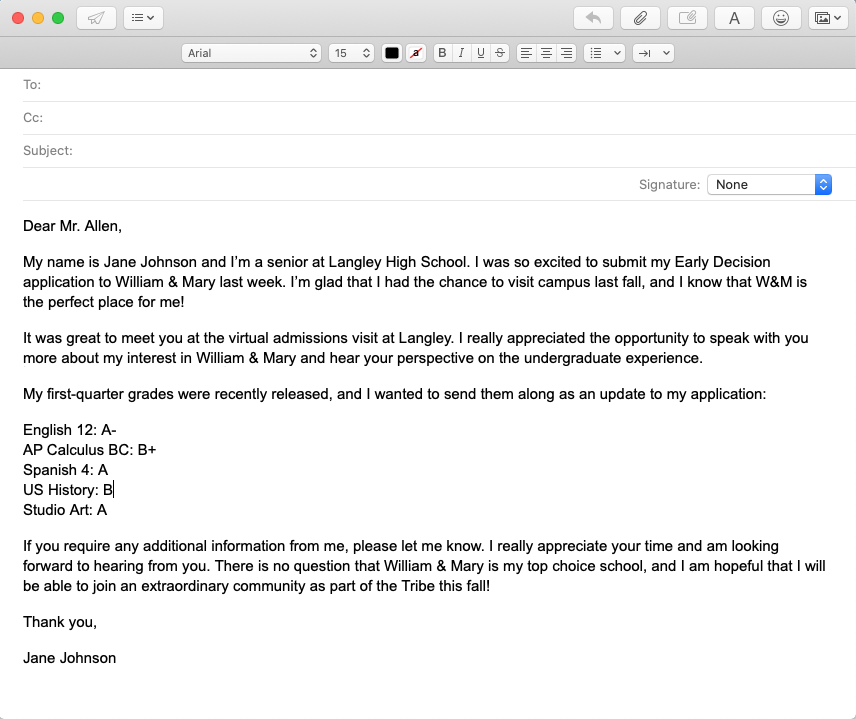
Remember: keep it concise and simple. Here is a sample:

Congratulations to all of the students who have submitted their remaining early applications this week! Comment to let us know if you will be following up with your first-quarter grades! 

College Experience Coaching - Applications & Special Programs

Last week, we covered the ins and outs of the course registration process and how college experience coaching can help. While course registration is often one of the most complex and nuanced parts of the first few years of college, it is by no means the ONLY challenge that students will come upon their first year (and beyond!)

College experience coaching can also help when students find themselves needing to complete internal applications within their college or university. Unfortunately, these have become a common part of the college experience!


What do you mean, more applications?

Yup. As a college student, there are two main types of applications that we help students complete (while ensuring they put their best foot forward!).

The first is an academic application for a special program, school, or course experience that interests them. Many schools offer selective programs within the university that students can potentially enter in their second or third year. These are often pre-professional programs; for example, both the McIntire School of Commerce at UVa and the Robins School of Business at William & Mary will only accept students through a selective internal application process. And this is quite common elsewhere, too. There may also be scholarship opportunities, honors colleges, or even research funding for which students can apply while at school.

The second type is actually an extracurricular application. Believe it or not, many clubs and organizations also require (sometimes extensive!) applications and even interviews from students looking for leadership opportunities or membership in campus organizations. Frankly, this can be a pain, but these experiences are worth the effort; not only do they help students develop practical skills they need for the workforce, they are very useful when it comes to building resumes for job or internship opportunities. We help students stay on track to put together the best possible application packages - all while balancing their academic work.

What type of applications can you help with?

Applications are our expertise! Here are just some of the application types that we’ve successfully provided coaching to help students complete:

  • Honors College applications

  • Internal applications for selective schools or majors within the institution

  • Study abroad applications

  • Internship applications

  • Research or grant funding applications

  • Internal and external scholarship applications

  • Leadership positions, including those in greek life

  • Campus organizations requiring applications for baseline membership

  • Student government, student ambassador, and other institutional applications

Does my student’s school even have these types of opportunities?

Most likely, the answer is yes! But many of them may not be highly publicized, or your student may not know about the deadlines for some more selective programs. It can be really disappointing to realize junior year that research funding would have been possible, if only you’d taken a one-credit research seminar that is only offered to sophomores! We can help students investigate the possibilities on their campus and make sure they are on track to achieving their goals and making the most out of their experiences.

Can’t I just help my student with this stuff?

Yes! For some families, this works well and parents can help and encourage their students to make the most of the college experience. If that is you, college experience coaching may not be the best fit.

However, if any of the following sounds familiar, this may be a good investment for your family: “I don’t think she has any idea what she wants to do.” “I’m worried that he’s not thinking about his future.” “I’m not sure how to support her without imposing my own ideas.” “He says he’ll apply but the deadline is in two weeks and I don’t see how that’s possible.”

We hear issues like these from parents all the time. You want to support your student, but you also want them to have their own college experience. Or you think they need someone to talk to about their future plans, but you just can’t get them to talk to you without feeling like you’re nagging every time you get a phone call! A check-in with a professional can provide a sounding board outside of the family for both you and your student, giving you peace of mind and helping to keep your relationship intact.

Have an upcoming application deadline?

Reach out to Shannon today to learn more about college experience coaching, and check out our Packages and Fees page for more information on costs.

College Experience Coaching - Course Registration Time!

Did you know that in addition to educational consulting, we also offer college experience coaching to help students navigate their first year of college and beyond? Whether students are hoping to prepare for success in graduate school admissions, enter the job market with a strong resume, or simply just maximize the undergraduate experience, working with us can help make it happen!

So while our high school seniors are submitting their applications and waiting to hear from their schools, we’ve been busy helping our Class of 2021, Class of 2020, and Class of 2019 students with their spring course registration!


Can’t their advisors help with that?

At many schools, course selection and registration are notoriously difficult - especially for underclassmen. Even at ultra-selective private universities, advisors are meant to help facilitate schedules and share information about graduation requirements. So while they can certainly help, it’s not typically the kind of personalized assistance that most of our students (and their parents) expect!

Yes, there are a few exceptions, but most do not sit down with students to examine options and plot out the best possible schedule permutations. They can’t - they just don’t have time to do that for each student. It’s just like the school counselor vs. independent counselor issue we’ve discussed so many times before.

How does it work?

We do the research and leg work to help put together a personalized schedule tailored to your student’s preferences, goals, core requirements, and major/minor requirements - as well as backups (and backups to the backups!) to be covered when registration hits those inevitable snafus. Worried about getting stuck with a hard or boring professor? Not on our watch! Want to make sure no classes start before 10 a.m. and Fridays are free? We make it happen all the time!

Revealing our secrets…

Want to try to put the best possible schedule together on your own? Here’s some tips and tricks right out of our playbook:

  1. Map out a four-year plan from the start. Colleges typically provide lists of various requirements (general education, major, minor, etc), but they don’t always put everything together in one place. Sketching out a general four-year plan is a necessary first step that we take with each of our students - we put all of their requirements together in one place and incorporate space for study abroad, co-ops, and any other deviations from a traditional schedule.

    This provides an easy way for students to visualize exactly which types of courses they need to take and when, and how much flexibility they have - for example, how many times they can change their major before they are at risk of graduating late! - or whether they have room to pick up a new minor, etc. It also really helps to have a baseline when it comes to planning out each individual semester. We do modify this four-year plan as things change, but we rely heavily upon it.

  2. Create a master list early. As soon as course schedules are released for the upcoming semester (typically about a month in advance of registration), start planning out options. Look at the four year plan, determine which requirements are slated to be met during that particular semester, and start playing with the schedule to determine which available courses will fit the requirements. Come up with a master list of potential options.

  3. Identify the top two criteria of choice and start removing courses from consideration. We recommend prioritizing the quality of the instructor more than anything else. Even the most boring material can be interesting with a great professor. We always look for those who aren’t harsh graders, but are engaging and make learning fun. Depending on the material and the student’s needs, we may also look for those who are highly effective in terms of teaching the subject matter. This is less important in some situations (i.e. an English major trying to meet a Natural Science graduation requirement)- but it’s essential in others (I.e. a nursing major who ultimately needs to pass the NCLEX exam, an accounting major who ultimately needs to pass the CPA exam, etc). In addition to instructor quality, we also prioritize aspects including time of day, day of week, difficulty of subject matter when compared to alternatives, etc.)

  4. Keep careful notes for future semesters. Maybe it comes out that Prof. Smith is the most amazing in the psychology department, but he’s only teaching 9am classes this semester and that’s a deal-breaker. No problem! Write down a reminder to check out his courses during the following semester’s registration period. After we research various professors, we often put together short descriptions of their characteristics - bad and good - to make for easy reference down the line.

  5. Put permutations together! Start with the classes that seem to fit the top two criteria best, and put together a whole bunch of permutations that fit the general preference guidelines. There will be pros and cons to each permutation, and we like to rank them in order of preference. We also make sure that there are options available with a wide range of classes, because we don’t know which ones will fill up immediately on the morning of registration. For example, if every single schedule permutation includes POL315 and that one fills, it would be a problem!

  6. Monitor closely and adjust when needed. Freshmen typically register last, and even juniors can find that their top-choice courses have filled by the time their registration window opens. It’s important to be aware of which courses are filling, and which seem likely to fill. This way we can remove those permutations from the list and examine whether we have a sufficient number ready for registration day. Sometimes we need to go back to the drawing board to add more.

  7. Be strategic on registration day. After all of this prep work, it’s vital to make sure that students don’t miss their registration windows - and these usually happen very early in the morning. Be at the computer, ready to go, at least fifteen minutes in advance. Make sure to have a list of courses (in order of importance - those with fewer spots or which are most critical to the schedule should be prioritized). Start refreshing about a minute before the window to make sure to gain access immediately, and start registering from the pre-determined list. Make sure that the backup permutations are readily available to make for an easy pivot if courses fill unexpectedly.

Money Well Spent

Does this sound incredibly time-consuming? Well - that’s because it is (now you understand why advisors could never do this!). That’s why many parents ask us to step in - we are experienced and can take care of this much more efficiently than a student or parent could.

Still, our services aren’t free, or inexpensive. But put it into perspective, the cost of college today makes our fees look like chump change in comparison! Planning out course selection this way will greatly maximize the likelihood that a student will be able to graduate on time, and with the best possible grades. Every time something goes wrong (the student misses a requirement by mistake, or signs up for a course with a difficult professor and has to drop mid-semester, or doesn’t leave enough slots to be able to take all of their major/minor coursework on time), the likelihood of graduating in four years decreases.

Just about a week ago, the National Center for Education Statistics released updated data on graduation rates, and it’s pretty bleak. Did you know that only about 40% of students graduate from four-year universities within four years, and perhaps even scarier, only 64% graduate from four-year universities within SIX years! Even at an in-state public university, an extra year can cost around $35,000 - and that’s not including the opportunity cost of the year of lost income (average starting base salary for a B.S. graduate from UVa’s Commerce School: $78,000). Even using conservative estimates, we’re talking about a six-figure loss. So the investment of professional direction can be well worth it, and often ends up saving quite a bit of money down the line.

Need some help with Spring 2022 Registration?

Reach out to Shannon today to learn more about college experience coaching, and check out our Packages and Fees page for more information on costs.

Academic Planning for Middle School Students

We’ve been hearing the question a lot lately: “How soon is too soon for my child to begin thinking about the college process? He’s only a seventh grader, does he really have to worry about this right now?”

The answer: yes and no. Your seventh grader certainly does not need to start drafting a Common Application essay or begin taking AP exams quite yet! But with just a bit of thought toward the end of middle school, you can help set your student up for success later on - during the active phase of the college process.


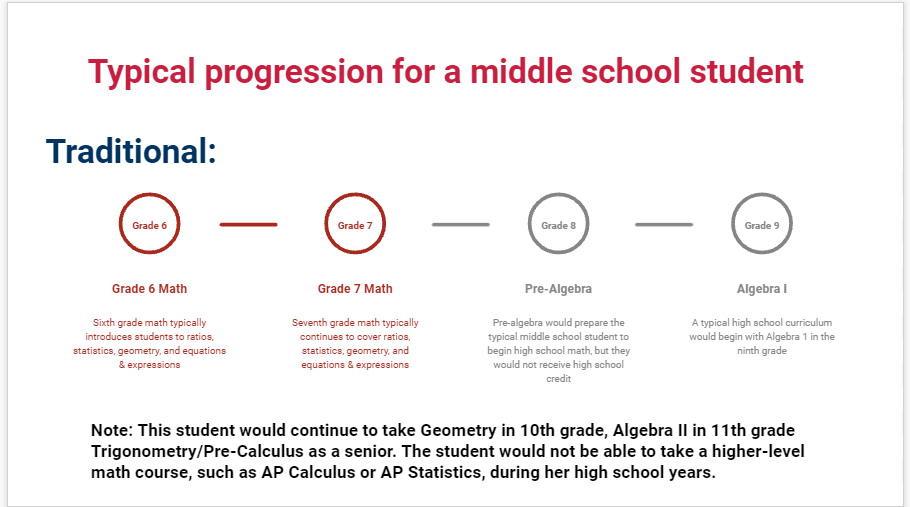
Believe it or not, middle school coursework often sets the stage for high school. Take a look at the basic progression:

ms progression blog snip.PNG

As noted, this student would not be able to take high school Calculus if she were to continue on this path - which may be a dealbreaker for a student applying to an engineering or other STEM program. And that student might not even realize that her seventh grade math course is closing such a big door!

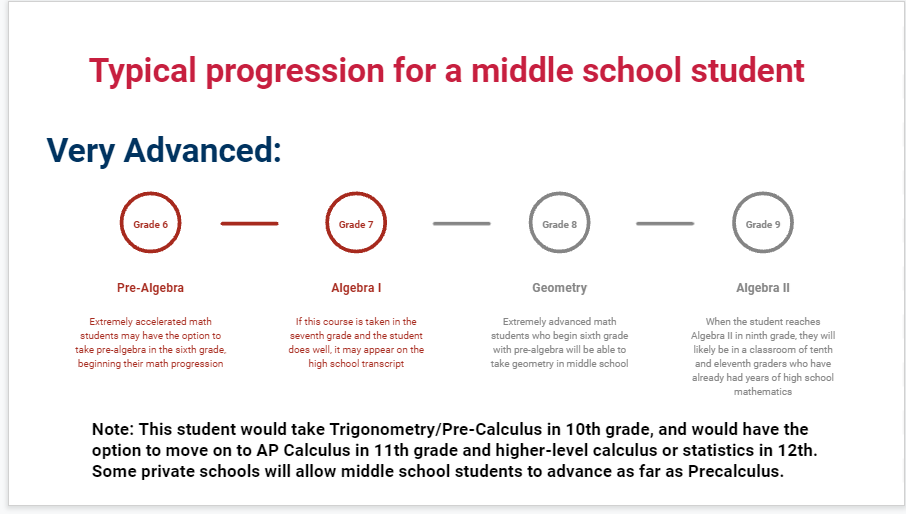
Compare that progression to this very advanced progression that would allow a student to take higher-level high school math courses:

This progression can differ from school to school, so talk to your student’s counselor about their individual school’s progression and whether middle school credits count toward the high school transcript.

If at all possible, we recommend that all middle school students plan to take Algebra I and at least one year of a foreign language. If your student does well in Spanish I and Algebra I in middle school, he will be able to continue with a more challenging high school progression.

But if your student doesn’t do well, there is no harm done - he will just retake Algebra I in high school and the previous grade will likely not appear on the transcript! So working to get that head start in middle school course planning can really only benefit most students, with the caveat that this can depend on the school system.

pexels-yan-krukov-8617514.jpg

In the end, colleges are far more concerned that students are challenging themselves during high school - so if taking Algebra I in the eighth grade is going to mean an extremely stressful year for you and your student, it is better to wait!

Remember: colleges won’t know which types of opportunities students had in middle school, but they will want to see students who choose the most challenging classes in their progression once high school begins (and of course, students who excel in those courses!). 

The bottom line is that your student should take the most rigorous curriculum available to them in high school.

Their placement at the start is relevant, but it doesn’t matter nearly as much as it matters to take advantage of everything their high school offers!


Still have questions about middle school course planning? Book a strategy session with us and we can help set your student up for success, in high school and beyond!


Should I Disclose My Student's Learning Profile or Evaluation to Colleges?

After getting this question from a parent this week, we thought that other families might be wondering the same thing. It isn’t a one-size-fits-all answer, but we wanted to offer some considerations for students and parents who may also be wondering about how much to disclose.

As a general rule, we recommend against disclosing your student’s learning profile during the application process. The reason for this is that admissions officers do not typically have the training or experience to read this type of document.

This is important - without an understanding of the way these evaluations typically read, or how learning differences present themselves, the admissions officer may conclude that the student isn’t able to handle the transition to college - even when this isn’t the case at all! Parents whose children have evaluations will know that these are written in a specific way to try to make the student eligible for accommodations - they emphasize the “differences” and to an untrained eye, they can sound extreme.

Especially for selective schools with large applicant pools, they are essentially looking for reasons to say “no” - and there are many unconscious biases. While no admissions officer would intentionally discriminate against a student with a disability, there is no point in providing information that could be perceived in a negative way.

And one note here - admissions officers CANNOT ask you to disclose your student’s learning profile! This is against the law and you do not need to disclose unless you want to do so.

That said, there are some cases where you may have a reason to disclose something specific about your student’s learning differences. We recommend doing this in an essay, additional statement, or counselor recommendation letter, rather than sending a learning profile, testing report, or other more involved document.

For instance, if your student had undiagnosed dyslexia that caused his grades to plummet during ninth and tenth grade, but received a diagnosis and saw rapid improvement in eleventh grade, that would be a reason to disclose the diagnosis. 

In short, it is helpful to disclose only if the disclosure will help to explain something in the student’s transcript (like a drop in grades) or an issue elsewhere in the application.

You may also want to discuss with your student’s school counselor whether they feel that there is something specific they need to disclose in their counselor letter in order to give context for the student’s performance in high school. This is an area where it’s very important to trust the counselor’s judgment. If they believe that they need to make a disclosure in order to say something positive, there’s probably a good reason for that.

pexels-katerina-holmes-5905709.jpg

If you do decide to offer an additional statement that touches on learning differences, it is important to include the strategies that your student has used to improve or maintain classroom performance. The disclosure will be so much more compelling if your student can point to ways in which they’ve worked hard and improved. This will also increase the confidence of that admissions officer, who may not have a full understanding of the student’s abilities. Overcoming a challenge can be a really positive thing to mention in an application!

pexels-kampus-production-5940841.jpg

Once your student is admitted, however, you should absolutely talk with the college’s learning center about what kind of support they can expect. Every college has a learning center (Shannon came to us from the one at Boston College!) and they will all provide similar services. The most popular ones are usually notetaking assistance, extra time on tests, and distraction-reduced testing environments. Generally, learning centers are much more likely to take the time to meet with admitted students than prospective ones, so you should absolutely reach out as you try to make your final college decision! 

And if your student is currently struggling with a learning difficulty, including ADHD, academic anxiety, and executive functioning challenges, we can also provide some extra assistance through academic coaching! If you are interested in learning more about academic coaching, you can book a Meet & Greet here.


Lies, Damn Lies, and Statistics: Pre-Med Edition

When a high school student applies for undergraduate admission, there’s no question that they will be able to go to college.

It’s not about “getting into college” - anyone can get into college. There are many 4-year schools around the country with acceptance rates that are close to 100%. Whether students are interested in those particular schools is a different conversation altogether - but everyone has options, even if they may not like their options.

The medical school admissions process is very different. Everyone is just trying to get in somewhere and if you have the luxury of a couple of choices, that’s amazing. Around 55-57% of applicants to medical school in any given year simply do not get in anywhere.

Can you imagine?! And this is after going through an excruciating application process.

Given this, it’s only natural that students and parents are interested in the medical school placement statistics for each college or university under consideration. It seems obvious that if you ultimately want to go to med school, you should select an undergraduate program with a high medical school placement rate. It’s only natural to assume they must be doing something right if nearly all of their applicants are admitted!

unsplash-image-hIgeoQjS_iE.jpg

Have you ever heard of Berry College?

It’s a small private school in Georgia with an undergraduate acceptance rate around 40% and a four-year graduation rate around 65%. I am sure it is a fine place, but it is not one that I would imagine would attract a whole lot of out-of-state applicants with super-high test scores and grades. In fact, I would bet that none of our current students have ever even heard of the place.

But wait! Check out this screen shot from their website:

Screen shot taken from Berry College website

Screen shot taken from Berry College website

Wow! A 98% acceptance rate to med school. That’s amazing. Remember, the national average is around 43-45%.

Let’s check out other schools for comparison’s sake. Here’s UVA:

Screen shot taken from University of Virginia website

Screen shot taken from University of Virginia website

What in the world?

Let’s find another school to compare. Here’s UC Berkeley:

Screen shot taken from UC Berkeley website

Screen shot taken from UC Berkeley website

If you scroll up and re-read the text above the Berry statistics, it explains that private school costs more, but when you consider the quality of education, mentorship and post-graduation outcomes… hard to argue with that, right? Is Berry the next big thing? Should we all fly down to Georgia to visit?

Probably not.

unsplash-image-701-FJcjLAQ.jpg

Here’s what’s happening:

A lot of colleges and universities advertise very high pre-med acceptance rates that don’t actually represent all of the students who wanted to apply to medical school.

Instead, the acceptance rates represent a select group of top students that the institution hasn’t already weeded out.

These schools require a pre-application process to internal committees that will make a decision about whether or not their institution will support each individual student’s medical school applications. If the committee deems the student worthy, it will then provide what is called a “committee letter” to send along with their medical school applications.

If a student attends a school that has a committee, but does not have a committee letter, they can technically still apply - but at that point they’ve essentially been blackballed and have an extremely low chance of admission.

This would be like applying to college and having your school counselor refuse to write a rec letter on your behalf - except worse.

unsplash-image-Pd4lRfKo16U.jpg

So it turns out we aren’t going to fly down to Berry after all. As you can see, it’s really easy for a school to manipulate their students’ medical school acceptance rate - all they have to do is restrict the applicants they support!

In reality, we have no clue how many students tried to initiate a medical school application from Berry. Maybe 10% of the original group actually got to med school at the end of the day, or maybe 90% did. We just don’t know. But what we do know is that 98% of their hand-picked group of top students was admitted - definitely less impressive when you look at it that way.

And I will stop picking on Berry now, because most colleges and universities throughout the United States do the exact same thing, from ones you’ve never heard of all the way to the Ivy League.

Many do it for law schools too, but it’s not nearly as cutthroat. There are many lower-ranked law schools out there with high acceptance rates, so colleges and universities feel more confident about the chances of at least one acceptance.


Interested in looking up this information for schools on your own list?

  • If you search for "pre-med committee" on google you can typically pull up each school's policy. As I mentioned, there are a lot of schools that do this, so I’m not suggesting excluding them from consideration. There’s also the relevant factor that if you weren’t strong enough to be accepted by the internal committee, you probably aren’t strong enough to get into medical school either. But I sure wouldn’t want to be one of those borderline students!

  • The AAMC website also offers helpful information about the number of applicants per undergraduate institution. This provides some level of context (keep in mind these schools vary in size tremendously - of course UCLA is going to have more applicants coming from their school than Villanova! We also don’t know which were successful and which were not.

  • You can also feel free to ask this question at an admissions information session if the school starts bragging about their medical school acceptance rates - obviously, be polite in tone, but you can ask if the percentage shared represents a restricted group or every student wanting to apply.

Lastly, know that you need to take all college admissions statistics with a grain of salt. Everything can be manipulated and often is!

Fall 2021 Virtual College Fairs, Tours and Information Sessions

We always stress with our clients that it is SO important to demonstrate interest for the schools on your list! Especially now that so many schools have virtual offerings, there is really no excuse for not checking out all of the colleges that interest you.

Check out some of the events on this list and make sure to bookmark this page, because we’ll continue to update as we hear about more events!

Discovering U Virtual Group Sessions

Event Description:

Join Columbia University, the University of Chicago, the University of Texas at Austin, the University of Michigan, and Yale University for this online info session. This is a great opportunity for students to hear from several highly selective schools at once. 

When:

The next session is being offered on September 30 at 7:00 pm EDT. However, Discovering U is also offering several special sessions that are worth checking out, including a Session with the Deans on October 20. 

Learn more and register for Discovering U here.


UCLA’s Annual Fall Open House

Event Description:

UCLA has made their annual event virtual for the past few years, which is a great opportunity for students on the East Coast who may not have been able to attend an in-person event on campus. There will be sessions on admissions, financial aid, housing, academic programs, and student life, among others. 

When:

Saturday, September 25 through Thursday, September 30. The sessions will be a little late for those of us in the DC area, running from 8:00 to 10:00 pm EDT on weekdays, but the Saturday session will be in the afternoon from 1:00 to 6:00 pm EDT. 

Learn more and register for UCLA’s Fall Open House here.

NACAC Virtual College Fairs

Event Description:

NACAC is offering a variety of virtual fairs this fall, with several that focus on particular regions. Their virtual experience lets you put together a schedule so you can catch the Zoom presentations from the colleges you are most interested in, as well as set up one-on-one meetings with admissions officers. 

When:

The next fair on September 28 focuses on colleges in the Northeast, including Boston University, Drexel University, and Northeastern University

Learn more and register for a Virtual College Fair here.

National CCAA Virtual College Fair

Event Description:

The Catholic College Admission Association is offering several virtual fairs this fall. Over 100 Catholic colleges and universities will be in attendance, and the fair will involve one-on-one chats with admissions officers from many of these schools.

When:

Wednesday, October 6, Tuesday October 19, or Thursday October 21 from 6:00 to 8:45 pm EDT

Learn more and register for a Virtual College Fair here.

Greater Atlanta Area Colleges Virtual Exploration

Event Description:

Nine Atlanta-area schools, including Emory, Georgia Tech, and UGA, will host sessions and presentations at this two-day virtual fair, with typical Admissions sessions as well as specific events like “Why Atlanta?” to help students explore schools in the area.

When:

Wednesday, September 29 - Thursday, September 30, with sessions in the afternoons and evenings.

Learn more and register for a Virtual College Fair here.

Six Colleges Events

Event Description:

Amherst, Bowdoin, Carleton, Pomona, Swarthmore, and Williams have joined together to put on these virtual events throughout the fall. Students can register for individual events, but there is also a single form that students can fill out to receive information about each school and all of the upcoming sessions.

When:

There are several sessions scheduled, including an Academic Experience session on Tuesday, September 21 at 8:00 pm EDT and a “Real Talk” session with students on Monday, October 18 at 8:00 pm EDT.

Learn more and register for a Six Colleges event here.

Explore Maryland Day

Event Description:

This full day of live sessions from the University of Maryland provides students with the opportunity to learn about the various colleges within the university, hear from current students, and learn more about resources on campus. Students can choose to attend just one session or the full day.

When:

Saturday, October 16, 10:45 am - 4:00 pm EDT

Learn more and register for Explore Maryland Day here.

Baylor Premiere

Event Description:

This is another full-day open house, with breakout sessions for academic programs, a live Zoom tour, a parent Q&A session, and other options throughout the day.

When:

Saturday, October 2, 11:00 am - 4:00 pm EDT

Learn more and register for the Baylor Premiere here.

Behind the Curtain

Event Description:

Bates, Claremont McKenna, Lehigh, and UChicago are teaming up to offer this information session where they let students see “behind the curtain” of the admissions process and hear from admissions directors.

When:

There are three events - the soonest is on Sunday, September 26 at 4:00 pm ET

Learn more and register for Behind the Curtain here.

Exploring Educational Excellence

Event Description:

Brown, UChicago, Columbia, Cornell, and Rice are offering this joint session that will include a brief overview from each school and the opportunity to ask questions of the admissions officers. A great way to learn about five highly selective schools at once!

When:

There are four remaining sessions - the soonest is on Tuesday, September 28 at 9:00 pm ET

Learn more and register for Exploring Educational Excellence here.

Tips for Building Your College List

As we transition over to the active stage of the application process with all of our Class of 2023 juniors this fall, we’re working hard to help them build their college lists! We’d love to share some tips to consider as you work toward building a balanced list (and if you are visiting colleges now as a senior, don’t forget to check out our tips for choosing your college for more help with those visits!). 

One major source of anxiety that we hear about from students and families all the time is not having options. Students are nervous that come decision time, they will feel “stuck” with a choice that they don’t love. The problem is usually that the student has a list of only super-selective schools. And while every student should absolutely apply to one or more of what we call “dream reaches,” there are often dozens of schools where the student could be equally (or more!) happy and successful. 

The other common mistake that students make is having just one “safety” school - that they would never want to attend! Yes, it is important to have less selective options, usually more than one, but that doesn’t mean that you should throw a school on there just to have one. With just a bit of extra research (or help from a counselor), you can find safety schools that actually meet your criteria, where you’d be excited to attend! The goal is that every school on your list is there for a reason beyond, “Well, I could probably get in.”

So if you are looking to build a list of colleges that makes you feel like you’ve got a TON of great opportunities, follow these tips:


1. Start early

Now really is the time to start building a list - we’ll start brainstorming with our class of 2023 students in a few weeks! When you start early, the process becomes a lot more fun and a lot less stressful. You can also capitalize on fall and winter breaks at school to visit campuses, and make sure that you don’t miss any important info sessions or college visits to your high school. 

2. Get to know yourself

During our first brainstorming meeting with students, we ask a TON of questions! We want to get to know exactly what our clients are looking for in their schools - from academics, to extracurriculars, to community experience. There are so many different areas of consideration when choosing a college, and it is helpful to have a sense of what you are looking for, and what is an absolute deal-breaker. 

Secondly, make sure you know how important those characteristics are. We put different aspects in four categories: Must Have, No Way, Would Be Nice, and Don’t Love. That way, we know exactly how important each characteristic is to a particular student. One student might prefer a suburban environment, but be willing to attend a rural school if it has a specific program or major. For another student, a city school is a Must Have - if it’s rural, they’re not going! Make sure you know what your priorities are so that you can build your list accordingly.

yingchou-han-IJrIeCs3D4g-unsplash.jpg

3. Do your research

Once you have some idea of the type of school that interests you, you can begin research. There are websites and free resources online that can be very helpful (we particularly like the Princeton Review), as well as paid resources like the Fiske Guide that you may also be able to borrow from your school counselor or local library. 

But of course, nothing beats a visit to the school! Some campuses are open now for in-person visits, while others are remaining virtual. Whether you do a tour in person or online, taking the time to really learn about the campus and community is the best way to figure out whether it matches your criteria. Also, in-person visits are the number one place that we see students’ criteria change - you may think you want a mid-size school, but realize after a few visits that a smaller campus is the best fit for you.

parker-gibbons-kfwPJieZVwI-unsplash.jpg

4. Check your balance

We recommend at least two likely/safety schools and at least three target schools to make up the base of your list. Once you have this foundation, you can build on some reach or “dream reach” schools. But without that core of likelies and targets, you are putting unnecessary pressure on yourself - if your mindset is “If I don’t get in, I’ll be miserable!” it is a lot harder to enjoy the process.

5. Check your own time!

Careful not to go too far with the list - be mindful of your time and other commitments. Again, the earlier you start, the easier this will be, but keep in mind that some schools can have six or more supplemental essays, and they add up quickly! We try for a list of 8-10 schools with our students, though of course there is always some range depending on the individual student’s needs. Just keep in mind that if you are planning on applying to 20 different schools, you will need to be prepared to complete the work. 

Building your college list should be a fun part of the process, not a stressful one. Follow these tips and you’ll be well on your way to a list that makes you feel happy and excited about the rest of the process! If you’d like to learn more about how we can help, book a Meet & Greet to discuss our brainstorming process in more depth. 

SAT Score Submissions: All You Need to Know!

Every year around this time, as our seniors finish up, we try to think about the tasks students can do at home with their parents if they are running out of hours.

I have posted before about how it’s really hard to mess up application submission (AFTER the entire application has been throughly proofread, of course - just talking about the act of clicking submit and paying for the application fee, etc). It’s so straightforward that it would be next to impossible to submit by mistake.

What I do fine to be pretty tricky, though, is the process of submitting official copies of SAT scores through the College Board website (ACT score submissions are easy).

Keep reading about the submission process to learn the SAT misstep a lot of families make by accident!

Getting Started

After students sign into their College Board account and select the option to submit a score report, the website instructs them to add their colleges to the list.

This isn’t too difficult - just confirm that you have the correct school names (one year we had someone submit her SAT score to American University of Paris instead of American University, but we caught it after reviewing the confirmation email!).

Score Recipients

The next screen takes you to a list entitled “My Score Recipients.” This is where things go wrong: So. Many. People quickly proceed to the next page after reviewing the list of schools.

What they don’t realize is that the list defaults to sending ALL scores to each school. You have to manually change this option for every single school in order to be able to choose to send your best scores!

In the screen shot above, do you see the yellow arrow next to SMU, pointing to “All Scores”? The entire column looked like this before we began working our way down the list school by school.

We started with Boston College at the top of the list, and clicked the “Choose Scores” link next to each school to manually change our selection from the “All Scores” default.

See how the orange arrow shows that Princeton is set to receive “Selected Scores,” along with the three schools above it? You want the entire list to look like this before you proceed to the next step in the score submission process.

Selecting Scores for Submission

But first, let’s look at what happens after clicking “Choose Scores.” You will be taken to a page where all of your scores are laid out for you.

Assuming the school practices score choice and allows you to submit your best scores, you should figure out which test date, or combination of test dates, results in the best Evidence-Based Reading and Writing and Math scores. That’s what you want to send. The others should be toggled to “No.”

In this particular case, the student had a 760 in math each time she took the test (she is so smart!). But we do not want to send her December 2020 or March 2021 test date, because she did better in Evidence-Based Reading and Writing on the May 2021 test date. In this case, we would toggle the December and March test dates to “no” and the May 2021 test date to “yes.” Then we would proceed ahead and repeat for the next school.

Don’t Forget to Double Check!

After making all of these selections, when all of the schools are set to “Selected Scores,” you can proceed to the next screen. At this point, click the plus sign next to each school just to confirm that you actually selected what you intended to select. We clicked through each one here to make sure that it listed the May 2021 test date ONLY!

Pay and Finish Up!

Whew! The hard part is done. At this point, you can proceed to the next screen and enter your credit card information. Don’t forget to wait for the confirmation that shows that the scores were successfully submitted before clicking out.

Common Questions

Is it better to send the scores before or after application submission?

The truth is, it doesn’t matter at all. If you already know that you are done testing, and you already know your college list, you may as well go ahead and send the scores to get this step out of the way. But I would highly recommend waiting until after your list is 100% set, or this can become confusing.

Is it a good idea to rush scores?

No! Never! Because scores are now sent electronically, the rushed (i.e. sent through FedEx or similar) score reports will almost always arrive slower than ones sent normally. Strange, I know, but trust me on this and don’t rush your scores.

Is it necessary to send score reports if self-reporting scores on the application?

For some schools, no, it is not. For example, UVa is very clear about the fact that you can just self-report your scores on the application and follow up with the official score report if you enroll there, for fact-checking purposes. And this will save you some money, as the score reports cost $12 per school. But many other schools DO require official reports, and there’s a lot of conflicting information out there in terms of who does and who doesn’t. After a lot of back and forth last year with inaccurate information, my preference is for students to just go ahead and send official reports everywhere.

Is it necessary to send scores to test-blind schools?

Technically, no, as they don’t consider them in the review process. But human nature is human nature, right? If there is any remote chance that someone will see their high scores, even if they aren’t technically considered, I’d rather a student pay the $12 to send them and hope for the best. That’s why I had this student send her scores to UCLA.

You’ve sent the scores.. great! But one last step - don’t forget to monitor your application status portals to confirm that the schools received your scores!