
We did it! Well, almost. While Regular Decision deadlines are still ahead, nearly all of our students have already submitted their applications, with just a handful left to wrap up! It's been a super busy fall, and somehow blogging keeps making its way to the bottom of the to-do list. But we made it through our first application season with Jordan as part of our team! (Not to brag, but she is really fantastic and has been such a huge asset. Very grateful to have her!)
In other news, this is officially my first school year as the parent of a HIGH SCHOOL STUDENT. Where did the time go?! After spending so many years helping other families navigate the high school experience, it's a little surreal to be doing it as a parent myself.
Of course, there's a big difference between advising other people's children and advising your own! Just today, I was telling Caroline in the car that we need to get her scheduled with Jordan ASAP for a ninth-grade strategy session to start working on summer plans. It’s tough to separate your professional perspective from your emotions as a parent (and even tougher to get your own teenager to take your advice!). Definitely going to have Jordan take the lead on this one!
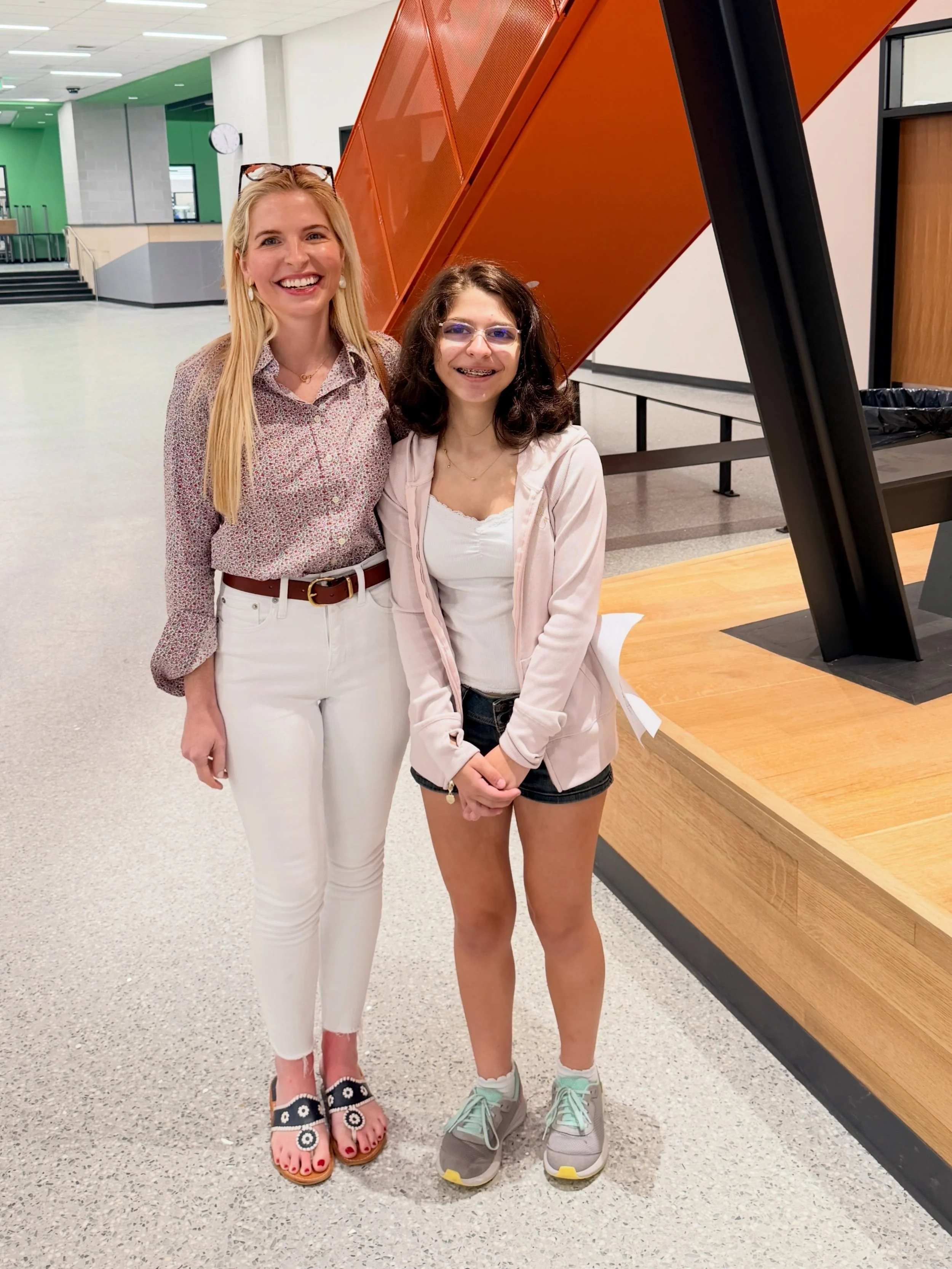
High school orientation!!
Anyway, enough about me. We've got quite a bit to catch up on!
BIGGEST COLLEGE-RELATED NEWS OF THE WEEK
INTERESTED IN POLICY? DON’T SLEEP ON GEORGE MASON
We have posted a few times over the past couple of years about how George Mason has a lot to offer. Now, billionaire philanthropist Dwight Schar has donated an additional $30 million to the university's Schar School of Policy and Government. The Schar School plans to launch two new institutes next fall, focused on national security and economic policy. The Institute for Security, Intelligence, and Defense will explore issues ranging from emerging technologies and cybersecurity-related national security challenges to nuclear threats and international security. The Institute for Economic Statecraft will focus on how governments use tools like tariffs, sanctions, and export controls to influence global affairs. From research to programming, these institutes will bring many new opportunities for Mason students!
COLLEGE COSTS ARE DOWN, BELIEVE IT OR NOT!
Here's a headline I never expected to write: according to the College Board's latest report, the average cost of attending college is lower than it was ten years ago! After accounting for financial aid and inflation, the average annual cost for an in-state freshman at a public four-year university is approximately $21,660, down 14% from a decade ago. At private nonprofit colleges, the average is $38,540, a 9% decrease. What's behind the change? Slower tuition increases, more financial aid, and increased competition for a shrinking pool of high school graduates. Of course, families paying full price may not be seeing much relief, but after accounting for financial aid and inflation, the average cost of attendance is lower than it was a decade ago. It’s a good reminder that the published sticker price and what a family actually pays can be two very different numbers. Don't automatically rule out a college without investigating the potential cost!
CORNELL FACULTY VOTES NO CONFIDENCE AMID CONTINUED SEXUAL ASSAULT CONTROVERSIES
Cornell University is facing serious turmoil after its Faculty Senate voted 75–50 to declare no confidence in university leadership over its handling of sexual assault allegations.
The vote follows a former student's lawsuit alleging that she was drugged and sexually assaulted by multiple men at a fraternity party in 2024. The accused men deny the allegations, and a criminal investigation is ongoing. Cornell's internal Title IX process did result in disciplinary action against several students, but many faculty members believe it wasn’t enough – and that administrators haven't done what they should to address sexual misconduct on campus.
Unfortunately, this isn't the only case raising questions about Cornell's handling of sexual assault allegations. The Cornell Daily Sun recently reported on a separate, ongoing lawsuit filed in 2023, in which two former students allege that the university failed to adequately respond to complaints of sexual misconduct. Cornell disputes those allegations.
The no-confidence vote is largely symbolic and cannot remove President Michael Kotlikoff, whose leadership continues to have the support of Cornell's Board. It's an incredibly troubling situation, and a reminder that campus safety, university accountability, and the handling of student complaints deserve considerably more attention than they typically receive during the college search process.
TULANE’S APPLICATIONS FOR THE CLASS OF 2031 HAVE DOUBLED
We don’t know most of the data from the early rounds yet, but Tulane did share an update with counselors about how their applications have DOUBLED so far this year. Seriously?
Shawn Abbott, Tulane’s VP of Enrollment Management and Dean of Admission, wrote: “Frankly, we're not sure what to make of the surge, but it is likely that the rising interest in southern universities and dropping our "Why Tulane?" question contributed. In addition, Tulane's appearance in the College Football Playoff last year against Ole Miss (validating the idea that athletics play a formidable role in application volume), as well as the establishment of a new nursing program and new academic programs in electrical engineering, mechanical engineering, and space science and engineering all likely appear to be of influence.” Sigh. This increased competition is not good news for our students, but I appreciate the transparency!
SALARY CAPS, LUXURY TAXES, AND THE NEW WORLD OF COLLEGE SPORTS
Just when you thought college athletics couldn't get any more complicated...
According to ESPN, the SEC is considering a luxury tax on universities that spend more on their athletes than the current revenue-sharing cap allows. Under the House v. NCAA settlement, schools can distribute approximately $21.3 million directly to athletes during the 2026–2027 academic year. But some universities are reportedly finding ways to spend more through third-party NIL arrangements, leaving athletic departments unsure how much their competitors are actually paying.
The SEC's proposed solution? Let schools exceed the cap, but charge them a financial penalty for doing so. The conference hopes this would encourage greater transparency and reduce the incentives to circumvent the rules. Nothing has been approved yet, but officials reportedly hope to reach a decision before December's football signing period. Can we just appreciate how wild this is? A few years ago, college athletes couldn't accept most forms of compensation. Now we're discussing payroll limits and luxury taxes. College sports really have become big business!
BEST ARTICLES OF THE WEEK
Let's start with a fascinating (albeit somewhat alarming) TIME essay by Duke sophomore Alana Kaufman about how AI has changed her college experience. She initially used ChatGPT to save time on tedious assignments, promising herself she would never use it for subjects she genuinely loved. But that boundary gradually disappeared, and eventually, when she sat down to write an essay without AI assistance, she discovered that she had practically forgotten how to organize her own thoughts into a coherent piece of writing. Yikes. We know a few students who could relate, haha. What makes this essay particularly compelling is her honesty about the pressure to prioritize efficiency, extracurricular activities, and professional advancement over actual learning. She raises an uncomfortable question: what happens when students become so focused on getting ahead that they lose the ability, or even the desire, to think independently? I think this is an especially important read for parents of college-bound students.
Speaking of AI, The New York Times published an investigation into cheating on the SAT. One particularly sophisticated product, called Auto SAT, was being sold for $499 and allegedly used AI-powered malware to display answers directly on a student's screen during the exam. The College Board discovered the software, purchased a copy, and made changes to prevent it from working. Meanwhile, other cheating operations are exploiting time-zone differences to obtain test questions in countries where the exam begins earlier and sell them to students elsewhere. College Board is now planning to change its international testing schedule in 2027, has already banned AI-enabled smart glasses, and has begun monitoring keystrokes and cursor movements in certain locations. I can't help but wonder what standardized testing will look like five years from now as cheating continues to evolve with new technology. It’s like a game of whack-a-mole.
On to a topic that seems to generate strong opinions from just about every parent I know: teenagers and social media. A new study published in SAGE Open challenges the increasingly popular narrative that social media is the primary culprit behind declining adolescent mental health. Researchers followed 653 teenagers over three years and found that greater social media use was associated with higher subsequent self-esteem among girls, with no statistically significant relationship among boys. Crazy, right? I had to read it twice because I was so surprised at the outcome. The researchers suggest that the decline in teenagers' independence and opportunities for unstructured socializing may deserve more attention than screen time alone. Of course, this doesn't prove that social media is good for teenagers, and self-esteem is only one component of mental health. Still, it's an interesting counterpoint to the argument that smartphones are responsible for everything that's gone wrong with childhood. Are we so focused on what our kids are doing online that we're not thinking enough about what they're not doing offline?
Finally, a unique take on college rankings! If you’re a TikTok watcher, you might have seen this making the rounds over the past week. The Manhattan Institute has released its 2026 City Journal College Rankings, and the results might surprise you. The organization explained that its purpose was to rank based on “campus governance, educational experience, student life, and career outcomes” and “present performance, not past prestige.” UT Austin actually takes the top spot, followed by the University of Florida and Notre Dame. Meanwhile, Harvard comes in at #19, UVA at #28, and UC Berkeley at #62.
Before anyone starts rearranging their college lists, though, take a look at the details behind the methodology! For example, colleges receive more favorable scores for eliminating diversity, equity, and inclusion offices and avoiding certain institutional political commitments. Of course, maybe that’s important to your student. And maybe the opposite is important to your student! To me, it’s a great reminder that no ranking system can tell you which college is best for anyone. It completely depends on what matters to your student, not what matters to the people creating the list!
OFFICE HAPPENINGS
I recently had the opportunity to visit both the University of Colorado-Boulder and the University of Denver! Boulder in particular is a really popular school for our students, because it remains one of the last non-Southern public flagships with a strong national reputation where an above-average student still has a reasonably strong chance of admission. For strong students applying to highly selective universities, Boulder can be a great option to round out a college list, although admission is more competitive in certain programs, particularly engineering. Did you know that Boulder has one of the highest percentages of out-of-state students of any public school in the country?

I was really impressed by my visit! It didn’t hurt that it was an absolutely gorgeous day. Pro tip: don’t miss grabbing brunch at The Buff while you’re in town. It absolutely lived up to the hype!! Put your name in well in advance. Of course I had “No two Buffs are alike” in my head the whole time.. if you applied to Boulder sometime in the last decade, you know what I’m talking about!
The University of Denver was considerably quieter on the day I visited, so I didn't get quite the same sense of campus energy. One thing worth highlighting, though, is its great learning support program. This is definitely worth exploring for students who would benefit from additional academic support.