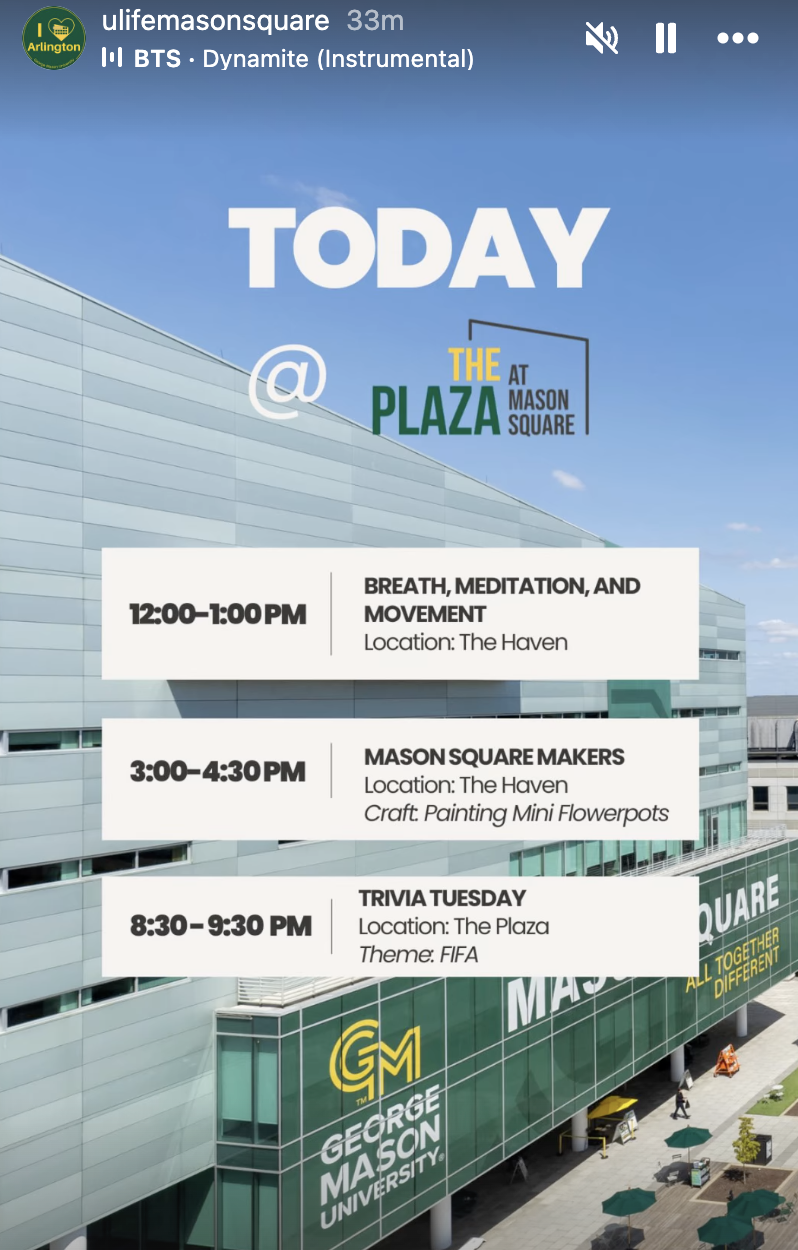

Every time I drive past the Plaza at Mason Square in Arlington (which is multiple times a week!), I think about how I need to share it on the blog, so here goes! The Plaza at Mason Square, located between Clarendon and Virginia Square near George Mason's incredible Fuse building (which we featured last year), is hosting a ton of fun, free community events throughout the summer. Our clients in the Northern Virginia area should definitely check it out, especially if they have any interest in George Mason.
We always stress the importance of campus tours to get a sense of a university's culture, but attending events like these can be just as valuable. The Plaza's summer programming reflects George Mason's commitment to community engagement and gives prospective students a chance to experience the university in a different way. I also think it's a great way to see what makes George Mason unique. There's so much more to the university than the Fairfax campus alone, and I don't think most students realize that. If you decide to stop by, the Mason Square Makers events (like DIY sunglasses and notebook decorating) especially caught our attention!
These are exactly the kinds of experiences that can help you better understand student life beyond the standard campus tour. And if you're looking for more ideas, be sure to check out our post from last year on Colleges with the Coolest Summer Events!
And now, let's get into this week's higher ed news!
BIGGEST COLLEGE-RELATED NEWS OF THE WEEK
NOTRE DAME INVESTIGATES SEXUAL MISCONDUCT ALLEGATIONS
The University of Notre Dame has placed a residence hall rector on leave while it investigates anonymous allegations of sexual misconduct that were shared through social media. The allegations, which were posted on an Instagram account in June, involve the rector of McGlinn Hall, who has held the position since 2024. According to university officials, Notre Dame has not received any formal or first-hand complaints at this time, but the Office of Institutional Equity has launched an investigation and is working to identify any individuals who may have information related to the claims. The university has encouraged members of the campus community to report concerns through official channels while the investigation proceeds. This news comes shortly after Notre Dame released a report examining failures in how the university previously handled allegations of sexual abuse involving a former priest accused of grooming male students in the 1980s and 1990s. The university stated then that it is taking steps to strengthen its response process moving forward, and we’re curious to see how they continue to handle this current investigation.
While the current allegations have not been substantiated, they are quite serious and warrant a thorough investigation. Families considering Notre Dame should remember that evaluating a college involves more than academics and campus traditions. It's also worth paying attention to how institutions respond to allegations involving student safety, transparency, and accountability. Families considering Notre Dame may also wish to review resources such as Share Your Story Notre Dame, an Instagram account where members of the community have shared personal experiences related to sexual misconduct.
FORMER BUCKNELL COACH CHARGED IN STUDENT ATHLETE’S DEATH
A former Bucknell University strength coach has been charged with felony hazing and involuntary manslaughter following the 2024 death of football player Calvin Dickey Jr. Prosecutors argue that Dickey collapsed after a punishing workout and that signs of medical distress were not handled appropriately before he later died. Dickey had been diagnosed with sickle cell trait, an inherited condition that requires precautions such as adequate rest and hydration. According to a civil lawsuit filed by Dickey's parents, the university knew he had sickle cell trait, but failed to take precautions that could have prevented his death. For now, the former coach has denied the allegations, and the case is still working its way through the courts. But this story, like the one above, serves as a good reminder to speak up about issues involving student health and safety. Many students expect college – and college athletics – to be challenging, but those challenges should never come at the expense of their well-being.
DECLINE IN PH.D. ADMISSIONS AMID RESEARCH FUNDING UNCERTAINTY
Some of the nation’s top research universities are admitting significantly fewer Ph.D. students this year, with admissions to doctoral programs dropping by approximately 15% compared to last year. University leaders point to ongoing uncertainty surrounding federal research funding, including grant delays and budget cuts. While domestic applications have remained relatively steady, international applications have declined, adding to concerns about the future pipeline of researchers in the U.S. This story doesn’t just affect graduate students; for high schoolers applying to research universities, it matters too. Graduate students are responsible for much of the research conducted at major universities and often mentor undergraduates, teach discussion sections, and help run laboratories. And if these trends continue, they could influence other research opportunities and academic experiences available to undergraduates in the coming years.
BUDGET CUTS ACROSS HIGHER ED
As colleges finalize budgets for the coming academic year, another wave of layoffs, program reductions, and restructuring has swept through higher education. Several universities announced significant cuts over the past month, including the University of Minnesota (230 positions), Johns Hopkins University (roughly 110 positions), The New School, the University of Arizona, and the University of Denver, while other institutions eliminated academic programs in an effort to balance their budgets. Many colleges cited declining enrollment, rising operations costs, or uncertainty surrounding federal research funding as reasons for the cuts.
While the news can sound alarming, it’s important to keep it in perspective. Most students will never notice the effects of a handful of staff reductions, and many of these changes happen behind the scenes. However, we’d encourage families to pay attention when universities begin announcing repeated layoffs, hiring freezes, or program closures, as these decisions can sometimes affect class offerings, student services, research opportunities, and campus life over time.

BEST ARTICLES OF THE WEEK
Artificial intelligence continues to reshape the college experience, from the classroom to career planning. A recent Wall Street Journal article highlighted how some high-achieving college students are moving away from traditional summer internships in finance and technology to pursue their own AI-focused startups. Instead of spending summers preparing for career paths that are increasingly uncertain, these students are joining incubators and accelerator programs, building products, pitching investors, and gaining hands-on experience as entrepreneurs. Some students have even questioned whether they should return to college after experiencing the speed and independence of startup life.
Of course, we strongly encourage students to finish college, even if the job market is uncertain. But this story also underscores the value of investing time into creative professional projects, as many of our clients have already started their own startups and small businesses (which also looks great in your college application materials). For many, college is also about developing the creativity, collaboration, and problem-solving skills needed to adapt to a rapidly changing world and to continue to grow projects they may have already started even before enrolling in a university.
AI isn't just changing career paths – it's also forcing colleges to rethink how students learn and demonstrate what they know. At Brown University, a recent controversy over suspected AI use on an exam has raised questions about how students are using these tools and whether they are actually developing the skills they will need after graduation. After one professor became concerned that students had relied too heavily on AI for a take-home assessment, he gave an in-person exam covering similar material – and the grades dropped dramatically. The situation has sparked larger discussion about the role of AI in college learning and how universities can balance new technology with academic integrity.
For students applying to college, this story is another reminder that the value of an education is not just the ability to complete assignments or earn a degree. The most successful students will be those who learn to use AI thoughtfully while continuing to develop the creativity, critical thinking, and judgment that technology can't replace. Whether launching a business or exploring academic and professional interests, the goal should be using technology to enhance what they can do, not replace the learning process itself.
OFFICE HAPPENINGS
July is typically when we see a sharp increase in the number of appointments students schedule with our essay coaches. While a few of our clients are putting the finishing touches on their Common App essays, most have shifted their focus to supplemental essays, taking advantage of the earlier generic prompts to make the process much smoother.
Many of these essays require substantial research into specific colleges, majors, and opportunities, and that work should be completed before each coaching meeting. Coming prepared allows students to spend their time with their coach refining and finalizing essays, rather than researching during the session, and leaves more time to brainstorm ideas for the next school on their list.
Stay cool!
See what else we’ve had to say about AI: