Special Topics

Introducing: Academic Coaching!

We are so excited to formally announce a new offering to our high school clients starting this spring - academic coaching! Shannon is an experienced academic coach and looks forward to working with our clients in this capacity.

Many of our students struggle with executive functioning challenges, and we have been so grateful for the opportunity to support them throughout the college application process. Families have seen what a difference it makes for their students to have us acting in the role of “project manager” and breaking daunting tasks down into manageable and accessible chunks.

Over the years, families have noticed how effective our method has been for their students and asked for our assistance outside of the active stage of the application process - helping students to develop their skills so they are more successful in high school with much less stress.

With so much interest, we decided to transition from offering this service upon request to including it among of our formal service offerings!

Think your student could be a good fit for academic coaching? Keep reading to learn more!


What is academic coaching?

Academic coaching is offered to help high school students who struggle with time management, organization, study skills, or academic anxiety. Our process gets to the root of a student’s difficulties and equips them with the practical tools they need to be successful in managing their workload, in their current academic stage and beyond! 

What isn’t academic coaching?

Academic coaching is not a replacement for psychotherapy! Coaching focuses on helping students implement actionable skills to achieve specific academic and personal goals. A coach is not a teacher or tutor - instead, a coach is a partner in helping your student be successful. Coaching can work in tandem with psychotherapy, medication, and other strategies as part of a treatment plan - or just by itself.

Academic coaching is also not subject tutoring. We will not work with your student on a paper, or teach them math skills - instead, students will learn organizational and time management skills that can be applicable across any academic or professional discipline. We can also work with an existing tutor or academic support professional to provide the best possible coaching for your student. 

pexels-cottonbro-4778667.jpg

Who could benefit from academic coaching?

Academic coaching is helpful for a range of students. Students with executive functioning difficulties, including those caused by ADD/ADHD or ASD, are great candidates for coaching. High-flyers who struggle with test-taking or other forms of academic anxiety can also learn coping skills from working with a coach.

Some students only need an hour or two of coaching on a periodic basis, to get them on track during busy weeks like finals, or through a recovery period from an illness or injury that led to missed schoolwork! Our flexible options let you choose what works best for your family. 

DOES THE STUDENT HAVE TO BE A CLIENT OF DC COLLEGE COUNSELING TO PURSUE ACADEMIC COACHING?

While academic coaching is open to current, past, and future clients, it’s also open to students who have no affiliation with us. The services are completely separate.

What does a typical academic coaching session look like?

This is a hard question to answer, because we hope that our sessions look like help to your student - and every student’s needs are different! Here are some things that might happen in an academic coaching session:

  1. We work with your student to plan out their schedule for the next week - when and how they will complete their homework, as well as any upcoming major tests, projects, or papers 

  2. We work with your student during a busy time of year, like finals, or after they are injured and are struggling to catch up with work. We help them to plan out a schedule to get through their busy season, and look ahead to what is coming up next! 

  3. We help your student come up with a plan to tackle a particular project, like studying for a major exam or writing a paper. We break the project down into manageable steps, then build a schedule to guarantee that it is completed on time. (Does this sound familiar? Yes - we can teach students to approach ALL projects just like they approach the college admissions process!)

  4. We work on study skills, test-taking strategies, or suggestions for note-taking in class or while reading. Working on these skills now will leave your student ahead of the game in college, where many students will arrive without ever really learning how to study. 

  5. Anything you need it to look like! Is your student having trouble sending an email to a professor or signing up for a time to meet with their academic advisor? Stop nagging and let us step in. We can provide support for a variety of executive functioning challenges as well as academic anxiety - feel free to reach out to us to learn more about how we can support your family.

pexels-bich-tran-760710.jpg

Packages and Fees:

Our flexible packages let you choose the best fit for the needs of your student and family. 

HOURLY COACHING - Introductory Rate of $200/session on an as-needed basis

WHAT YOU GET: 

  • One-hour student coaching session to discover and address particular needs and challenges. 

  • Follow-up email including any materials or strategies covered during the session, along with tips and instructions for implementing them at home. 

  • One fifteen-minute follow-up phone call to check in on student progress and make changes to strategies if necessary. 

MONTHLY COACHING - Introductory Rate of $600/month with minimum commitment of three months

WHAT YOU GET:

  • Monthly parent meeting to talk about student needs and parental concerns. 

  • Weekly one-hour student coaching sessions to discover and address particular needs and challenges. 

  • Follow-up emails after each session including any materials or strategies covered during the session, along with tips and instructions for implementing them at home. 

  • One check-in text message each week to remind student of important tasks and deadlines. 

  • One check-in parent text message each week to further discuss student’s progress.

Shannon loved her work as an academic coach at Boston College before joining our team, and is excited for the opportunity to support more students in this role!

Shannon loved her work as an academic coach at Boston College before joining our team, and is excited for the opportunity to support more students in this role!

We are so excited to introduce this additional way to provide support for our students, and help prepare them to take the next step in their education.

Questions about academic coaching? Reach out to Shannon for more information.

Ready to get started? Let us know you’re ready for monthly coaching and we’ll send a contract your way, or sign up for a one-time coaching session here.

Social Media, College, & Careers

Jayana Garvey.jpeg

This week, we have our promised guest blog post! Recruiting and hiring guru Jayana Garvey is here with us today to share some great tips for cleaning up your social media.

While Jayana’s primary focus in this post is on the hiring process for a student’s first job or internship, everything she says is applicable to the college application process as well!

Think we’re exaggerating? Check out this timely article from this week’s Washington Post about the impact that the use of social media can have on your college applications.

And for other potential red flags for admitted students (yes, even after you have been admitted!), don’t miss last week’s post on staying out of trouble.

Now, here’s Jayana!


Do my social channels matter while I’m in high school and college? Can they impact my career search? 💯yes.

Studies show that 70% of employers are using social media to screen candidates during the hiring process. Some companies and organizations certainly will and others follow strict protocols and only look at a candidate’s application in their system. You’ll never know for sure because every organization has different policies and processes related to their recruiting.

I would encourage today’s high school and college students to look at ALL their social media accounts as fair game for ANY recruiter or hiring manager (or admissions counselor!) to potentially come across.

pexels-tracy-le-blanc-607812.jpg

In my campus recruiting days, I could tell you about several college students who were in the running for prestigious leadership programs and were denied due to questionable content on their social media. It came up in many discussions with career services at universities.

It came down to this: recruiters were simply not confident that the individual could have a professional presence at work with an unprofessional, public, social profile. That immediately made the candidate lose credibility. Right or wrong about your character, it clouded a hiring manager’s view of you immediately and made them question their decision.

Remember, they are generally only going by one page about you and an hour spent with you. Employers are looking for a variety of competencies when interviewing you and assessing your candidacy. These could range from leadership skills, teamwork, your ability to collaborate, handling change, technical expertise, and so on.

You want an employer to stay focused on your application and interview - not to get distracted with a poor decision online that may jeopardize the stellar resume you’ve worked so hard to develop!

So how do you know what is OK and what’s not?

A good rule of thumb is to not post updates or share content on social media that you would not feel comfortable having a future boss see.

Use that as your litmus test. It’s an easy way to think before you share, comment, upload a photo, or like content. 

pexels-ketut-subiyanto-4353618.jpg

There will likely also come a time where colleagues at work may become friends with you on social channels and have a deeper view into your personal life.

Of course, you don’t have to accept everyone, but I’ve been on teams where it’s common and others where you would never be connected on personal social accounts with a boss.

Every single company culture and team culture is different. It’s best to begin preparing now. And if you’re reading right now and thinking about certain posts, TikTok videos, or Insta photos in your head that you might not be so proud of, it’s never too late to clean up your online presence and prepare for your future job search (Note from DCCC: This is also true about preparing for your college applications!).

Sure, you may be thinking some of this sounds overkill, and I get that! Our work and personal lives are becoming very blurred nowadays and are continuing in this direction. If you think about years ago when people went to work and didn’t have a laptop to bring home - work stayed at work. We now have remote work, colleagues as friends, and social media mixed in. This creates an entirely different environment - something your parents didn’t experience when they were applying to their first jobs out of school. 

pexels-cottonbro-5081918.jpg

Of course you can never control the social media trolls on your pages or crazy Aunt Sally’s comments on your photos, but how you interact with them and respond is key.

You may want to lock down certain profiles to keep them more controlled while being more discerning about who you accept as a friend. You may even want to take it a step further and approve tagged photos/timeline posts for example (if you’re on Facebook). Again, some organizations will look at things and some will not. You’d rather err on the side of caution. 

I’d also recommend being mindful of what you post on your personal social pages vs. what you post on LinkedIn. As you begin creating your professional presence on LinkedIn, you’ll want to keep it just that - professional. It’s not the page for a long vacation reel, tons of political posts, or controversial topics. People go to LinkedIn for work related topics, idea sharing, job searches, and business connections.

The few people who are sharing content not aligned with the general purpose and intention of LinkedIn always stand out on the newsfeed - and not in a good way. 😀 Yes, it’s OK to share some personal stories and information on LinkedIn too, but there should be a thoughtful connection to your professional life (generally). 

pexels-cottonbro-5053765.jpg

So we talked a lot about mitigating your social media working against you. It is absolutely a powerful tool to work for you in maintaining personal and professional connections and showcasing your “brand” as a prospective employee. If a recruiter or hiring manager goes to channels you choose to keep public and sees insightful content, industry articles, and friendly conversations with followers, they may feel even better about your candidacy by seeing you interact with others with varying viewpoints in a professional manner.

Now let’s contrast that with someone having a Twitter war with poor tone and dropping f-bombs with their followers. That may be an indication of how you would interact with your team members who might challenge your ideas or not share the same perspectives. Your creativity, professionalism, and intelligent conversations can boost your candidacy. 

In the end, you want social media to accelerate your applications, your job search, your candidacy, and your eventual career - not put opportunities to a halt! Think about what you have today and whether you need to tune things up now to help make that happen. You got this! 


Looking for more information on Admissions Strategy? Check out these posts!

Staying Out of Trouble

Yes - it was still below freezing when I woke up this morning, but the first week of March means spring is just around the corner! The warmer temperatures and exciting news in the mail can always induce some senioritis, and this year we expect that the loosening coronavirus restrictions and increased vaccine availability will make it even more tempting for students to relax. 

And for the most part, that is great! In fact, we hope our seniors are able to relax a bit in the classroom and enjoy the end of the year safely.

But students should still be making good decisions throughout the spring and summer to ensure that years of hard work toward those college acceptances do not go to waste. 

pexels-daria-shevtsova-1054974.jpg

This includes monitoring your social media posts carefully - keep an eye out for our guest blog next week from recruiting and hiring guru Jayana Garvey for more about making good decisions on social media.

Before you post or message, ask yourself, “Would I be okay with explaining this to my college of choice?” If the answer is no, don’t put it online!

Last year, more than a dozen colleges, including Clemson, the University of Richmond, and the University of Florida rescinded offers of admission to students based on their social media posts. And in 2017, Harvard rescinded offers to ten students who wrote offensive posts in a private Facebook group (yes, even in a closed group, this can happen!). In the last three years, 14% of private schools and 4% of public schools have rescinded admissions offers based on social media activity from incoming students. Whether schools should have the right to do so is up for debate, but as things stand now, it is much better to never find yourself having to make the argument. 

Remember, perception is reality, so try to avoid situations where others are behaving inappropriately or breaking the law. Yes, even if you are not doing it with them. Ask yourself, “If a video of this was posted on social media, would I be okay with that?” If not, do your best to get out of the situation before it becomes a larger issue. 

pexels-tracy-le-blanc-607812.jpg

Of course, the most common reasons that offers of admissions are revoked are academic in nature.

As a general rule of thumb, if your grades slip in one or two classes, it shouldn’t pose a problem - especially if the classes aren’t related to your major. If you are typically an A student, a grade of C or below may raise red flags, and you will likely be asked to explain your downwards trend in academic performance to the colleges.

You don’t want to change your senior year schedule, either. Dropping some AP classes may seem like an easy way to relax a bit during senior year, but colleges will notice. If you have a true conflict and need to make an adjustment, contact the schools on your list in advance of making the change. This is not the type of situation where you should act now and beg forgiveness later - far from it.

More serious academic issues include plagiarism or cheating - don’t do this! Violations of academic integrity are likely to result in revoked admission. 

pexels-cottonbro-5124902.jpg

That said, this might be the most important thing we say in this post: don’t lie! If you do have a major disciplinary or legal issue, report it to your colleges.

For current clients, we can help you do this, and you may also want to consult a lawyer - especially for cases involving criminal misconduct. On the other hand, if colleges find out that you lied or withheld information, they will not be willing to work with you. It is much better to get any issues out in the open and control how they are presented instead of having your college find out through the grapevine from someone else.

(And don’t think that doesn’t happen - your classmate Johnny down the street was waitlisted at your school of choice, and his mom could not have been more excited to learn about your suspension. She’s going to place an anonymous call to the admissions office first thing tomorrow morning to make sure they know!)

We don’t say any of this to scare you - we want our students to enjoy their senior year! But make sure to stay safe, stay productive, and stay out of trouble. If you have questions about anything we’ve covered here, please let us know and we are happy to help! 

2021-2022 Common Application ® Essay Prompts Released for the Class of 2022

It’s about time!

This year’s Common Application ® essay prompts were released much later than in years past, and it sounds like a lot of thought went into them- two committees were involved, and experts in psychology and gratitude were consulted.

That said, there were ultimately only two shifts from last year:

Shift #1: The long-standing “problem-solving” prompt was phased out.

Describe a problem you've solved or a problem you'd like to solve. It can be an intellectual challenge, a research query, an ethical dilemma—anything that is of personal importance, no matter the scale. Explain its significance to you and what steps you took or could be taken to identify a solution.

Shift #2: A new prompt, meant to “validate the importance of gratitude and kindness,” was added.

Reflect on something that someone has done for you that has made you happy or thankful in a surprising way. How has this gratitude affected or motivated you?


I think the new prompt is adorable… for a social media post, conversation with friends, or maybe a therapy session. But not a college essay!

It’s cute, and would be fun to write - especially during such a depressing year.

pexels-julia-m-cameron-4144173.jpg

Our friends at the Common App ® wrote that the experts who helped develop the new prompt “believe the new choice will generate stories that students are inspired to write and that colleges are excited to read.”

They continued: “An essay prompt can’t erase the loss and anxiety of the last 12 months, but it can validate the importance of gratitude and kindness. We hope students see the new prompt for what it is intended to be: an invitation to bring some joy into their application experience.”

Totally fair. In fact, I actually could not agree more.

An essay on this topic would be inspiring to write and exciting to read, and who wouldn’t feel a little more positive after spending time brainstorming examples of nice things that other people have done to make them happy or thankful?! I certainly agree that writing this essay would be enjoyable.

I think that the gratitude experts may have missed a critical piece of information here, though - we don’t write college essays for the enjoyment. We write them for a purpose.

That’s not to say that we don’t want the experience to be enjoyable, too; we definitely do. We make it as fun as we can - but the two don’t need to be mutually exclusive. And let’s be honest, people don’t come to us for entertainment purposes.


Revisiting the Purpose of a College Essay

The first thing our juniors do in the essay writing process is learn about the purpose of a college essay, which I covered at length last year in a blog post on the topic:

Focus on the message, not the story. The #1 concern I hear from students and parents is that they just don’t know what to write about. This is especially the case from students in Northern Virginia, who have often just lived a normal, suburban lifestyle - no huge tragedies or adversity to overcome. The good news is that with a few exceptions (we’ll get to those), it honestly doesn’t matter what you write about. I swear. An amazing topic is not what makes an amazing essay.

What will make an amazing essay will be an authentic snapshot into your personality - a characteristic that you can share about yourself that really captures who you are. Maybe it’s a cool way you think, an odd quirk, or an interesting habit you have. If you are working on this alone without our help, talk to your parents, siblings, friends, and teachers about characteristics that make you unique. What are you “known for”? It doesn’t have to be fancy or impressive!

Once you have something in mind, back into a story that clearly showcases the characteristic. Again, it’s not really about the story itself (caveat to come!); instead, it’s about how well the story showcases the characteristic… how authentic it sounds!

That said, try as hard as you can to try to avoid cliche, overused, and/or inappropriate topics. If you feel like you HAVE to write about a cliche story, write about one that is loosely related to it (so you are able to reference or mention whatever it is without having your whole essay revolve around it).

End by considering how you will be able to apply that characteristic in the short-term and/or long-term future, to be able to make a difference in a positive way.

pexels-katerina-holmes-5905870.jpg

Revisiting What the Purpose of a College Essay is NOT

  • A way to bring joy into a student’s application experience

  • A way to validate gratitude and kindness from others

  • A way to appreciate what may have been overlooked in a student’s life

  • A way to inspire students to write

Don’t get me wrong. These are all great things, and they’d make great journal entries, conversations with friends, or topics to cover in therapy. And if a student can emerge from the application process as a more joyful or grateful person (or feel more validated), no one would be happier than me. Truly.

But we’ve got to keep our priorities straight here! Even if the essay turns out to be very exciting for an admissions officer to read, that doesn’t mean that the admissions officer learned anything new about the candidate or that the candidate is more likely to be accepted.


With that said, here’s the full list of 2021-2022 Common Application ® Essay prompts

  1. Some students have a background, identity, interest, or talent that is so meaningful they believe their application would be incomplete without it. If this sounds like you, then please share your story.

  2. The lessons we take from obstacles we encounter can be fundamental to later success. Recount a time when you faced a challenge, setback, or failure. How did it affect you, and what did you learn from the experience?

  3. Reflect on a time when you questioned or challenged a belief or idea. What prompted your thinking? What was the outcome?

  4. Reflect on something that someone has done for you that has made you happy or thankful in a surprising way. How has this gratitude affected or motivated you?

  5. Discuss an accomplishment, event, or realization that sparked a period of personal growth and a new understanding of yourself or others.

  6. Describe a topic, idea, or concept you find so engaging that it makes you lose all track of time. Why does it captivate you? What or who do you turn to when you want to learn more?

  7. Share an essay on any topic of your choice. It can be one you've already written, one that responds to a different prompt, or one of your own design.


Pro Tips on Prompt Selection

pexels-anete-lusina-4792255.jpg
  • As I keep reiterating, the purpose of the essay is to share a message. Go with the prompt that offers the best way to get that message across - whether it’s the new prompt or an old prompt! That being said, I’ve been doing this for a while and I don’t think it’s going to be easy to accomplish this goal with the new prompt, even if it provides a more enjoyable essay writing experience.

  • I actually found the “retired” prompt about problem solving to be a great way to demonstrate some very positive characteristics - critical thinking skills, creativity, and so forth. That was probably my second-favorite prompt and I’m pretty bummed that it’s not going to be an option anymore.

  • The prompt that is my all-time favorite, though, is still here: Discuss an accomplishment, event, or realization that sparked a period of personal growth and a new understanding of yourself or others. Remember, what’s right for one student is not going to be right for another, so I’m not suggesting that this is a good choice for everyone. But for most students, this prompt offers the easiest way to share a unique characteristic in the context of an interesting story while also looking forward to the future by showing growth.

  • I also really like this one: The lessons we take from obstacles we encounter can be fundamental to later success. Recount a time when you faced a challenge, setback, or failure. How did it affect you, and what did you learn from the experience? That said, you need to be careful. Writing about overcoming a “failure” that shows persistence, creativity, or out-of-the box thinking is awesome - but writing about what you learned from the time you got in trouble for smoking pot in the parking lot of your high school? Not so much.

  • My least favorite is the last one: Share an essay on any topic of your choice. It can be one you've already written, one that responds to a different prompt, or one of your own design. Never say never, but I don’t know that I’ve ever seen a response to this one that I liked. Essays that respond to this prompt are typically sort of direction-less and don’t share a clear message.


Our Class of 2022 students will begin their essay writing process later this week or next week, and almost all of them will wrap up right around spring break. Like we always say, it’s going to feel so amazing to have that done and out of the way with very little stress. Our juniors will then be able to shift their focus to working with us to prepare information for their teacher and counselor recommendations, along with writing supplemental essay material.

If your family isn’t working with us yet, sign up for a no-obligation Meet & Greet to learn how we can help your student - and why an amazing college essay and an enjoyable writing experience do not have to be mutually exclusive! We make the process as easy as possible for our families while still keeping the right priorities at the forefront!

In-Person College Visits During COVID-19

Whether we’re meeting with Class of 2021 seniors who are making their final decisions, Class of 2022 juniors who are hoping to squeeze in some visits before finalizing their lists in June, or Class of 2023 sophomores who don’t know where to start with their college search during such a strange time, everyone’s asking the same question:

When WILL SCHOOLS OPEN FOR IN-PERSON VISITS AGAIN?

IMG_6426.JPG

We don’t have a crystal ball, so the answer for many colleges and universities is that we simply don’t know. But there are a number of institutions that have reopened for prospective students already - yes, you could theoretically tour one of these schools this weekend if you felt like it!

That said, the offerings vary greatly from school to school - and many won’t be the typical campus tours of years past. Keep reading to learn more about what’s being offered right now and how to make the best out of each opportunity!

pattern-SOnbCnBKNaU-unsplash.jpg
  1. Traditional Campus Tours

Some schools are offering relatively traditional visit opportunities. In general, these tours are offered through one of two approaches.

The first, at schools like Tulane, American, the University of Alabama and Loyola University Maryland, are small-group tours. These are very similar to pre-COVID tours, except that the schools typically require advance registration and the use of face coverings. Some schools doing small-group tours will also limit the number of guests that the student can bring, and others may limit the scope of the tour (Tulane will only take tour groups through outdoor areas of campus, for example). 

The second option is an individual tour and meeting with an admissions representative. Smaller schools, like the University of New England, will allow students to register for a visit that consists of a one-on-one meeting with an admissions counselor as well as a private tour for the student and family. These events typically also require face coverings, limit the number of guests, and may take extra precautions such as requiring visitors to fill out COVID-19 symptom questionnaires. 

Pro Tips:

  • If you do your research and find out that the school you want to see is offering tours, try to book sooner rather than later! You will get the best sense of the campus while school is in session, so you can see what the day-to-day really looks like. On many campuses, you will see a very different school after May begins, and this is even more true during an already unusual time! 

  • Even if you are able to snag a tour reservation, take your own “unofficial” tour to see even more of the campus (mostly, the parts that the tour doesn’t show off!). See the section below on informal tours for more tips. 

  • Finally, take notes! Just like virtual tours, in-person tours will blur together after a while, and you want to make sure that you write down your thoughts and feelings about the school during and soon after your visit. And make sure that you send an email afterward to thank your regional admissions representative for the experience. Clients who want more help on the thank-you email should reach out to us and we can provide a template!

element5-digital-jCIMcOpFHig-unsplash.jpg

2. Hybrid Campus Tours

Other schools offer opportunities for students to come to campus in some form, but with elements of self-guided or virtual tours to supplement a safe visit.

The University of Richmond, for example, offers both a self-guided walking tour and a self-guided driving tour of campus. They provide students with a map, written descriptions of the buildings on campus, and driving directions, in addition to audio about each building that you can play from your car! This is a great option for local students to take a day trip and see the campus. 

And while you’re driving, head on down to Virginia Tech - they also offer a driving tour map and audio to help you get to know the campus safely. GW, right in our backyard, has a self-guided walking tour brochure that you can pair with audio from their student-run podcast tour as you walk around campus. William & Mary has a walking tour brochure as well that will allow students to read along - keep in mind that masks are required at all times while on campus! 

Pro Tips:

  • Maximize your walking or driving tour by arranging an outdoor lunch or coffee with a friend who attends that school. Don’t know anyone personally? Ask your school counselor if there are any alumni there who would be comfortable meeting with you. Make sure you check out the local area as well, and track down a Starbucks, community park, beach, or whatever is important for you to have nearby. 

  • You’ll notice that all of the examples in this section are local to DC-area residents. If you are unable to travel to see the school of your dreams, you can still develop an understanding of the type of school you are looking for from our many excellent Virginia schools. For example, you know how Georgetown is a green campus near the city, while GW is in the city? Same goes for University of Richmond (green and suburban) vs. VCU (extremely urban), even though both schools are in Richmond. Once you have an understanding of the differences, you might be able to form an educated opinion on whether Columbia or NYU is more your speed - even if you can’t make it to New York! 

marie-bellando-mitjans-yL6CrMggt8g-unsplash.jpg

3. Informal Walk Through Campus

Other schools, like Johns Hopkins or UVA, are not offering tours at all. There are a few ways you can combat this if you really want to get a better sense of a school by visiting in person. One is to show up on campus for an informal walk or drive. This is an especially good solution for nearby schools that do not require a lot of travel. 

Again, this is also a great time to reach out to friends or other contacts at the school to see if they’ll meet you for a socially-distanced conversation about their experience. 

Pro Tips:

  • Make sure to check university regulations to confirm that you will not be breaking any rules by visiting campus and walking around or driving through. Some schools are not open to visitors at this time, and you can reach out to the Public Safety department to inquire.

  • While you won’t likely have access to dorms or academic buildings on an informal walk, pay attention to everything you see outside - do students hang out on the quad? Is there a popular dining hall or coffee shop? Do you see flyers or posters hanging up around campus for events that interest or excite you? Remember that even if you are not able to step foot on campus itself, you can still look online to find an off-campus spot that’s popular with students. For example, grab bagels at Bodo’s!

  • Finally, don’t be afraid to wander “off the beaten path” to find the less desirable parts of campus - if the gym is outdated or the math building is really far away (and you’re a math major!), you want to find out sooner rather than later.


Whether you choose to visit in person or virtually, take careful notes and do a gut check by envisioning yourself on campus. Not sure where to begin with your visits? Current clients should reach out to us for more tips, or leave a question in the comments and we’ll answer it in a future post!

Note: DC College Counseling does not encourage or advise students to visit campuses in person during the COVID-19 pandemic. Each family needs to make the decision for themselves about whether or not this is safe based on current conditions, vaccination status, and individual comfort level. If you are not planning to visit schools in person just yet, take a look at our blog post about virtual visits to make the most out of your virtual experience!

Breaking Down School Counselor & Independent Counselor Differences (and Misconceptions!)

We <3 School Counselors

Did you know that this is national school counseling week? Here at DC College Counseling, we love school counselors and try to collaborate with them as much as we can! We also enjoy providing consulting services for counseling staff at private and public schools. 

We get this question all the time - what will you do for my daughter that her school counselor won’t? Or, from some of our clients, why doesn’t my son’s school counselor do what you do?

The answer is that being a school counselor is a very different job from being an independent consultant, with very different responsibilities. Luckily, both can work together to make sure families have maximum support during the admissions and application process!

In fact, we believe that the best outcomes are more likely to occur for any student when that student’s parents, school counselor, and independent counselor(s) approach the process together as a unified “Team Student” front - along with any other supplemental service providers such as therapists, tutors, or academic coaches!

National School Counseling Week 2021

My Daughter’s School Counselor is Lazy

I hear this a lot and cringe every time. While there are of course bad apples in every profession, most school counselors aren’t lazy at all - they are just busy! In Fairfax County, for example, the average school counselor is responsible for over two hundred students. TWO HUNDRED! And that’s actually considered to be a great ratio - nationally, there’s an average ratio of five hundred students per counselor.

And they do a lot more than just college counseling - often, that’s just a very small part of their job. Public school counselors are typically responsible for ensuring students’ academic, personal, and social growth, and are usually assigned to students with a wide variety of needs, sometimes across multiple grade levels.

Due to the scope of their roles, most public school counselors report spending only 20% of their time on college admissions and the application process. This makes sense when you consider that less than half of high schools in the US have dedicated college counselors!

The landscape is very different at private schools (and particularly independent schools) where school counselors have much smaller caseloads that usually consist of between 30 and 40 students. These school communities often do have a dedicated college counseling team that is fully separate from the “personal counseling” team. With fewer competing job duties and many fewer students, there’s no question that private school counselors are able to provide much more one-on-one assistance for their students than their public school counterparts.

Still, it’s a misconception that private school counselors can do everything. They can’t!

Did you know that Colleen spent eight years working as an independent school college counselor after working in college admissions? Here she is with her co-counselor Whitney on Twin Day during their former school’s spirit week!

Did you know that Colleen spent eight years working as an independent school college counselor after working in college admissions? Here she is with her co-counselor Whitney on Twin Day during their former school’s spirit week!


Sometimes our public school families are surprised to learn that a majority of our students actually attend private schools. However, it’s not a coincidence that so many of these private school families come to us for the first time with their second child, after realizing the first time around that they needed more help than their school counselor could reasonably provide! In total, our staff will spend an average of 70 work hours per student - on top of the school counselor’s work!

The reason we have time to do this is that we only engage with a maximum of 20 students per counselor; moreover, our students are also supported by our amazing team of essay coaches and administrative staff. We are able to allocate resources ourselves to be fully focused on the process for each individual student, whereas school counselors answer to school boards, trustees, and other individuals with a stake in the college counseling process. Lastly, we don’t spend our time writing recommendation letters or sending transcripts, so we’re able to spend more of our day in a student-facing capacity.

How will the admissions process look with each type of counselor?

In addition to our standard services, we also provide what we like to call “professional nagging” - following up with students to ensure that they are completing everything to the best of their ability well before the deadline

This is one of the main reasons why we are so popular with families with second children - first-time parents often do not realize that this process is much more complex than it initially appears. Even the most amazing, experienced school counselors are not able to take on the role of managing and facilitating every aspect of the process for students and families. 

They just don’t have the time to do this type of personalized project management, which is why working with both a school counselor and independent consultant might be the best choice for families that need help each step of the way. It can also be a great option for families with students who are not likely to self-advocate and seek out help from a busy school counselor. No one is able to hide when working with our team. When students don’t respond to us, we seek them out! On the other hand, most school counselors have students lining up who are need immediate help - it’s not realistic to expect them to bypass students with immediate needs to track down unresponsive ones.

There are a few major takeaways here:

  • A student’s school counselor plays an essential role in the college admissions process. An independent counselor can by no means replace a school counselor’s value in this process, from the letter of recommendation to advocacy calls and everything in between.

  • An independent counselor’s role is not essential to the process, but can certainly make it much easier on everyone involved. However, a dedicated and knowledgeable parent with a lot of free time to commit to college admissions-related tasks can substantially lessen the value add of an independent counselor.

  • It’s very important for families to manage their expectations of school counselors. They simply cannot provide the same level of support that a paid independent consultant can, and it’s not right to suggest that they are bad at their jobs because family expectations are off base.

  • While school counselors and independent counselors have different roles, they can work together to provide students with the dedicated support they need to put their best foot forward in the admissions process!

Don’t forget to say thank you to your school counselor this week!

Is "Test-Optional" a Trap?

It seems like all we’ve done this past week is talk about testing, testing, testing!

But these conversations go beyond the College Board’s recent decision to cancel the SAT Subject Tests. The bigger conversation this cycle, just like the last cycle, will be about that ubiquitous “test-optional” designation. 

We’ve seen some students and families this year dismiss the “test-optional” language as a trap, going above and beyond to make sure their student is able to produce test scores for fear of being disadvantaged in the process. And we’ve also seen the other extreme - students who take “test-optional” at face value and neglect to test, even with easily accessible test dates. So who is right?

What does “test optional” really mean?


The short answer is, unfortunately, it depends. As we’ve documented over and over, admit rates have dropped to shockingly low levels this year at the most selective universities, in large part because the applicant pools were so much bigger than in previous years. Without a testing requirement, it became easier than ever to apply to these schools. Furthermore, students with high test scores were more likely to apply, because they felt their test scores would make them stand out, and students with low test scores were also more likely to apply - because they didn’t have to submit the scores! 

Less selective schools, however, are seeing the opposite effect. Our local neighbor George Mason was one of many institutions that extended its application deadline from January 15 to February 1. While this is a nice way to cut students some slack in a difficult time, it is also a sign that the school was low on applications. The University of Rochester saw early decision applications drop 47% year over year, leading them to extend their ED I deadline from November 1 to January 20. This is evidence that students who in previous years may have applied ED to Rochester instead chose to “shoot for the stars,” helping to make up the huge applicant pools at schools that are more selective.

jeshoots-com--2vD8lIhdnw-unsplash.jpg

All this to say, test-optional policies are going to be treated very differently at the high volume, highly selective schools than at the vast majority of institutions that are not seeing this increase.

Stanford, for example, has said that it will require test scores from the Class of 2022 if it is possible to do so, while Baylor and Penn State have already committed to remaining test-optional.

In the past 48 hours alone, two different Ivy League schools, Cornell and Columbia, have announced their plans to move forward with a one-year extension of test-optional admissions for the Class of 2022.

Cornell’s, as it was this past year, is actually more of a unique hybrid between test-optional and test-blind depending on the undergraduate division in question, but the school points out that the policy is only due to “the extraordinary circumstance” of the pandemic and students will face “increased scrutiny” with the rest of their application materials, including “evidence of commitment and effort to pursuing other challenging learning experiences” outside of school.

At Michigan, Swarthmore, and Rice, students will be able to self-report PSAT or pre-ACT scores - a sign that scores are still important to the admissions committees!

Northwestern’s website notes that they “will still find value in scores,” while Georgetown has similar language, noting that they “value the information provided by standardized testing.” At these schools, nearly every applicant is highly qualified, and those who submit test scores, even if test-optional continues, will have very high scores to report. Most high-scorers will still submit test scores to these institutions, and admission will be just as difficult, if not more so!

Selective state schools have more encouraging language for students who are unable to tesk, with Michigan and Wisconsin both specifying that students who do not submit scores “will not be disadvantaged” in the application process. These still-competitive schools will probably see strong test scores as an advantage in the process, but not submitting test scores will not be disqualifying for an otherwise strong applicant. For clients considering submitting scores, chat with us first and we can help you decide how to present the strongest application!

Feedback from a current senior parent whose student decided to follow our advice and go test-optional. For what it’s worth, the student had amazing grades with a rigorous course load, very strong activities, and followed our advice to the letter by …

Feedback from a current senior parent whose student decided to follow our advice and go test-optional. For what it’s worth, the student had amazing grades with a rigorous course load, very strong activities, and followed our advice to the letter by differentiating herself during the lockdown with a community leadership role related to Covid. Most of her list was comprised of selective public schools. All of these factors played a role in the advice we gave her!

On a related note, we have heard about some exciting developments are on the horizon that relate to at-home testing. The ACT is currently beta-testing an at home, computer-based test, and while there is no date scheduled for wide release, the system could be operational as early as this fall. The SAT is also working on a computer-based model that will reroute a student to different questions based on previous performance, much like the GRE. This will certainly make test-taking strategies different in the future, but students have plenty of time to plan, as the test is not anticipated to be released until 2023. 

nguyen-dang-hoang-nhu-cbEvoHbJnIE-unsplash.jpg

Bottom line: while testing will be very useful, there are also plenty of circumstances in which submitting test scores will not be the right choice.

So if it is truly impossible for you to take a standardized test without risking your health, rest assured that over 500,000 students this cycle were unable to test. The admit rate for students who didn’t submit test scores was roughly equal to the rate for those who did at most schools that have released that data so far, with the (somewhat substantial) caveat that we do not know any details about demographic differences between the two groups.

On the other hand, if you do have the option, make sure you consider all of the factors when deciding whether to submit your scores.

Overwhelmed by the decision? Book a Meet & Greet or Strategy Session to learn how we can help!

Breaking: SAT Subject Tests and the SAT Essay Cancelled!

The big breaking news for the world of college admissions this week is that the College Board has decided to do away with the SAT Subject Tests as well as the SAT Essay.

Wondering about the impact? Keep reading for everything you need to know..


WHAT YOU NEED TO KNOW: THE ESSAY

The essay will still be part of the test until June, but we recommend that students skip it if they can, as it will likely no longer be part of admissions considerations at any school.

For what it’s worth, we’ve been recommending that our students bypass the SAT Essay for a while now. We haven’t recommended it since before Covid, and even then, only for those for students interested in attending a school in the University of California System - they were the lone holdouts that required it. Once the UC System schools shifted to a test-blind system in Fall 2020, there was no reason for any applicant to pursue the essay.

If you’re currently registered for it, the College Board is waiving change fees for students who would like to eliminate the essay portion from their SAT registration, though students registered for a School Day SAT will likely still have to complete the essay. 

WHAT YOU NEED TO KNOW: SUBJECT TESTS

While the dropped essay is not a big deal in the grand scheme of things, the lack of subject tests could have more of an impact on some of our students’ overall strategy.

First, know that even though the essay will still be offered for a few more months as stated above, SAT Subject Tests will no longer be offered in the US effective immediately, and all existing registrations for the tests will be cancelled.

Subject tests will still be offered internationally for the May and June test dates this summer, but we do not recommend students going abroad to take the test during a pandemic!

That said, if you have already taken these tests, you will still be able to send those scores to colleges (and if you are a client, please make sure to discuss this option with us before deciding to send). 

nguyen-dang-hoang-nhu-qDgTQOYk6B8-unsplash.jpg

We know that a lot of students are celebrating right now - one less test to take! Not so fast, though. For certain applicants, this is not necessarily welcome news.

The lack of subject tests could hurt students in DC-area schools with little grade inflation who typically perform better on these tests than students in less competitive settings.

Other students who fall into the categories below have typically benefited from taking subject tests:

  • Homeschooled students

  • Students from less competitive or relatively new high schools that hope to attend highly selective colleges or universities (that’s not a typo - this change could hurt students at the most and least competitive schools)

  • Students at independent schools that do not offer AP coursework

All of those applicants can benefit from providing additional data points to colleges, who can use that data to measure academic achievement across students from different high schools with varying levels of known rigor.

How else could a college compare an A from TJ to an A from Potomac to an A from Ballou High School in Southeast DC to an A from a homeschool course graded by Mom or Dad?

Here’s the issue:

  • Students at highly competitive high schools like TJ or Potomac who worked harder than their counterparts at less competitive schools for the same (or lower) grades will have a difficult time proving that their version of the course was more challenging and work-intensive.

  • Students at less competitive high schools like Ballou who worked very hard to master the material despite their environment will have a difficult time proving that their school offered an equally competitive version of the course.

  • Don’t even get me started on homeschool students. Along with students at brand new high schools without established reputations (to a lesser extent), it’s going to be really hard to be able to standardize their achievement in a comparable way to students at any high school, competitive or not.

AP Exam scores will now the be the only source of data points to measure classroom achievement.

It’s not as simple as switching to an AP Exam instead of a subject test, even though some students will likely do just that. AP Exams are longer and much more comprehensive, and are meant to measure performance in standardized AP courses that share a common curriculum.

And that’s why it will be difficult for students at independent schools who have veered away from the AP program in recent years to avoid “teaching to the test.” While students from these schools may actually gain a deeper understanding of the subject matter than other students enrolled in the AP course equivalents, they are not typically as prepared to sit for the AP exams.

For example, the U.S. History Subject Test has always been a popular choice for 11th graders. This measured U.S. History knowledge and could theoretically be taken by students enrolled in a U.S. History course of any level at any school; on the other hand, the AP Exam in U.S. History is more appropriate for students who took a course that followed the standardized Advanced Placement U.S. History curriculum.

This shift will also likely have a larger effect on students interested in engineering and other subjects where more specialized standardized testing can be a more substantial factor in admissions.

FREQUENTLY ASKED QUESTIONS

I’ve already taken the SAT with an essay, and while I was happy with my reading/writing and math scores, my essay score wasn’t great. Does this mean I should retake the test?

NO! Do not put yourself through that. One of the primary reasons that many colleges stopped requiring the essay a while ago - well before Covid - was that the scoring was highly flawed. We’ll tell you when to worry about something, but this is not something you need to worry about one bit. Colleges will not blink an eye when they see a low essay score, and it won’t be held against you. It will just be as if you didn’t take it in the first place. If you’re happy with your score otherwise, stick with it!

What does this mean for the ACT with writing?

Nothing has changed on our end - we don’t see any particular reason for students to take the writing section anymore now that the UC system has dropped this requirement. Whether the ACT goes the way of the SAT and drops it entirely or not, it doesn’t really matter: there’s no direct advantage or disadvantage to taking it. However, it does lengthen the amount of time that students need to spend at the test center - and that in and of itself arguably provides an indirect disadvantage as it could impact the student’s performance on other test sections. If you’ve already taken it, no problem, but if you’re registered, drop the writing section.

Why would College Board have gotten rid of SAT Subject Tests if they were so important?

They were important for specific groups of applicants - not the average American college-bound high school students that hope to attend their moderately selective flagship state universities. Those students would likely never have taken these tests, Covid or not.

Of the types of students who did regularly take these tests pre-Covid, hardly any in the HS Class of 2021 took them because subject tests have to be taken on the same test day as the actual SAT, and everyone was consumed with finding a slot for that instead.

With different strains of Covid spreading and a lot of unknowns about testing for the HS Class of 2022, it sounds to me like the College Board may have decided to double down on the more profitable AP test by getting rid of the subject tests.

Why could this be an issue for high schools?

Since this move eliminates a potential positive data point for applicants and may lead to to increased pressure on students to take AP exams, high schools may in turn face increased pressure to offer AP courses.


We will be paying close attention as colleges and universities update their testing policies in light of this change, and of course the ongoing challenge that the pandemic presents to testing. For more updates, see Friday’s blog!

What Does the COVID-19 Stimulus Package Mean for Financial Aid?

With most of the focus on stimulus payments, unemployment funding, and the second round of PPP, most mainstream media coverage either completely missed or barely touched upon the fact that the latest stimulus package included major changes to the federal student aid process as we know it.

While some families will celebrate the changes - such as Pell Grant recipients and those whose students have had drug convictions - others may be see their tuition bills rise substantially, including large families with multiple students in college at once, small business owners, and divorced parents. These changes will go into effect in 2023, and will impact families completing the 2023-2024 FAFSA.

Keep reading to learn more about what to expect:


1. The FAFSA is going to be a whole lot shorter

While the FAFSA form originally contained 108 questions, the new legislation reduces it to about 36. But the so-called FAFSA Simplification Act doesn’t actually make everything simpler, as you’ll soon learn.

2. The EFC will be replaced by a new calculation

The Expected Family Contribution (EFC) will be replaced by the Student Aid Index (SAI). This name change replaces what was a bit of a misnomer - families often pay more than the EFC, either because colleges do not meet full need (providing loans rather than grants) or because the college recalculates the contribution and requires more than the federal calculation suggests. 

3. Large families and small business owners could see their tuition bills increase substantially

The biggest impact will probably be felt by large families with multiple students in college at once, as the parent contribution of the EFC/SAI will no longer be divided by the number of family members in college at once. This will greatly reduce the amount of financial aid that families paying multiple tuition bills at the same time currently receive. Depending on the number of students in college, this could be a high five to six figure difference per family per year! Small business owners will also see a potential increase in the cost of attendance for their children, as the values of those businesses will now count towards parental assets.

4. Pell Grant recipients will have an easier, more consistent process

For Pell Grant recipients, the SAI will automatically be set to zero. Students can also receive negative SAIs, of as low as -$1,500. Changes to Pell Grant criteria will make it easier for incarcerated prisoners and students with single parents to be eligible for grants. 

5. Students with past drug-related offenses will no longer be barred from receiving federal aid

In a move that is consistent with our society’s evolving attitudes on drug use and addiction, students with drug convictions in their past will now be eligible for federal aid. They have not been eligible since the Higher Education Act of 1998 was passed, and a Government Accountability Office report in 2005 found that up to 40,000 students were impacted each year as a result.

pexels-pixabay-53621.jpg

6. Divorce-related strategizing will be a thing of the past

Divorced parents have long been able to make strategic decisions about financial aid eligibility by modifying sleeping arrangements, as the parent with whom the dependent child spends more overnights is currently responsible for completing the form (regardless of legal custody arrangement). However, this will change with the new legislation, which requires the parent who provides the greater portion of the student’s financial support to complete the form. When both parents provide equal support, the form must be completed by the parent with the greater income. Step-parent income will still be included in the calculation if the parent completing the form has remarried, regardless of whether the step-parent plans to contribute to the child’s education. In fairness, many families have already had to release non-custodial parent financial information through the CSS Profile’s non-custodial parent form, so this change will have the greatest impact on students who attend schools that do not require the Profile in addition to the FAFSA.

7. Cost of attendance may look very different

There are many changes to the cost of attendance calculation in the new FAFSA. Some of the biggest include the separation of room and board into separate allowances for housing and meals, and the requirement that the meal allowance account for three meals a day. Institutions must also include loan fees on federal loans in the calculation (this is currently optional), and there will be no allowance for private loan fees. The cost of obtaining professional licenses or certifications will also be mandatory rather than at the discretion of the institution.

pexels-andrea-piacquadio-3791270.jpg

8. IPA rises in line with inflation

The Income Protection Allowance (IPA), which shelters a portion of parent and student income to provide for basic living expenses, has been raised and will continue to be adjusted for inflation. The 2023-2024 IPA for parents is 20% higher than 2021-2022, and for students, the 2023-2024 IPA is 35% higher.

9. Demographic changes

The FAFSA will now include a question that asks about the applicant’s race or ethnicity. Male applicants are also able to complete the FAFSA without registering for the Selective Service, a welcome change with the new legislation. 


We hope that this rundown of major changes is helpful! It will definitely be a very different landscape in the coming years, especially for families that have more than one student attending college at a time.

For more information about all of the changes made in the FAFSA Simplification Act, we recommend this Forbes article, which also provides a list of the changes to the appeals process once families complete their financial aid applications, as well as this Q&A from the National Association of Student Financial Aid Administrators.

Writing an Effective Letter of Continued Interest: Instructions and Samples

If you read our blog post from a few weeks ago about the best actions to take after a deferral, you know that Letters of Continued Interest (LOCIs) are typically a central part of most deferral strategies. Of course, it’s important to remember that some schools do not actually want LOCIs.

UVA, in particular, has specifically indicated that they do not want to receive these letters this year - so don’t send them! That said, for schools that do consider demonstrated interest, this is the best way to let them know you are still interested and provide any updates since you submitted your early application.

We’ll start off with sharing some steps to get started before moving on to sample letters. Remember, don’t copy these directly (or even indirectly!). These are just examples that we hope will be helpful as sit down to write your own letter.


1. Introduction

Start the letter by introducing yourself and letting the admissions officer know that you appreciate their continued consideration in the regular decision round, if applicable. The introduction is also a great place to reiterate your interest in the school and confirm that you will attend if admitted (only if that is truly the case!)

2. Personal Connection

It is helpful to include a personal story to demonstrate your interest in your top-choice school. This should not be something you’ve mentioned in the application, but if you were able to visit campus since you applied, or speak to a current student or alum, this is the place to mention that interaction. Your goal here is to demonstrate how your values align with the school’s values, and why you think you would be a good fit. You might also mention a specific program or organization that interests you, especially if your application did not include a “why this school” essay.

pexels-pixabay-207692.jpg

3. Updates

Try to include 1-3 updates along with your LOCI. You likely submitted your application between August and October, so now is the time to let them know how the last couple of months went for you. If you earned an award or became president of a club, great! But even if you don’t have a big accomplishment to share, you can still let the college know how you have been spending your time. Are you working hard to participate in online classes? Did you do any volunteer work over the holiday? Admissions officers understand that updates will look different during the pandemic, so don’t be afraid to include activities that you have worked on at home, virtually, or on your own.

4. Conclusion

Finish the letter by reiterating your interest in the school, particularly if it is your first choice. You can also offer to include additional materials, meet with the admissions office, or answer additional questions if appropriate - if you do, make sure to include your contact information as well. Finish the letter off with your name, high school, and applicant ID number (usually available through your applicant portal) to make it easier for the admissions officer to quickly add the letter to your file. 

Here are a couple examples of LOCIs from different types of students to help guide you through your draft:

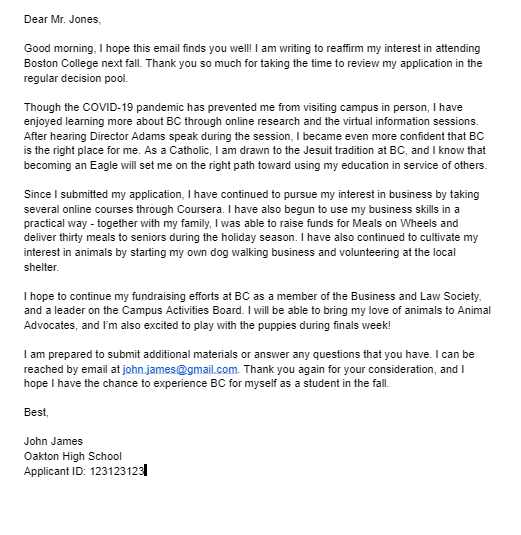
This student mentions clearly that the school is her first choice, and has some impressive accomplishments to share!

This student mentions clearly that the school is her first choice, and has some impressive accomplishments to share!

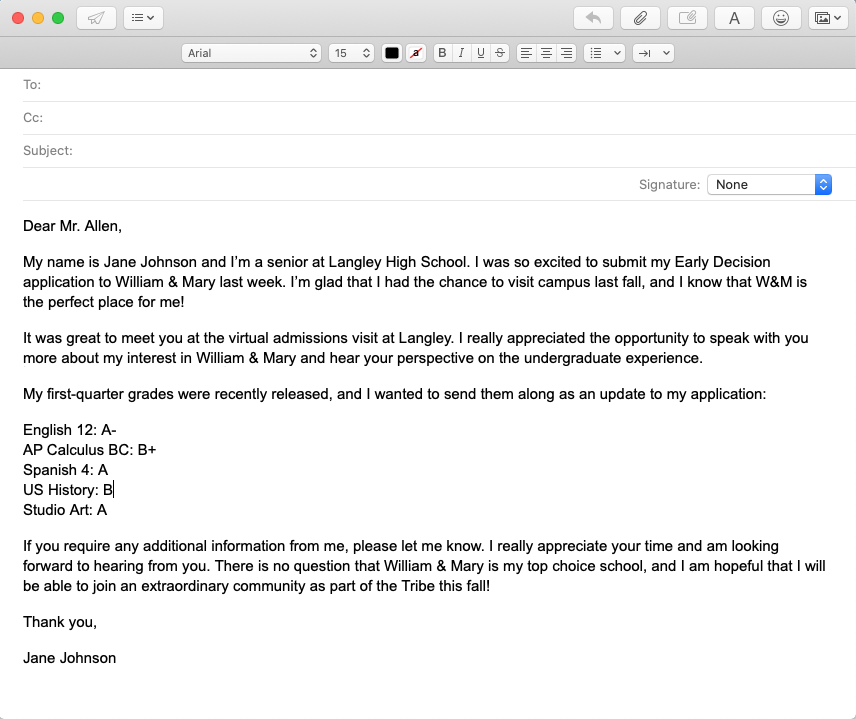
This student doesn’t mention that the school is his first choice, but still expresses his interest and updates the admissions officer on his last few months!

This student doesn’t mention that the school is his first choice, but still expresses his interest and updates the admissions officer on his last few months!

As we have also mentioned in past blog posts, if you are a student who is not working with us directly as a client, you should make sure to reach out to your school counselor about your deferral. They will be able to let you know whether or not a specific school accepts LOCIs, and they can also make a call to the school to see if there are any particular areas that you should focus on improving or emphasizing in your application. This information will help you to tailor the LOCI to a specific school. 

For our own clients, we will instruct you to contact your school counselor if appropriate, depending on the college involved (some schools will provide useful information to school counselors and others will not). Don’t forget to book a meeting with us so that we can discuss the situation and help you write your LOCIs.


Questions about LOCIs that weren’t answered in this post? Send us a message or let us know in the comments!

What To Do After Your ED Acceptance

This was a historically competitive early application cycle, so we know that not every student got the decision they wanted - if you were deferred or denied from your early decision school, read our post from two weeks ago for next steps. 

That being said, we are very proud that SO MANY of our students were admitted to their first choice schools! If you received the early decision acceptance you were hoping for, you may be busy celebrating and sharing the news, but the work isn’t over just yet. Read on for your next steps after receiving that ED acceptance!


1. Accept the Offer

This would seem to go without saying, but it is important to officially accept the offer and pay your deposit to the school. This process will look a little different for each school, but can usually be completed through your applicant portal. Make sure you take the time to re-read the decision letter carefully and make sure you are following any instructions from the school about how to confirm your acceptance. Your deposit officially holds your place in the class, so make sure to do this soon!

2. Withdraw Other Applications

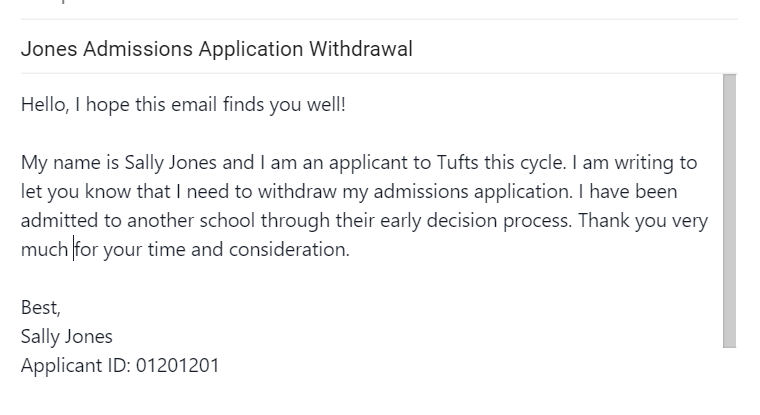
We get it - we also want to see whether our students were admitted anywhere else! But after an ED commitment, it is important that you let other schools know that you will be attending college elsewhere. Many schools will allow you to do this through your applicant portal - you just click to withdraw or cancel your application and usually fill out a short form or comment box. For those that don’t, you will need to send an email. You can send this email to the school’s main admissions address (found on their website). Here is an example:

Sample App Withdraw Email.PNG

3. Contact Your Counselor and Recommenders

If you have not already, let your school counselor know your decision. Then, make sure that you also let anyone who wrote you a letter of recommendation know that you were admitted. They have been rooting for you! This is a great time to write a thank-you note or email thanking them for their help and including your big news. 

4. Keep Up Your Grades

With the acceptance letter in hand, it is tempting to sit back and coast through the rest of senior year. But remember, your acceptance is contingent on you keeping up your academic performance! While it is okay if your grades slip a bit in one or two classes, a big drop or a drop in every class is reason for the school to be concerned, and you absolutely don’t want to end up in a difficult situation due to your senior year grades. 

5. Check Your Email

IThe school you’ve committed to is likely to continue to communicate with you by email throughout the spring. Make sure you are checking regularly for information about housing, orientation, course registration, and any other important deadlines. You may also join an admitted student group on social media to get to know other students who will be attending. 

pexels-nubia-navarro-(nubikini)-714899.jpg

6. Celebrate!

While it is important to do everything on this list, don’t forget to take some time to celebrate, share your news, and buy a school sweatshirt. You did it! Take a deep breath and get excited for the next four years!


We hope that you all are having a happy holiday season and a restful winter break!

What is a Legacy?

In the college admissions world, the word “legacy” gets thrown around a lot, and you may have heard that one kid at your school talking about how he’ll be going to Harvard because he’s a legacy - as if being a legacy gives you a secret password for admissions at a top school! 

Spoiler alert: legacy status is not a golden ticket for admission at any school. That said, the concept of “legacy” can mean very different things to different institutions, and admissions committees handle legacy applicants in different ways.

In general, know that the vast majority of schools will not consider applicants to be legacies if their connections are through extended family members (aunts and uncles, cousins, so forth). Most schools do not even extend legacy preference for siblings! While every school will consider an applicant to be a legacy if their mother or father received an undergraduate degree, that legacy status does not always mean that the student will receive any kind of preferential treatment in the admissions process.

pexels-feedyourvision-1184578.jpg

Want to know where you can get more legacy bang for your buck? Keep reading to learn more about the various types of policies that exist and examples of schools in each category.


1. Schools that only consider “primary legacy status”

These schools limit legacy preference to only those applicants with parents who graduated from the institution. It’s also important to note that elite schools will also grant more weight to a parent who attended the undergraduate school, rather than a graduate program. And the more involved a parent has been since graduation, the more likely it is for their legacy status to help out their child as an applicant.

Schools that use this definition include:

  • UVA - “A legacy student is defined by the Office of Admission as a child of a degree-holder. Step-children are also considered legacy applicants if they reside with a step-parent who has earned a UVA diploma.”

  • Stanford - “At Stanford, “legacy” applicants are defined as the children of Stanford graduates at either the undergraduate or graduate level.”

  • UNC (only for out-of state applicants) - “For non-resident children of alumni (those whose mother, father, step-father, or step-mother attended Carolina), family ties to the University may be used in our final admission decision. Please note that legacy status cannot be derived from siblings, grandparents, or other extended family. There is no formal preference for resident applicants who are children or step-children of alumni.”

  • Columbia - “Applicants are considered to be "legacies" of Columbia only if they are the children of Columbia College or Columbia Engineering graduates.”

pexels-andrea-piacquadio-3823497.jpg

2. Schools that consider children and grandchildren to be full legacies

A number of schools consider applicants to be legacies if their parents or grandparents are alumni. Make sure that you think about where your grandparents went to school, and look into whether any of the schools to which you are applying use this definition. Penn, for instance, admits around one-third of legacy applicants - more than double the overall admissions rate!

Schools that use this definition include:

  • Cornell - A legacy applicant is “a student whose parents or grandparents — or great-, or great-great, etc. — hold a degree from Cornell University.”

  • Duke - Legacy applicants are “the children and grandchildren of alumni."

  • Penn - “Legacy applicants are defined as those whose parents or grandparents graduated from any affiliated school or graduate program.”

3. Schools that extend legacy consideration to siblings of current students and alumni

Do you have an older sibling applying to college anytime soon? Pay attention to this category, because some schools sweep siblings into the definition of legacies, right along with grandparents and parents. Yes - that mean’s that your brother or sister’s college choice could give you a real leg up in the process when it comes to your own chances!

Schools that use this definition include:

  • Emory - “In the admission-review process, “legacy” status is for applicants whose immediate relatives have graduated or are currently enrolled in an academic division of Emory University. This includes grandparents, parents, and siblings.”

  • Northwestern - A legacy applicant “has a sibling, parent, or grandparent that graduated from Northwestern.”

  • Georgia Tech - “We define legacy as having a parent, sibling or grandparent who attended Tech.”

  • University of Southern California - “Those applicants with a parent, grandparent, or sibling who graduated from USC (or is currently enrolled) are considered a legacy for admission purposes.”

legacy admissions

4. Schools where legacy matters a lot

At certain schools, legacy status can make an enormous difference in your chances of admission, because of the very strong preference extended to these legacy applicants. Georgetown, for example, had a 30% admit rate for legacy students in the class of 2021 - significantly higher than the 15% overall admit rate. It’s important to note that for schools without early decision programs, legacy status can be seen as an indication of demonstrated interest - legacy students typically already have stronger emotional ties to a school, and so colleges may admit more legacies in order to increase yield overall. There is also a higher likelihood of alumni giving down the line when it comes to a candidate with a well-established family ties.

Schools that show substantial legacy preference include:

  • Baylor- 32% of the freshman class

  • Notre Dame - 22% of the freshman class

  • Georgetown - 10% of the freshman class

5. Schools where legacy does not matter at all

At the opposite end of the spectrum, some schools do not consider legacy status at all when it comes to admissions. At certain schools, your legacy status (or lack thereof) won’t make one bit of a difference when it comes to the manner in which your application is reviewed.

Schools that do not extend preferential treatment to legacy applicants include:

  • Johns Hopkins

  • MIT

  • Caltech

  • Texas A&M

  • University of California system institutions (UCLA, UC Berkeley, etc)

  • University of Georgia

6. Schools where legacy only matters if you apply early

We have always been fans of applying early decision for the strategic advantage that it gives an applicant, but for legacy applicants, this may be even more important. Some schools only consider legacy status for early round applicants. This is just one example where legacy status in and of itself will not help a student who doesn’t take advantage of other strategic choices in the admissions process. And if you are not in the middle 50% for test scores and GPA for a college, legacy status is unlikely to give you a huge boost. But that combination of legacy + ED can seal the deal for an otherwise-qualified applicant.

While many schools operate this way behind the scenes and only provide maximum legacy consideration in the early round, those who come right out and state this policy include:

  • Penn

  • Cornell

If my daughter was applying to college today and was dead set on an Ivy League school, I’d encourage her to think about ED’ing to Cornell - because of their legacy policies, she could leverage her great-grandfather’s degree with their legacy ED pref…

If my daughter was applying to college today and was dead set on an Ivy League school, I’d encourage her to think about ED’ing to Cornell - because of their legacy policies, she could leverage her great-grandfather’s degree with their legacy ED preference for a much better shot!

7. Schools that have expanded legacy status in the interest of social justice

Georgetown most notably expanded legacy status to include the descendants of enslaved people who were sold by the Jesuits who founded the school. It is not the only school who has made a similar move to make the legacy factor in college admissions more equal across race and socioeconomic status, and we may see continued shifts like this change the definition of “legacy” further as more schools reckon with systemic issues.  


Whether you are a legacy or not, having the background knowledge about how a school will view legacy status will be helpful as you make strategic decisions about college admissions!

Not the Decision You Hoped For? Read This!

The decisions began pouring in shortly after last Friday’s blog post was published, and we have absolutely loved hearing more and more good news from our students! Sending a number of kids to UVA and VT as they hoped, yay!

That said, I’m a total stress case while writing this because it’s Tuesday afternoon and we will learn a whole bunch of ED results over the next few hours: NYU, Columbia, Vanderbilt, Davidson, Swarthmore and Villanova. We have multiple ED applicants at some of those schools, so there’s a lot riding on this evening!

Even with a stellar track record, it’s hard not to feel anxious with this particularly unpredictable cycle in an always-uncertain process. As I mentioned in my last post, applications at top schools have continued to skyrocket and it’s statistically inevitable that some kids will learn disappointing news this week.

If you find yourself in that category, read on for more about deferrals, denials, and where to go from here!


1. Take a moment to process

If you were denied or deferred from your dream school, you may be feeling a lot of emotions. Whether you are disappointed, sad, angry, or some combination of the three, take a day or two to process those feelings. If it takes some time before you are ready to talk about your decision, that’s okay! Giving yourself the space you need will prepare you to tackle next steps with new energy.

2. Tell the people who need to know

You may not want to shout your denial or deferral from the rooftops - if and how you share the news is your decision. But beyond your parents, there are two people who should absolutely know this decision sooner rather than later: your school counselor and (if you are a client) ME! I will be able to share this news with the rest of our team so that we can immediately help you consider your options and give you some more information on next steps.

3. Strategize

At this point, and this is particularly the case if you are not a client of ours already and put your list together without expert help, you may need to look at your list critically to make sure that the schools you have selected are realistic. Yes, we’re up against the clock, but it’s not too late to consider how you might change your list in light of new information. The longer you wait, though, the more difficult it will be to do this. If you are a current client and want to talk more or rethink your strategy, go ahead and book a session with us immediately. If you are not a current client but want some extra help in the next round, you can book one of our emergency strategy sessions to help get you on the right track.

pexels-breakingpic-3243.jpg

4. If you were denied, let it go and move forward

It can be tempting to follow up with a school to ask questions or attempt to provide more information, but the hard truth of this process is that a “no” essentially never turns into a “yes” unless a true error was made. While there are certain situations in which asking for feedback can be useful - and we can discuss this individually with students if that is an appropriate course of action - it’s important to know that the chances of reversing a decision are extraordinarily unlikely. It would have to be a “my counselor sent the wrong student’s transcript” type of mistake for something like that to happen - not “you are missing out on the best student ever” kind of mistake! It is a more productive use of your time to let this one go and focus on your other applications. Whatever the decision, it will all work out in the long term, and this one rejection will not define your next four years.

5. If you were deferred, gather more information and make a plan

If you read our blog post from last year about turning a deferral into an acceptance, you know that the first step is to talk to your school counselor. That person will be able to reach out to the school and provide us with more information that we can use to help you come up with a plan. Your plan is going to be specific to your application and the school - some students will need to retest, others will need to work hard on making sure their grades are the best yet, and so on. The only way you will know the best path for success is by understanding the objection you’re trying to overcome.

pexels-andrea-piacquadio-3760528.jpg

6. Write your Letter of Continued Interest

Regardless of your strategy, it will likely include a Letter of Continued Interest to let the school know that they are still your top choice. Make sure to talk with us or with your school counselor about writing this letter, and if you don’t know where to begin, you can check out our blog post on LOCIs for a template.

7. Keep going!

Fatigue can definitely set in at this point - you have done the hard work of applying, you aren’t sure whether writing that LOCI will really help or whether applying to another school or two is really worth it. This is not the time to shrug it off or give up, though. You’ve come so far! Focus on your other applications and your deferral strategy, and keep pushing forward. Your hard work will pay off in the end!


Questions about defer or deny decisions that weren’t answered in this post? Send us a message or let us know in the comments!

Should I Apply to Transfer?

As we finish up work with our seniors, we have started to get busier with transfer applications in advance of the March deadlines. In this particularly tumultuous year, we’ve gotten a lot of questions about transferring during the 2020-2021 transfer admissions cycle.

Here are some considerations if you are thinking about making a switch next year:


1. COVID-19 Won’t Last Forever

This is not the first semester of college that anyone was hoping for - and it made what can already be a difficult transition even more challenging. But if you are thinking about transferring just to attend a school with a different learning model (going from virtual to hybrid, for instance), think again. Individual schools’ responses to the pandemic can change quickly, and just because a college or university was in person this semester does not mean it will stay that way. 

And if you are feeling like you haven’t quite met ‘your people’ yet, that’s okay too! Clubs, sports, and other social activities are limited, so it can be even more difficult to find your niche than it would be during a normal year. But if there are other things that you love about your school, it may be worth sticking out this challenging time and becoming more involved when campus opens up to normal operations. Remember why you chose the school in the first place!

2. Neither Will Homesickness

Even in a typical year, the first semester away from home can be tough for some students. If missing your own bedroom and a home-cooked meal is making college challenging, you are not alone. Just keep in mind that homesickness may not be solved by a change of scenery - you may be better off allowing yourself to get more comfortable with your current campus and social circle before you jump ship.

pexels-zen-chung-5538626.jpg

3. You Need Time to Prepare

This is true of every type of application, but transfers especially have a lot going on as they adjust to a new college schedule and workload. If you are thinking about applying to transfer in the spring, the time to start working is now! The holiday break is a great opportunity to spend some time becoming familiar with the transfer requirements for different schools and working on applications. If you haven’t chosen second semester classes yet, this is also a great time to see what the course and credit requirements are for the schools that interest you. And whether you’re ready to begin the transfer process now or are just starting to discover the overwhelming range of different requirements, it is a great time to book a Transfer Strategy Session.

4. ThIs Is an Especially Unpredictable Cycle

We all know by now that this is, wait for it, an unprecedented time (I hope I never hear that phrase again!). While some students are banking on the increased number of deferrals this year to give them a second shot at their dream schools, this is not necessarily going to be the case. Most of the schools we’ve heard from this cycle say that they are not making up for deferrals with transfer students - instead, they will admit the usual number of freshmen and will limit the number of transfers to keep the size of the student body consistent. Good news for our first-year applicants, but not as promising for transfers! Assume that your chance of being admitted to a school is the same or lower than in previous years, and ask yourself if you truly want to go to school elsewhere. 

pexels-rfstudio-3059745.jpg

5. Get involved

If you do decide that transferring is the right decision for you, you may feel like you want to pull away from the social life on your current campus. Resist the temptation! Now is actually the time to become even more involved. Why? Because schools are looking for someone who is going to be an asset to their community, and as a transfer student, you will be able to provide a direct comparison with how involved you are at your first school. Prove to the schools that interest you that you will be a valuable member of their community by getting involved now. 

6. Pay attention

As we’ve mentioned before, transfer applications are not at all like first-year applications, even though students can and should still apply through the Common App. Take our word for it - it’s not the Common App you grew to know well as a high school senior! Beyond the fact that the application components are completely different, transfer requirements vary substantially from school to school. If you thought it was confusing to track requirements the first time around, you haven’t seen anything yet! It’s absolutely essential to be sure that you are keeping track of all of the different pieces of the applications to set yourself up for success during this process.

Transfer Common App Snip.PNG

7. Keep it to yourself

Keep in mind that there is a chance you will return to your current campus next year, so you want to be careful not to burn any bridges before you go. While you will need to ask professors for recommendations, make it clear that it is not about any failing of your current school, but rather your desire to find a better fit for you. When it comes to friends, it is better to keep quiet about your transfer plans - otherwise, you may find that other students don’t want to invest in a friendship with someone who isn’t sticking around. Again, this is not the time to disconnect or pull away from your academics or social life - grades and involvement matter.

8. Stay out of trouble

We’ve encountered a number of situations recently where our students are facing disciplinary action for violating Covid restrictions. This will make the transfer process infinitely more difficult, so please try to abide by the rules on your campus. As a judge ruled earlier this week, you probably won’t be able to escalate the issue into the legal system if you do get into trouble!

9. Take a deep breath 

Remember to stay present in the moment and enjoy your year, whether you already have one foot out the door or are just testing the waters. For better or worse, the current academic year will represent a quarter of your time in college; you should try each day to look for the good in your experience and make the best of where you are. You never know - you may find that your school is a better fit than you thought!


Thinking of transferring this cycle, or have questions that we didn’t answer here? Comment to let us know!

Approaching the College Admissions Process with a Growth Mindset

Our team at DC College Counseling is full of current and former teachers. And as educators, it is really important to us that students do more than slog through their college applications. We want this process to be fun and exciting, and we also want to help students begin to adopt a growth mindset when faced with tasks that may seem unpleasant at first glance.

Can applying to college be frustrating and tedious? No doubt about it. But this period in time also presents a unique opportunity for students to be able to develop skills that will benefit them in college and beyond. Best of all, they don’t even have to try or focus on building those skills - it will happen authentically, a positive bonus of sorts!

By approaching each task with a positive outlook and active appreciation for the personal and academic growth that occurs during this time, the entire process will feel much more pleasant. Here are just a few of the skills with which DC College Counseling students will walk away after they’ve finished this process!


1. Writing Multiple Drafts

Those of us who have taught college freshmen know that the most common thing we hear in a first-year writing class is, “In high school, I just wrote it the night before.” This strategy just isn’t going to cut it in college! Our students get a head start on their college-level writing because they definitely go through multiple essay drafts in this process. In the course of writing a Common App or supplemental essay, students learn important writing skills like brainstorming and pre-writing, outlining, and getting content down on paper before going back and correcting for syntax and structure. We hear from so many parents that their students become better writers through this process - and that is our goal!

pexels-ivan-samkov-4458554.jpg

2. Time Management

This is why a lot of students and families come to us in the first place - the process has them feeling overwhelmed and wondering how they could possibly complete their applications by the deadlines. We step in and help kids learn strategies for making (and sticking to!) a schedule, by breaking each task down into manageable parts and ensuring that they are prepared for success each step of the way. College is a much less structured place than high school, so the ability to set aside time to make a schedule is essential for helping our students perform to the best of their abilities, long after they have submitted their applications.

3. Self-Advocacy

There is no doubt about it - self-advocacy is an essential skill to have as a college student and later in life as an adult. Our students practice it early, and with help! From writing emails to admissions offices to preparing for stellar interviews, we help students learn the most appropriate way to reach out to an adult and advocate for themselves. Students can head off to college confident in their ability to write a succinct, polite, and appropriate email to a professor to set up a meeting or ask for help in a class. And again, take it from current and former college-level instructors - this is a skill that most college freshmen need to work on! 


We love working with our students because we get to see them grow throughout the process and finish with skills that they can use far beyond application submission! To learn more about all that we do, you can book a Meet & Greet with us. 

Tips for Virtual Visits

Now that 11/1 is behind us, our focus has shifted to the Class of 2022!

The upcoming 2021-2022 admissions cycle has so many unknowns, but we’re doing our best to embrace this new normal so that our students are as minimally impacted as possible by all things Covid!

One of the major concerns we’ve heard over and over again relates to the difficulty of finding a “best fit” college without the opportunity for traditional college visits. No, it’s not ideal, but it’s not the end of the world, either.

As promised, Shannon is joining us today to share some tips about the virtual college search!


At this point, nearly every school has a variety of virtual options, whether a live guided tour with a current student or a virtual information session on YouTube (I even saw a Minecraft tour option during a meeting with a student this week!). But when opportunities to travel are limited, it can be even more challenging to get a feel for each school on your list, because the official representatives from the admissions office can only tell you so much about the feeling on campus. Eventually, you want to find out for yourself! Here are a few tips to make the most out of virtual visits and find your best fit.

1. Meet with current students

Talking with students at a school you’re considering may be the most important action you can take to gain a better understanding of the community. If you choose to apply to this school, there is a chance that these people will be your classmates, teammates, and roommates, and talking with them can give you a real sense for the culture on campus. Reach out to the admissions office and see if they can put you in touch with students for a one-on-one Zoom call or FaceTime, or connect you with young alumni in your area for a physically-distanced walk or coffee.  

The Princeton Review has a good list of general questions for current students, but when you can’t get to campus, you can focus your questions on the physical aspects of the school: Do students stick around campus, or go into town on the weekends? When you walk through campus, do you see students studying or playing games on the quad? Where do you go when you’re tired of dining hall food? If close proximity to a Starbucks or a community park is important to you, ask!  

pexels-andrea-piacquadio-3762940.jpg

2. Use social media

Sure, you’ve been following your dream school’s official Twitter account throughout the process, but social media is a great place to find more informal information as well, which can give you deeper insight into the college or university. Look for Instagram, YouTube, or TikTok accounts run by teams or student groups, and see if there is an admitted students Facebook group that you can join. These resources will let you have the kind of casual conversations that you might have during a run-in at the dining hall, virtually. 

And remember that if you do choose to use social media during your college search, make sure that your own page is cleaned up! Interacting with a school on social media is a great way to demonstrate interest, especially virtually, but make sure that there is nothing on your page you wouldn’t want to share with the admissions office. On the other hand, don’t go over the top in the opposite direction either. It will be very obvious (and will appear inauthentic) if you try to create a fake profile to impress college admissions officers.

3. Take notes and dig deep

As you learn more about different institutions through virtual visit days, conversations with students, and social media, jot down your impressions. When every school visit takes place on Zoom, it is even easier for different schools to blend together, so you want to have notes to review once you’ve finished your research.  

Write down not only important facts about academic programs, but also your feelings and reactions to each school. It is good to know if a school will accept AP or IB credits, but it is also easy to double-check online. Instead, think about how your conversations with students, faculty and staff made you feel, or how excited you were to see a busy campus coffee shop on the virtual tour. It’s vital to write down those emotional reactions when you may not be able to experience the “feels like home” sentiment in person.

We ask all of our students to make a list of six new things they learned about each school during their virtual visit - three positive and three negative. This helps them and us begin to gain a sense of what they are seeking in a college, and we can take that information and use it to make recommendations and tailor the list. Sometimes they end up being surprised by their reactions! Remember, you don’t know what you don’t know. If you are feeling overwhelmed by the search process - so many schools to consider! - book a Meet & Greet with us to learn more about how we can help. 

Election Day Blog: Schools for Politically-Minded Students

Living in the DC area, we don’t have to look far to find colleges that offer exciting opportunities for politically-minded students. We all know that American, GW, and Georgetown offer great programs for the future politicians among us - and you can’t beat the exposure to the DC political scene (in both good and bad ways!).

Today, though, we want to spotlight a few others that may have fallen under your radar!


Hillsdale College

Hillsdale hosted Secretary of Education Betsy DeVos just last week, and has also had visits from prominent speakers like Attorney General Barr. Hillsdale is a nonsectarian Christian institution, and according to its mission statement, “considers itself a trustee of our Western philosophical and theological inheritance tracing to Athens and Jerusalem, a heritage finding its clearest expression in the American experiment of self-government under law.” One of the only colleges in the country that does not accept any form of state or federal aid, Hillsdale is very appealing for ultra-conservative students with an interest in politics. The interdisciplinary Political Economy major combines economics, politics, and history, and students of all majors report positive experiences participating in WHIP, the Washington-Hillsdale Internship Program based at the school’s D.C. campus.

Claremont Colleges

The Claremont Colleges include Claremont McKenna, Pitzer, Pomona, Scripps, and Harvey Mudd. The Consortium offers several unique programs for students interested in politics through a more philosophical lens, including majors in Philosophy, Politics, and Economics (PPE), and well as Philosophy and Public Affairs (PPA). The PPE major uses the Oxford tutorial style to provide students with the opportunity to learn in small group discussions and seminars. Students can apply for this highly selective major in their sophomore year.  For students interested in current political issues, the interdisciplinary Environment, Economics, and Politics major prepares them for a career in many environmental fields. While activism is popular at all of the Claremont Colleges, Pitzer stands out in particular, with core values including Social Responsibility and Student Engagement. Graduation requirements at Pitzer even include coursework in Social Justice Theory and Social Responsibility! All Consortium students can take advantage of the many resources at Pitzer’s Community Engagement Center, including funding to support individual projects.

Syracuse University

Syracuse made international headlines several years ago after student protests led the university to remove fossil fuel stocks from its endowment several years back, and the administration has continued to demonstrated its commitment to student activism by establishing a dedicated Student Activism Engagement Team. More recently, the university sponsored dozens of informational sessions and conversations about voting for students in the lead-up to the election. Academically, they also offer a Citizenship and Civic Engagement (CCE) program, in which students combine the CCE major with a second, related major of their choice and finish their senior year by creating a workable Action Plan around a social issue. Environmentally-minded students may choose to combine CCE with a major in Environment, Sustainability, and Policy. Both majors are housed in Syracuse’s Maxwell School of Citizenship and Public Affairs. Maxwell is also home to nine different research centers, where interested undergraduates can complete research on a variety of political topics. However, students from a variety of different majors can take advantage of the DC campus and all of its offerings!

pexels-cottonbro-4669109.jpg

Texas Christian University

TCU’s Political Science department offers a variety of opportunities for students to learn outside of the classroom, including an internship program in Washington, D.C. and the ability to participate in Model United Nations and Moot Court. Whether students pursue the BA Program in Comparative Race and Ethnic Studies or the signature TCU Justice Journey program that actually takes students on a bus tour to sites that were significant in the civil rights movement, there is no question that the Interdisciplinary Department of Comparative Race and Ethnic Studies provides opportunities that cannot be found at other schools. TCU is also home to a number of politically active student groups, including chapters of the College Republicans and College Democrats. The Community Engagement Programming division works hard to keeps students active, and has even pivoted to sharing virtual engagement opportunities during Covid!

Washington University St. Louis

Wash U in St. Louis has always been known for its politically active campus community. The university has hosted four presidential debates (and one VP debate!) through which students were able to volunteer and gain real-world experience behind the scenes of a presidential election. The school also offers a unique “religion and politics” minor that offers the chance to delve deeper into niche issues. Another appealing option can be found in the distinctive, in-depth civil engagement leadership training program for juniors and seniors called the Civic Scholars Program. Lastly, future artists might enjoy the Civic and Community Arts Residency initiative, which offers the option for undergrads to blend an interest in civic engagement with a passion for arts. 

Hampden-Sydney College

Located right here in Virginia, Hampden-Sydney is the country’s oldest traditional all-male college and one of the most conservative schools in the country. The Government and Foreign Affairs department at Hampden-Sydney offers two distinctive minors through the Wilson Center for Leadership: National Security Studies and Leadership in the Public Interest. Hampden-Sydney is also home to the Center for the Study of Political Economy, a co-curricular center that sponsors lecture series and reading groups. The Center’s mission is “to motivate undergraduate students to create a more just and prosperous world through entrepreneurship and scholarship in classical liberal political economy.”

Columbia University

Columbia has always had a well-known reputation for political activism on campus, including the Butler Banner Project in recent years. While the majority of students are liberal, the school also has a large conservative population and a diversity of political thought on campus. Students can publish political commentary in two journals, The Columbia Political Review and The Current. The World Leaders Forum allows students to hear from political leaders all over the world, and undergrads can join a wide variety of political organizations on campus. The dedicated Task Force on Inclusion and Belonging proactively identifies issues and solutions, including the Campus Conversations intiative that encourages students to engage in dialogue. Columbia has graduated three Presidents, eight Attorneys General, and ten Supreme Court Justices, as well as numerous other political actors in recent years, and hosts many notable speakers in its political speaker series. 

Colleen Ganjian


Remember to get out and vote today!

I was pleasantly surprised at the non-existent lines after hearing so many cautionary warnings!

If you’re already thinking about tonight’s dinner-table discussion, I really liked this piece from NPR for parents of teenagers and younger children alike!

Post-Submission Emails and Grade Updates

We are so excited to be nearly DONE with submitting all of our early applications! But as our clients know by now, the work does not stop when you click “submit!” Not only is the post-submission portal tracking extremely important, as we have mentioned before, but some students may also want to consider sending follow-up communication to the various admissions representatives to share first quarter grade updates.

Let me start by mentioning that this is not a one-size fits all approach. Some schools specifically indicate that they do not want follow-up emails with grades. If that’s the case, don’t send them! While schools that track demonstrated interest are generally the ones to whom these emails should be directed, it’s important to note that there’s a fine line between an enthusiastic update and over-the-top bombarding.

We do not recommend sending repeated emails. Down the line in a deferral or waitlist situation, depending on the school - possibly. But definitely not at this point in the admissions cycle. You do not want to annoy anyone, and repeated emails will be annoying - no two ways about it.

With that warning out of the way, we suggest that if you do have new grades to report that reflect positively on your candidacy, you take the initiative to reach out to the admissions office and let your assigned admissions officer know. A handful of high schools will send out first-quarter grades as a matter of course, but most will not do so unless asked - especially this year, when school counselors are already overburdened. So if you believe your first-quarter grades will improve your application, it is up to you to take on the responsibility of sharing them with the admissions office!

scott-graham-5fNmWej4tAA-unsplash.jpg

One more note of caution: while I would not recommend proactively sharing poor first-quarter grades, it’s also important to recognize that it’s not necessarily possible to hide them, either. I think that many applicants believe that admissions offices are too busy to follow up on particular aspects of a single application - but this is not necessarily the case! For a student who has had a shaky math score in 11th grade, the admissions officer is definitely going to want to see how that student is doing in math at the beginning of 12th grade. 

So, now that you know why to send a post-submission email, here’s how:

  1. If you can, address your email to your regional admissions officer. At many schools, you can find this information on the website with just a bit of research. Your email is more likely to be read by the right person if you address it directly. You can also ask your school counselor if you’re not sure.

  2. Identify yourself by name and indicate that you have applied to the school already.

  3. Show that you have done your homework. This is a place to address any questions that you have that were not answered by the school’s website. You can also ask if the representative is planning a virtual visit to your school this semester, or reference a previous visit if you have met them before. 

  4. Report your grades. Tell the admissions officer that you want to update your application with your first-quarter grades, and provide them in a clear way that is easy to read. 

  5. Close your email by thanking the admissions officer for their time and reiterating your interest in attending their school. If this is your top-choice school, make sure to let them know!

Remember: keep it concise and simple. Here is a sample:

Screen Shot 2020-10-28 at 10.45.26 AM.png

Congratulations to all of the students who have submitted their remaining early applications this week! Comment to let us know if you will be following up with your first-quarter grades! 

Should I Apply Early?

We have been so busy that it feels like the admissions cycle is flying by, and early deadlines are right around the corner. While some schools had their deadlines as early as October 15, the big date to watch out for is November 1, and we have been submitting applications with our students all week long.

For us, it is really important that applications are submitted well before the deadlines to give students peace of mind and to make sure that there is plenty of time to deal with any last-minute requirements, especially this cycle when schools are adding them left and right! We actually prefer to submit in late August or early September, but this year presented challenges upon challenges upon challenges relating to standardized testing delays.

Our original cohort or seniors finished up a little while ago and many of our late start seniors are done too! However, we’re still hearing from a lot of panicked senior parents whose students haven’t really started the process in earnest yet. They almost always reach out with the same first question:

How important are early applications?

Families who feel rushed by the November deadline start to wonder if it would be better to apply early at all costs, or to spend some more time on the application and submit a polished product by the regular decision deadline.

If you are a bit on the late side and find yourself asking these same questions too, read on for some considerations.


1. Know that applying early decision - yes, the binding one - does have a measurable strategic impact. This is especially the case during the current admissions cycle.

Understanding the reason for the advantage might help you decide whether ED is right for you. Colleges are concerned about a factor called yield, or the percentage of accepted students that enroll. Since ED forces students to accept admissions offers, colleges favor ED applicants because the large number of students bound to attend will inflate their yield numbers. This, in turn, will improve the institutions’ reputations and boost their rankings. Slick, right?

Early decision can provide a major competitive advantage in the application process in exchange for the binding commitment; however, applying ED only really increases your chances of acceptance at schools where you are “admissible.” You can get away with having qualifications that are slightly below-average for that school, but you can’t be much further off than that. 

If you’re in the sweet spot, though? You’re golden. In some cases, early decision applicants are two or three times as likely to be admitted than a regular decision applicant. As we’ve said before, these factors present a strong case for applying in the early decision pool.

pexels-energepiccom-313690.jpg

Some students are initially scared off by the so-called “binding commitment,” but you will make a binding commitment to any school when you choose to attend. Early decision is simply a case of making that commitment sooner rather than later, so you can spend the rest of your senior year focused on school, extracurriculars, and planning your dorm room décor. 

And yes - you’ve heard all of this from us before. But this year, early decision may have an even greater impact for applicants. Colleges are all dealing with new uncertainties due to the pandemic, and the certainty that an applicant will attend if admitted is extremely valuable to institutions concerned about enrollment. 

So if you’re on the fence between submitting an early decision application vs. regular decision application to your top choice school, it’s worth putting your social life on hold for a little bit to maximize the rest of October.

2. Early action requires some more thought.

The truth is that it’s very school dependent, and we can see an example of the different institutional approaches right here in Virginia with our state universities! At UVa, there is no question that applicants are better off waiting to apply in the regular decision round if they will be more qualified at that point. So if you’re on the fence between an EA or RD app at UVa but could an extra few weeks or months to perfect your essays, RD is a no-brainer.

At Virginia Tech, however, that’s not the case at all. In fact, VT encourages all students to apply early decision or early action, and clearly states on their website that regular decision “will have less open spots available” because of the “large population” of EA applicants.

Make sure to do your research and know which kind of school you’re dealing with while making this decision. And if you aren’t sure? Pick up the phone and call the admissions office to ask! You don’t even have to give your name.

3. Be strategic (and realistic!) about your plans to improve your test scores and grades.

In previous years there may have been a case for holding off on an early application for a student who was hoping to retake a standardized test and submit a higher score, or a student who expected that their GPA from the first semester of senior year would elevate their overall transcript. 

This year, though, that gamble is very different. As our friends over at McLean High School are learning the hard way, there is no guarantee that students will even be able to retest as planned. Even if testing occurs smoothly, you can’t bank on a markedly higher score without a markedly higher level of commitment to test preparation.

We are also seeing that students have reported more challenges with virtual learning this year in terms of course difficulty. Last spring’s “Easy As” are no longer happening at most schools. And BC Calc over Zoom is a challenge!

4. Traditional campus visits may simply not be possible this cycle.

Yes, we know it is difficult to tell if you are willing to commit to a school without the chance to visit campus. But will this really improve in the short term? While we wouldn’t necessarily recommend a binding application to a school far away in a city with which you are completely unfamiliar, a few more months in the middle of cold and flu season isn’t going to open up too many doors for you in terms of campus visits. It might be time to accept that your postponed April 2020 spring break college tour is not going to happen anytime soon after all.

pexels-andrea-piacquadio-3755760.jpg

Did you visit the campus a few years ago, but remember that you had a good feeling about it? Do you have friends or family in the city who could drive over and walk around for you and share their feedback? Can you take a virtual tour of the campus and the surrounding area? Keep an eye out for our future blog post about how to get to know a campus virtually - it is not impossible! 

5. There’s rushing and then there’s rushing. Make sure you can still realistically put together a strong application.

So you’re convinced that an early application may be the right choice for you. This doesn’t mean that you should scramble to put together your application the day before the deadline. It does mean, however, that the hard work begins NOW!

If you have already filled out the Common Application and made some progress on your main essay, you want to focus on your supplemental essays and make sure you have a chance to ask your parents and school counselor for edits before you submit.

Reviewing Staci’s post-meeting essays at the Galleria on Black Friday 2019!

Reviewing Staci’s post-meeting essays at the Galleria on Black Friday 2019!

A sloppy, rushed application with noticeable errors or missing components will not help you get into the school of your dreams, and there’s a big difference between starting a week in advance vs. starting a night in advance. If you do not have time to focus on your application over the course of the next two weeks, this is a case where it is best to wait and apply before the regular decision deadline. 

If you do bypass the early deadlines and want some guidance on getting your application in “17-year-old perfect” shape by December, I heard a rumor that one of our favorite essay coaches is willing to pitch in again over Thanksgiving week if needed!

Go ahead and book a Meet & Greet now to learn about how we can help!

Should I Apply To Graduate School?

While most of our blog readers are interested in assistance with undergraduate admissions to a four-year college, we also work with younger students applying to private high schools and older students/young professionals who are interested in a graduate degree.

In a typical application cycle we will generally work with four types of graduate school applicants:

Not surprisingly, interest in our graduate school admissions consulting has risen substantially this year given the economy and increased competition, but sometimes the hardest decision is whether to pursue the degree now or wait a few years. It’s not like applying to college, where an undergraduate education is the obvious next step for a high school student.

Keep reading to learn more about whether graduate school is the right choice - and if you decide that you might need more targeted guidance, book a Graduate School Strategy Session!


1. Why now?

As previously mentioned, applications to graduate and professional schools are on the rise this cycle. This is often the case during an economic downturn, when students and professionals turn to continued education to combat layoffs or pivot to a new career. There will also be more deferrals in next cycle’s class, as some students chose not to pursue remote learning this fall. 

The big caveat here is that just because there are more graduate school applications, that doesn’t mean that they are better. Applicants who are just looking for a place to wait out the pandemic will have rushed applications that don’t clearly articulate why they want to attend graduate school. 

So, think about why you are applying to graduate school now. Is this a dream of yours, and a good time in your career to make a change? Have you thought through your reasons clearly, and worked with a consultant or trusted mentor to articulate your ambitions? Great! Your application is going to stand out. Are you applying to graduate school simply because you don’t know what else to do? Skip this cycle, and focus on defining your goals. 

This matrix helps to condense some of our advice about applying to graduate or professional schools this cycle. As you can see, a lot depends on your industry and the progress of the COVID-19 pandemic.

This matrix helps to condense some of our advice about applying to graduate or professional schools this cycle. As you can see, a lot depends on your industry and the progress of the COVID-19 pandemic.

2. Where am I heading?

If you weren’t scared off by #1, you probably have some idea of why you want a graduate degree. Having clear goals, whether for a business proposal or an academic manuscript, is essential to forming a successful graduate school application. Don’t lose sight of your goals, but do think critically about how you can best serve them. 

If you are on a career path that excites you, and you still have room for upward mobility during COVID, you may choose to stay at a well-paying job and gain experience that will strengthen your application in the future. This is particularly true for younger applicants, who need more time to develop career experience. If the pandemic limits your upward mobility or your ability to pivot to a new career, graduate school may be your best option for progressing toward your goals. 

If you’ve decided that applying is the right path for you, keep reading, and keep those goals in mind!

3. Articulate your story.

For most postgraduate degrees (with the exception of many law schools), you will be asked to write a statement of purpose that discusses your experience and future plans. You should use this opportunity to tell a cohesive story about yourself. Make sure that you demonstrate how your previous experience in school, extracurricular activities, and any work experience you have align with your future goals, and include specific information from your research about how the program you are choosing will help you achieve those goals. 

At this point in your academic and professional career, schools do not want to hear about how you will be able to explore a lot of different topics. They want to know that you are focused on your next steps, and you’ve thought about exactly how their school will help you get there.

pexels-markus-winkler-4052198.jpg

4. Polish your resume.

At this point in your career, you probably have a resume that you’ve used before, either for college applications or for the job or internship search. But that resume is likely not going to help you apply to graduate school. Specific programs are going to want to see very different things - a business school resume should look very different from the resume for a Ph.D. program. We help our clients tailor their resumes directly to their programs, but even on your own, make sure you highlight the skills and experience that will be most relevant to your desired program. Also, familiarize yourself with the conventions of resumes in your field. Are they usually a page, or can they be longer? How are they ordered? What type of aesthetic is most common? 

5. Find your best fit (but keep rankings in mind!)

There are plenty of issues with U.S. News rankings for undergraduate institutions, and my general advice is to explore a college based on best fit, not based on rankings. This is true for graduate schools as well - but only to a point. You absolutely should not attend a school that will make you miserable just for a higher ranking. But particularly for graduate and professional schools, rankings can mean a lot. 

BUT - another caveat! - it’s important to pay attention to the fact that exceptional programs in individual fields of study can outweigh an institution’s overall ranking. For example, UT Austin and Duke are (just) outside of the top-ten ranked MBA programs. But if you’re interested in oil and gas, UT Austin might be the best possible choice - far better than even the #1 ranked program. Same would go for Duke if you have an interest in energy or the environment. Do your research to see which schools are most highly regarded in your area of interest, so you can apply to the best possible programs for you.

All this to say, don’t settle for a school that isn’t the right fit. You can always reapply with more work experience, or with help from us! 

pexels-polina-zimmerman-3782144.jpg

There are a TON of variables when it comes to a graduate school application, but that is part of why we enjoy the process. And from a selfish perspective - it is so much fun to reconnect with former students. Last night I got to meet with one of my all-time favorite “kids” (he is definitely not a kid anymore) who I hadn’t seen since probably 2014 or 2015 - it all blends together. So rewarding!!

Have topics or questions that you’d like to see us address in a future blog post? Comment and let us know!