Special Topics

Introducing: Our Pro Bono Program!

A few weeks ago, we announced our pro bono program in partnership with the Fieldstone Foundation. We are so excited to be able to serve more students through this program, and we wanted to take some time today to tell you more about our new project and answer your questions!


What is the Pro Bono program?

As you know if you are a client or regular reader of the blog, we at DC College Counseling specialize in helping students who need one-on-one assistance with the college process. However, there are many students out there who need some extra support, but don’t have the ability to pay. While we love helping students, we know that there are ongoing issues of equity in educational consulting and in the college process as a whole. We are so excited to be able to help in a small way by providing one-on-one college counseling services to economically disadvantaged students, completely free of charge for the student and family!

What is the Fieldstone Foundation?

The reason that we are able to make this happen! One of our favorite clients and an active FCPS parent, Heather Hawa, founded the Fieldstone Foundation and is providing generous support that will allow us to do this work without passing on any of the costs to the student. In Heather’s own words: 

“I AM SO INSPIRED BY THE SERVICES DC COLLEGE COUNSELING HAS PROVIDED MY FAMILY. I AM A FIRST GENERATION COLLEGE GRAD SO I APPRECIATE THE VALUE OF A COLLEGE DEGREE. I WANT TO MAKE THE SAME SUCCESS POSSIBLE FOR THE NEXT GENERATION OF COLLEGE STUDENTS.”

Who is eligible?

Students who are enrolled in grades 10, 11, or 12 for the 2021-2022 academic year who reside in Fairfax County and receive free or reduced price lunch at school are eligible to apply. 

We hope that students who are interested in this program are eager to maximize their application strategy and demonstrate their commitment and desire to succeed in the college process and beyond.

How are students selected for the program?

Students interested in the pro bono program can fill out our application. If we receive more applications from students than we have spots in the program, we’ll evaluate them based on their essays, passion, and determination when it comes to being successful in the college process. 

We will review applications on a rolling basis, so apply as soon as possible! In order to ensure that we can provide dedicated time and assistance to each student, we will not accept applications once all slots are filled.

Are pro bono students treated differently from full-pay students?

No! While pro Bono students will have a different package that provides a more standardized set of services and meetings, they will receive access to all of the resources that we use with our full-pay students. These include a customized college plan through College Kickstart, a paid subscription to the Wow Writing Workshop college essay curriculum, access to weekly drop-in hours for ongoing assistance, and reminders and support to keep track of tasks and provide accountability, as well as strategy sessions and meetings with our essay coaches. 

If there are any needs that we are not able to meet, we can provide recommendations and referrals to other resources, such as College Access Fairfax.

What can I do to help?

Spread the word! We are currently accepting applications for our first class of pro bono students, so if you know anyone who may be interested (or want to pass on the opportunity to your own school counselor), please let them know and send them to our website: http://www.dccollegecounseling.com/probono.

How can I learn more about the program?

If you can’t find the information that you need on our website or in this post, email Shannon or give us a call at (703) 66-ADMIT ((703) 662-3648).
Tips for Organizing Your College Applications (and a Cautionary Tale!)

Our students are starting to submit their applications - yay! Unfortunately, the process doesn’t end just because they click “review and submit.” In many ways, that’s when they really need to start paying attention to details!

Each school has different requirements for applications (recommendations, test scores, transcripts, etc.) and will keep track of those requirements in different ways, in different status portals, with different login information and passwords… you get the idea.

It is incredibly important for every applicant to make sure that they find a way to keep their application components organized. Otherwise, you could have a nightmare scenario (stay tuned) where an admissions committee is unable to review your application because you’re missing important documents and aren’t aware of the problem in time to fix it.

We already do this with all of our clients as part of our regular service offerings. No missing materials on our watch, that’s for sure! But if you are a non-client blog reader, you will need to find a way to monitor components that works for you. Here are some of our favorite ways to keep track of all the elements you need:


Asana

In our office, we use Asana to keep track of all our students’ applications. The best way I can describe it is that it’s similar to an electronic version of a list, with a lot of really cool functions like reminders, messaging, project-sharing and more.

If you like lists and you appreciate efficiency, it’s hard not to fall in love like I did. While we have a version of Asana that is meant for businesses, they also offer a free version that can work well for keeping track of personal tasks too! This is the one I make the other members of my household use so that we can link our accounts and collaborate together :)

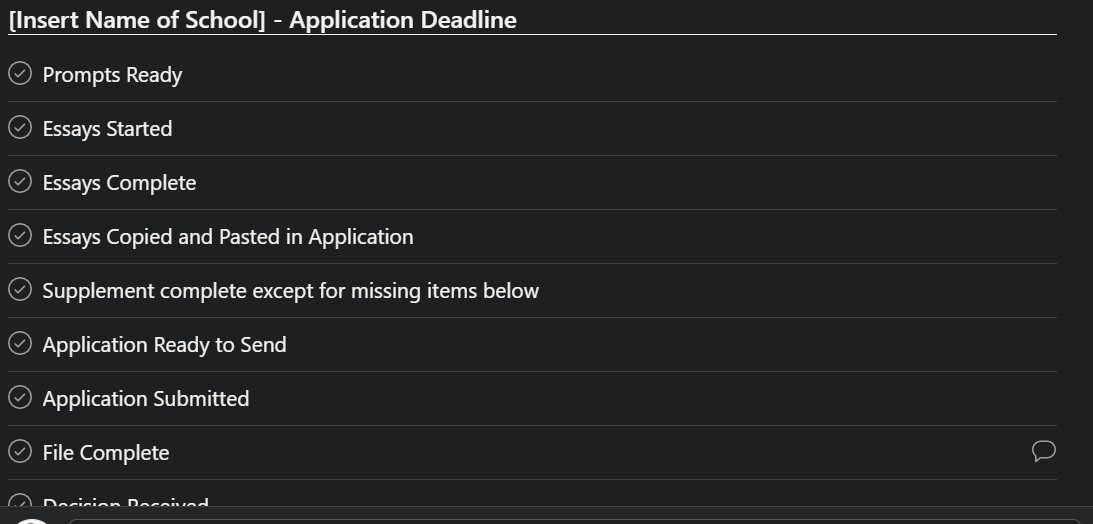
Here is an example of a status chart for one of our students in Asana: 

asana status chart snip for blog.PNG

But once students apply, we’re keeping track of different materials, to ensure that their file is complete:

status portal info status chart snip for blog.PNG

Note that any form of organization that you use should contain this basic information: how you access the status portal, your login information, the materials the college has already received, and the materials that are currently missing as of given dates. We also like Asana because there is an app with push notifications, so our students can keep track of everything on their phones!

Trello

Trello is another service with a free level that can help students to keep everything organized, and it has an app too. We actually used Trello in our office for one admissions cycle back when we caught the project management bug and hadn’t discovered Asana yet. While we like Asana better, we still appreciate Trello, and it’s particularly great for people who are more visual and like a high-level overview without seeing all of the details.

The nice thing about these online services is that the student, parents, and anyone else helping with the application can all access the information and mark things off in real time. That way, parents don’t have to worry that the spreadsheet they have is no longer up to date, and students will know any changes parents make to the application. You can opt in for notifications every time someone else makes a change, too.

Trello uses kanban boards to help the user sort components into different categories:

trello board snip for blog.PNG

You can also add checklists to individual tasks within a board, which helps to break some of the big tasks down into their smaller parts (and make sure you don’t forget anything!):

trello checklist snip for blog.PNG

Google Sheets

You can also use free software like Google Sheets (or something similar, such as an Excel spreadsheet), which is perhaps not quite as fun but will get the job done. This type of system is probably best for a student who doesn’t need a lot of reminders, as it is much harder to set up automatic notifications in this system than in some of the others we mentioned. Or for parents who aren’t comfortable with learning new technology and like to keep things old-school.

The reason we prefer Google Sheets to Excel is that the file lives on a cloud. This makes it easy to share with parents and anyone else that needs to be able to keep track of applications in real time, and it’s also easy for students to update at any time without needing to be at their personal computer.

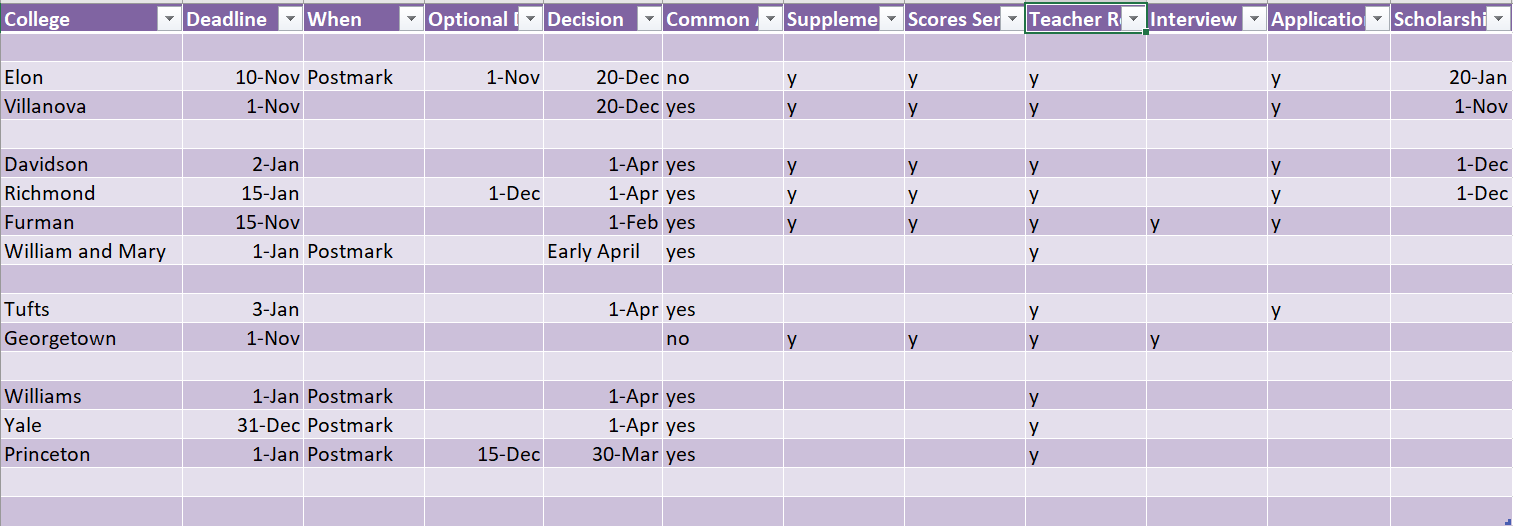
No, it’s not as pretty, but it’s functional:

P.S. - this is Shannon’s actual application spreadsheet from when she was applying to college! She’s learned a few new tools since then, but still stays just as organized :)

P.S. - this is Shannon’s actual application spreadsheet from when she was applying to college! She’s learned a few new tools since then, but still stays just as organized :)


If you’re not bought in yet, I’ll leave you with a true story that resulted in a major change for us here at DC College Counseling:

Long ago, we let families decide how involved they’d like us to be after application submission.

Many decided that they didn’t need professional help at this point and opted to take care of tracking components themselves with varying degrees of success (although a lot of times we’d hear back a few weeks later asking for our help after all!).

One winter morning, I woke up to a panicked email from one of my favorite students who had repeatedly assured us he had taken care of all the tracking.

Great kid, super smart, Mr. Personality - he was really a lot of fun to work with. For all of his positive qualities, he was not so amazing at checking email or just following through on tasks in general. Not to stereotype, but I am sure we all know a number of young men who would fit in this category :)

But this student was very confused because he did not receive an admissions decision from one of his top schools on their decision release date the way his peers did. Weird, right?

Several months earlier, he had asked his mom to send his ACT scores to all of his schools, and so she did. She forgot that one of his schools required the ACT with Writing (at the time - not anymore). Unfortunately, she did not send his ACT with Writing score - she sent a different score from an administration without the writing component.

This was such an easy mistake to make. Anyone could have done this, and the mistake itself was not the issue. The issue was the fact that we were not aware of the mistake.

The school emailed him a few reminders to set up and monitor his post-application status portal, but he missed the emails. Most schools don’t even send email reminders, by the way. They just expect that students are taking care of post-submission tracking on their own.

As soon as I got involved and learned that he’d never set up his portal, I knew that his lack of decision notification wasn’t because the mailman was late that day, and that we were likely not going to be happy with the outcome. I helped him find the emails and set up portal access.

We immediately discovered that the Portal showed he had not fulfilled the test score submission requirement, so his application remained incomplete for months, and they ultimately withdrew him from consideration without his knowledge.

This would have literally taken all of five minutes to fix if we had known about it when it occurred. But we just never knew! So all of his hard work - three supplemental essays, a visit there, that extraordinarily time-consuming business school portfolio (if you know, you know!).. it was all for nothing. We are talking about 10+ hours of work literally thrown away. The school never even read the application.

At that point, I decided that we were going to start keeping track of application components whether our families believe they need our help or not!

It all goes back to one of my favorite sayings, “if you don’t know, you don’t know,” and many people just don’t understand what a big deal application component tracking is. I feel a professional responsibility to make sure things like this don’t happen on my watch!

We then modified our packages to include specific hours dedicated to administrative work, including those ever-popular ongoing reminders from Donna as well as the application status tracking this post explains. These are the same packages we have today.

And because we have access to every single portal, nothing like this could ever happen again, and it never has, despite the process becoming so much more complicated all these years later.


Moral of the story? Whether you go with Asana, Trello, Google Sheets or something else entirely, the important thing is that you have all of the information you need in one place both during the application process and well after submission.

Moreover, you need to monitor your portal carefully until all materials are accounted for and the application file is considered complete. Only then can you breathe a sign of relief and put everything aside until decision day!

Want more about the ins and outs of applications? Check out these posts!

Interview Series 3 - Make a Good Impression

If you’ve read our previous interview series posts, you’ve signed up for the interview and prepared some questions to ask your interviewer. Now the day is here, and while you know you’ve got the content prepared, you’re worried about making an impression. Well, you’ve come to the right place! Read on for our tips to put your best foot forward during your interview - before you even say a word.

pexels-sora-shimazaki-5668859.jpg

Lay out your outfit the night before.

Choosing what to wear (and making sure it’s clean!) the day before your interview will eliminate a lot of stress for you in the morning. Sometimes, the school will provide guidelines about attire in your interview invitation or confirmation email, so make sure to read those carefully. If you’re still not sure, err on the side of dressing more formally: a shirt and jacket for boys and a nice blouse and skirt or slacks for girls are usually appropriate! Business casual should be your default, even in a more informal informational interview - remember, every time you interact with the admissions office, you’re making an impression. 

(Note - If you’re wondering what to wear for a campus visit that does NOT involve an interview, check out our blog post on the subject here).

Avoid fidgeting!

Especially when you’re nervous, it’s natural to get a bit fidgety. You might not even notice you’re doing it! So eliminating anything that you’re tempted to play with is a good idea. That means avoiding necklaces, bracelets, watches, or earrings that you’ll be tempted to toy with, and even pinning or slicking back the front of your hair so that you don’t feel the need to push it out of your face. And if you are interviewing on Zoom, avoid sitting in an office chair that spins - that spinning will be very tempting during the interview!

Pay attention to your introduction.

Some research shows that it takes as little as a tenth of a second for someone to make an impression of who you are - so it definitely doesn’t hurt to make sure those first few seconds of the interview leave a positive impression on the interviewer. When you meet them, introduce yourself warmly, smile, and make eye contact. If you need to wait for the interviewer in a waiting room or Zoom room, sit and look around or read brochures about the school if they are provided - you don’t want the interviewer to walk in/log on and see you looking at your phone.

evan-wise-eJ0UGX8da2c-unsplash.jpg

Arriving ten minutes early is a great way to calm your nerves. You could even find a private place to take some deep breaths or even strike a power pose, and walk into the interview feeling confident. 

But don’t arrive too early - when I worked in admissions, it would always drive me a little crazy when kids showed up 30-60+ minutes in advance - and a huge number actually did this. I’m sure they thought that showing up earlier would make them look better, but this was not the case at all.

Instead, I would feel unspoken pressure in these situations to start before our scheduled time if I wasn’t in a different meeting. This would in turn disrupt my schedule and often meant that I had to cut my lunch short! And you don’t want your interviewer to start off the interview annoyed and hungry, trust me :)


Interviews can be nerve-wracking, but this is really an exciting opportunity - you get to show the admissions office who you are and help them put a face and a personality to the words on your application! You are meeting with someone who wants you to be successful, because that’s how they’ll get to know you better.

Follow these tips and walk into the interview with confidence, and you’ll be ready for a valuable conversation! If you need more help, though, you can always book an interview preparation session to work on these tips with one of our coaches. 

Want more about essays and interviews? Check out these posts!

Meet Sarah!

Our newest essay coach, Sarah, is guest blogging with an introduction today!

Many of you have already met her in essay coaching meetings, and we hope this post helps you get to know her a little better.

Photo.jpg

Hi, everyone! My name is Sarah Zentner and I am so excited to be joining the DC College Counseling team as a new essay coach.  

My own common app essay consisted of the life lessons I’d learned from the scraps that I was always appalled to find under the lunch tables in first grade -- and while it has yet to be required reading for any college philosophy class (I’m still holding out hope!), it was a blast to write. 

With that essay, I applied to a number of small (primarily West Coast) liberal arts colleges and ultimately decided on the University of San Diego. Only a six hour drive down I-15 from my childhood home in Las Vegas, and decked out in gorgeous Spanish-Renaissance-style architecture, the setting was ideal. But the small class sizes, strong sense of campus community, and proximity to the Pacific (with ocean views from campus!) sealed the deal.

I declared an English major during my sophomore year, thanks to an incredible Intro to Shakespeare class and my new job in the campus writing center. Both of these experiences showed me how much I love working with words and writers, and that’s a passion that has energized me to this day! After graduating from USD, I went on to pursue my M.A. in English at Colorado State University in Fort Collins, and now I’m here in D.C., earning my Ph.D. in English at Catholic University. When I’m not studying, you can find me scoping out the best chai latte in D.C., wandering in a bookstore or museum, or indulging in all things “hygge.” 

I connected with DC College Counseling earlier this spring, and I am so grateful to be a part of a team that’s committed to de-mystifying the college applications process and making it as stress-free as possible. Essay writing can be an intimidating part of that process, but I want you to feel encouraged and supported every step of the way.

There’s something deeply fulfilling to me about helping others write clear and engaging content -- especially when it’s serving a goal as important and defining as helping you attend the college of your dreams! As we work together in the coming months, I’m looking forward to hearing more about your experiences and interests, your college plans, and your long-term hopes for the future. I’m excited to meet you!

Want to meet with Sarah?

You can book a session right here!

Wondering who our other essay coaches are?

Interview Series 2 - Ask the Right Questions

In our blog post last week, we talked about signing up for interviews and how to find out if the colleges on your list are offering interview opportunities in the summer, before you apply. 

This week, we’re continuing the conversation by discussing some of the different types of interviews that you may encounter during the college process!

linkedin-sales-solutions-W3Jl3jREpDY-unsplash.jpg

Interview with an Admissions Officer

At some schools, you will be interviewed by an admissions officer - someone who works for the school reviewing applications and making admissions decisions. So naturally, you want to put your best foot forward - if you impress this person, they will be able to advocate for you to the rest of the admissions committee! 

If you are interviewing after you’ve applied for admission, the interviewer will likely have access to your application, so they may have been able to review the materials you’ve submitted. In this case, it is possible that the person will have specific questions for you about activities or experiences that you mentioned in your application. 

(PRO TIP: We all know that the hours per week/ weeks per year approximations in the activity section of your application can involve extensive calculations, since you can’t vary the time commitment from season to season or year to year.

Since you may not be able to just think back on the spot and remember the final calculation you put in your application, please re-review your activities list and familiarize yourself with this information before your interview.

Worst case, if the interviewer asks you about your time commitment and you freeze up, just explain that you don’t have the math in front of you and you can’t remember the final number, but explain your general thought process -> “Before Covid, I danced for 15 hours per week during spring and fall, but..”

Whatever you do, do not make a number up! One of the things I remember most about my time giving admissions interviews was that so many kids mentioned time estimates for activities that didn’t line up with what they put down on their applications, and discrepancies always set off red flags about possible deception.)

unsplash-image-FoKO4DpXamQ.jpg

The other type of interview that admissions officers may offer is an “informational interview.” This is an interview that does not have a formal impact on your application - meaning that the interviewer probably will not fill out a report that is added to your file. However, do not assume this means that you do not need to prepare! You definitely do not want to make a negative impression on an admissions officer, even in a more informal, informational setting. And just think about human nature - if they like you, they might go to bat for you. If they don’t, well..

For either type of interview, make sure that you prepare questions for the interviewer. These shouldn’t be questions that you can easily find on the school’s website - you want at least one or two questions that show that you’ve done some research. Here are some good questions to ask an admissions officer:

  1. I was [Insert Emotion Here] to read about [Insert Story Here] in the campus newspaper online. Can you tell me [Insert Follow-Up Question Here]? (For example: I was very impressed to read about the new alumni mentoring initiative in the campus newspaper online. Can you tell me if this will be available to all students or just upperclassmen?)

  2. What do you think is the most important quality for a [Insert Name of College] student to have?

  3. I really loved learning about [Insert Cool Thing Here]. Does [Insert Name of College] have any other unique offerings that you wish were available to you at the college you attended? (For example: I really loved learning about how students laminate their notes during exams so they can study in the amazing leisure pool! Does Miami have any other unique offerings that you wish were available to you at the college you attended? 

amy-hirschi-JaoVGh5aJ3E-unsplash.jpg

Interview with an Alumnus or Alumna

Many schools have an alumni interview program through which graduates of the college can volunteer to interview students in their area (or, increasingly during COVID, virtually). Unlike an admissions officer, the alumni interviewer will likely not have access to your application. They may have a list of your activities or request a copy of your resume, or they may not know anything about you at all! In this type of interview, you can draw on the stories that you told in your application to represent your positive qualities and experiences. You may need to do a bit more “explaining” of your classes and activities, as this person probably does not have the context of your grades or activity list that an admissions officer might. 

But don’t think that this is an informal interview just because you are not meeting directly with an admissions representative! These types of interviews can vary widely depending on the school and personality of the individual interviewer, so be prepared for a formal interview and be flexible when it comes to engaging in conversation with the interviewer. 

Alumni interviewers are usually passionate about their alma mater, so you can ask questions that draw on their experience as a student! Here are some ideas: 

  1. What did you like best about being in [Insert Location Here] and how did you take advantage of what the city has to offer?

  2. What quality did you develop as a result of your time at [Insert Name of College]? How did this quality help you after graduation? 

  3. What is one thing you wish you had done while at [Insert Name of College], but didn’t have time?

christina-wocintechchat-com-LQ1t-8Ms5PY-unsplash.jpg

Interview with a Current Student

Finally, you may be offered an interview with a current student - typically an upperclassman. These students may be volunteers with the admissions office, but like alumni interviewers, they probably won’t have access to your transcript or application materials, so you can help them get to know you by providing more context when you talk about your experiences. 

While an interview with a current student may seem less formal than an interview with an alumnus or admissions officer, keep in mind that this person is still evaluating you! You want to be personable and comfortable while still making a positive impression. And while this person may only be a few years older than you, please keep romance out of the equation (yes, this actually happens)!

Don’t forget - an interview with a student can be just as beneficial to you as it is to the school. You want to take advantage of the opportunity to ask the interviewer questions that only a current student could answer!

Here are some ideas for questions to ask a current student: 

  1. What advice would you give to an incoming freshman? What would you encourage them to do or join to help integrate them into the school community?

  2. What are your favorite courses you have taken at [Insert Name of College]? Are there any classes that are unique to the school?

  3. I’ve been to an info session with an admissions officer, but I’m really interested in the student perspective as well. What’s something about [Insert Name of College] that I wouldn’t know from the info session and tour?


No matter where you are interviewing or who you’re talking to, you can have a successful experience if you come prepared! Practice asking and answering questions at home with your parents or a trusted friend, or set up an interview session with us for extra help. Vault Members and current clients can also see a list of interview questions and best practices by referring to the “Interview Guide” in the Membership Vault

Good luck on those interviews!

It's Time To Talk About Interviews - Yes, Really!

We always try to make sure that our blog posts are useful to you at the point in the cycle that you are at now - so why are we posting about interviews in July??

Many schools actually begin offering interviews to prospective students over the summer before they apply, and often this opportunity is not very well-publicized. But we highly recommend that students take advantage of interviews where possible! This is a great way to demonstrate your interest in the school as well as help admissions officers put a face to a name this fall when they are considering your application. 

If you already have your interviews scheduled, make sure that you check out our earlier blog posts with some key tips for interviews and some info on virtual interviewing. But if you are reading this and thinking, Interviews?? What interviews?? Oh my gosh, I’m so far behind! - take a deep breath and read on for some key questions to research and get ahead on interviews now!

pexels-alex-green-5699475.jpg

Which of my schools offer interviews?

For our ongoing clients, we contact each and every school on their lists to determine their interview policy. Some schools require interviews for admission, and others do not offer them at all. Then, there are all those in the middle - interviews may be “optional,” “highly recommended,” “informational,” even required for certain programs and not others. 

 Your first step toward handling interviews like a pro is to search up the policies for each school on your list. There is no shame in contacting the main admissions office email, either, to ask about their interview policy - this just shows that you are proactive and interested in the school! Just make sure that before you do so, you put in the work of scouring the website for the information (as a general rule, don’t email the admissions office for any information that is easily accessible on their site, but do email with thoughtful questions!).

How are interviews arranged?

Among the schools that do offer interviews, there are many different ways that they work. The two most important questions to ask are:

  1. Do students or the school initiate the interview?

  2. Can I interview before I apply?

Some schools do not allow students to sign up to interview - the school will contact applicants with interview offers after applicants click submit. Offers may be extended to students that they want to admit, or those that they are not sure would be a good fit and want to learn more about.

That said, don’t read into it. What’s more common is that the school offers the opportunity to every single applicant, or every applicant from certain geographic areas where alumni are present to handle the interviews. If the school is invitation-only and you are in contact with the admissions office, you can always express your interest in being asked to interview. If you do so early enough, some schools will take this preference into account!

At other schools, you will need to be the one to initiate the interview, whether through an applicant portal or other forms of online sign-ups. This is where you need to be very clear about each school’s policy - you don’t want to miss your opportunity!

Regarding the timeline, some schools require students to wait for interviews after applying, but others allow interviews as early as the summer before senior year. Yes, if you’re a member of the Class of 2022, that means right now!

If the school does offer interviews to students before applying, it is very possible that they will run out of interview slots quickly. Make sure that you sign up as soon as you can, in these circumstances, to take advantage of the opportunity (William & Mary, for example, is a school where it is very beneficial to interview over the summer). Wake Forest is a school that has historically encouraged students to self-initiate an interview before applying, but they have changed their policy beginning this application cycle.

pexels-gustavo-fring-3874035 (1).jpg

So, should I interview?

This is the question that we hear most often - so, this school offers interviews, should I sign up? Nine times out of ten, the answer is yes! An interview lets you demonstrate your interest in the school, helps the admissions office get to know you, and helps you get to ask questions and get to know the school a bit better. Generally, it is a win-win for everyone, provided that you have time to prepare and put your best foot forward. 

That said, there are definite caveats to this rule of thumb. If you are particularly shy or have real trouble speaking to strangers, or know that there is no way you’d present well in an interview setting (and would not be able to do so no matter how much you practice) an interview may not be the best choice. Be honest with yourself, and ask a parent, family member, or trustworthy advisor if you need help deciding whether an interview is the right choice. 


Still not sure you’re ready to tackle an interview? Current clients and Vault Members can book interview prep sessions with us now!

Keep an eye out for next week’s post, where we’ll cover different types of interviews that you may be offered and some frequently asked questions!

Supplemental Essay Secrets Revealed!

Are you hoping to write some amazing supplemental essays during the 2021-2022 admissions cycle? You’re in the right place.. because we are the supplemental essay gurus!

Here at DC College Counseling, nearly all of our Class of 2022 students have already begun work on their 2021-2022 supplemental essays. In fact, most of them started this work before any schools had released their supplemental essay prompts!

Our process allows our students to finish their (amazing) essays with the least amount of stress, and we are definitely not submitting anything the night before the deadline. Students who begin working with us before the end of their junior year complete and submit their college applications by September - yes, 2-4 months in advance!

If you’re wondering why we submit so early, there are a few reasons:

  • Students are able to do their best work when they are not rushed and stressed

  • The home environment is much more pleasant when parents don’t need to nag

  • Even before opening their files, admissions officers will jump to lots of conclusions about the types of 17-year-olds that turn their application materials in far before the deadlines. Spoiler alert: they are good conclusions :) That may not be fair, but it’s human nature and we’ll take it!

Keep reading for a sneak peek into our process and how we get it done:

pexels-picjumbocom-210661 (1).jpg

1. Common App ® comes first.

Even though some of our students start their supplemental essays as early as April, we make sure that every student completes their main essay for the Common Application ® first. That way, when we approach the supplemental essays, we know what the college will already know from the student’s main essay - and where the gaps are! This order is essential, because the Common App ® essay will go to nearly every school on the student’s list, and we need to avoid overlap with the supplemental essays in order to show as many different aspects of the student’s background and personality as possible. 

2. Getting a head start.

Before our students even look at the school-specific supplemental essay prompts, they complete four different “generic supplemental essays,” as we call them. Even though no school will see these exact essays, they still put in 4-6 hours of work with our essay coaches to make sure every line is perfect. Why? Because we’ve identified four themes that come up again and again in the supplemental essay process, and it makes sense to start there. Once the generic essays are complete, students have a strong base of options and can repurpose language they’ve already written - considerably speeding up the essay writing process!

pexels-startup-stock-photos-7112.jpg

3. Moving to school-specific essay prompts. 

Yes, schools have until August 1 to release their supplemental essay prompts for the coming year. However, many schools do release prompts early, and others do not publicly release the prompts, but are able to confirm them over the phone. We do the work of sifting through to ensure that our students begin the prompts soon after they are released over the summer, freeing up their time in August to tackle those later essays. Want to get the same head start? Check out our listing of supplemental essay prompts for the class of 2022, which we update every week as new prompts come out! 

4. Revision, revision, revision.

A college essay will typically have at least two readers, if not more, who bring different perspectives and biases to the process. We try our best to mimic that process, ensuring that every single essay is not only approved by a coach, but also by Colleen or Shannon as the secondary reader, to make sure we catch any potential issues! The essays are also reviewed by the parents and family, and then Colleen and Shannon again, before they are added to the application. 

pexels-suzy-hazelwood-3631711.jpg

5. Finish by September

Senior fall grades can be vitally important in the college admissions process, especially for students who are deferred from their dream school during the early rounds and need to provide grades at the end of the semester. Plus, often students are taking their most challenging high school courses this year! Thanks to our process, they can often put the supplemental essays behind them as early as September and spend the rest of the fall focusing on their grades and excelling in their last year of high school. 


Questions about the supplemental essay process? Comment below and we’ll answer in a future blog post! Want some more help moving through the process outlined above? All of our materials, as well as our generic supplemental essay prompts and method, are laid out for you in our DIY Membership Vault! 

Colleen, Shannon and Tyler's Best Tips for Freshman Year

This past weekend, I (Colleen) came across an article in Northern Virginia Magazine entitled 19 Tips Every [College] Freshman Should Know. I very much agreed with most of them* and thought we could do our own spin-off for this week’s mid-week blog post!

*While I do not agree with all of them, I vehemently disagree with #13. Study abroad is fantastic but by all means, do NOT take out a loan to do it!!!

If you do opt out of studying abroad, you can still get a mini-abroad experience by visiting friends! I studied abroad in the UK but here I am meeting up with my friend in Paris during his study abroad in Padova! A year earlier I visited other friends in Madrid during their summer study abroad, and we went to Amsterdam together too. So much fun!

If you do opt out of studying abroad, you can still get a mini-abroad experience by visiting friends! I studied abroad in the UK but here I am meeting up with my friend in Paris during his study abroad in Padova! A year earlier I visited other friends in Madrid during their summer study abroad, and we went to Amsterdam together too. So much fun!

Academic Tips

Go to class (Colleen)

There’s a reason why this piece of advice made the number one slot both here and in Northern Virginia Magazine’s article. It is so, so, so much easier to do well in college if you go to class. Ironically, this is also the tip that most students have trouble fully understanding before they get to college - from a high school student’s perspective, of course you’d go to class. Is that even an option?

Well, the reality is that when you get to college, skipping class may be more of an option than you realize. This is especially the case if you attend a mid-sized or larger school; my own school had about 5500 undergrads when I attended and I would say that approximately half of my professors did not take attendance. It’s so easy to rationalize skipping when the professor just reads off slides that are available online, but the reality is that you will miss information that’s not on the slides. Not to mention, are you actually going to review those slides the same day you missed class, or will you be cramming in several weeks’ worth of them the night before the exam?

My best advice would be to never miss a single one if you can help it, because it becomes like a gateway drug of sorts. You skip one at the beginning of the semester and you realize how nice it was to be able to sleep in. Then you start missing one each week. Then two. Then the next thing you know, it’s final exam time and you haven’t been to class since mid-terms. I see this all the time with our students - it’s so easy to fall into a spiral from which you can’t easily extricate yourself. So GO TO CLASS!

Ask for help (Shannon)

Many college students do not even begin to scratch the surface of all of the incredible resources available on campus! You can likely get a tutor in any subject, work on organization, meet with an academic advisor, attend extra study sessions, go to professor’s office hours… the list is truly endless, but these extra opportunities are only available to students who seek them out.

Make sure you don’t miss the career center, either - this isn’t obvious for most freshmen. They have exceptional resources, but again, they won’t (typically) come looking for you if you don’t proactively make an appointment - which I recommend doing during your first semester on campus.

Their career specialists can help you put together a four year plan to employment (or grad school) broken down into chunks, semester by semester. Remember: just like all four years of high school are important for college admissions, all four years of college are important for the job search or graduate school admissions. The students who have strong grades from the beginning and meaningful internships each summer are much more likely to be happy about their choices post-graduation.

I think that many students who were very successful in high school feel awkward and embarrassed when it comes to asking for help in college, but truthfully, those resources are there for a reason! You are making a BIG academic and social transition, so don’t be afraid to ask for what you need on campus.

Map it out (Tyler)

During your first couple days, take the time to walk around the campus! Not only will it help you to know where all of your classes are, but you will also feel more comfortable if you know the lay of the land. Plus, you may run into other curious students!

Tyler’s parents helping him move into his new campus home!

Tyler’s parents helping him move into his new campus home!

Social Tips

Do live on campus, don’t live with a friend (Colleen)

Northern Virginia Magazine noted (and I absolutely, 100% agree) that it’s so much better to live on campus than off during your freshman year. Typically we don’t see students opting out of that because most are very excited about living on campus!

What we DO see is that a number choose to room with friends from high school, summer camp, etc. Particularly with girls, this rarely ends well. There are exceptions, but our students who are most satisfied with their freshman year residential life experience have typically chosen to live with someone that they did not know before arriving on campus. And definitely don’t be afraid that you won’t be best friends with your roommate! For me personally, my favorite roommates over the years were girls who I enjoyed, but were not in my core social group.

Don’t Worry if You haven’t found “Your People” by Day One (Shannon)

You might get to college and find that your roommate or the person sitting next to you in your freshman seminar is your new best friend. They might be! But I think that freshman year especially, it is easy to feel like everyone on campus is fitting in except for you.

College campuses are diverse places with all different kinds of people, so just because you don’t click with your forever friends right off the bat, don’t give up! Join clubs and take part in extracurricular activities that interest you, put yourself out there by attending social events, and you will find your niche - even if it’s not right away!

[Note from Colleen - you should TOTALLY check out this video that went viral a few years ago! I have sent this to so many kids because I love it!]

LEave YOur Door Open (Tyler)

Yes, literally! Other students who pass by will be able to see that you are open to making friends and talking to others on your hall. If you are feeling bold, you can also just walk around the hall and knock on doors to meet people. Freshman year, everyone is interested in making friends, and they will appreciate your confidence and remember you!

Also, talk with your roommate. You two might not click as best friends, but living with someone else all the time can be hard, so being on the same page and getting comfortable with them from the beginning is a lifesaver.

Try not to attach yourself to a significant other (Colleen)

Whether it’s your high school girlfriend who you’re calling every night, or the cute guy to whom you became attached at the hip during orientation, a serious relationship in college often leads to a less enjoyable experience than you might otherwise have had. Sure, there are some exceptions, but these relationships just don’t typically last. Do you want to look back one day and think about how your college years revolved around someone you don’t even talk to anymore? That’s so depressing!

Get out there and have fun, and if you meet the perfect person, keep it light! We aren’t in 1960 anymore and most people do not get married to the person they met in college. If it’s meant to be, they will still be around after graduation!

Luckily, Shannon and her roommate DID click as best friends (bonding over a mutual love of country music) and are still close today!

Luckily, Shannon and her roommate DID click as best friends (bonding over a mutual love of country music) and are still close today!

Campus Opportunities Tips

Consider Going Greek (Colleen)

I realize this sort of borders with social, but joining a sorority was one of the best things I did in college. I was not someone who came from a long line of sorority women, and this was definitely not a given for me the way it is for some other girls. But it was such a wonderful opportunity for me to find my niche and have a smaller group within a larger community. From Thursday nights in the suite watching the OC (may it rest in peace!) to late-night study sessions to crush parties, there was always something going on and a group to do it with.

I didn’t click with every single girl, but the repeated exposure I did have to the same group of faces led to a lot of long-term friendships. Sororities also provide a lot of chances to develop real-world skills - I know it sounds sort of silly but I’m serious! From event planning during recruitment to leadership skills on the exec board, there were so many opportunities to step up and try out something new.

And it really expanded my network! One of the most surprising parts of joining a sorority for me was how grateful I’d be for it AFTER college. When I moved to NYC and knew nobody, I randomly ran into a girl from my chapter in Columbus Circle who also knew nobody. Three years later, we were in each others’ weddings! I have so many stories like this, and met some of my closest friends in both NYC and DC through my sorority affiliation.

Seek Out Mentors (Shannon)

For many of you, you haven’t had to work at building relationships with the adults in your life. Maybe you had a teacher or coach who you grew close with, but it is easy to let these types of mentors disappear from your life when you graduate from high school.

The interesting people that you will meet on campus aren’t only your fellow students - faculty, staff, and coaches have a lot of wisdom to share, but you won’t know unless you seek them out! So make sure that you go to office hours, take the time to chat with professors and advisors, and let them know that their help and guidance is appreciated.

Bonus: having these relationships in college make it much easier if you need to ask for a grad school or job recommendation or connection down the line!

Go to the Club Fair (Tyler)

The club fair, which usually takes place during the first few days of school, can definitely seem intimidating, with representatives from all the different student clubs trying to get you on their sign-up sheets! But it is definitely worth it to attend and sign up for anything that interests you, and then actually check out a meeting! This is a great way to get involved on campus and connect with more people, especially upperclassmen who you may not be running into every day.

Sorority Recruitment 2006

Sorority Recruitment 2006

So much more!

This isn’t an exhaustive list, by any means, and we could have written a book on the subject (maybe we will!). Here are a few more random tips to consider while starting this journey:

  • Always look up your professors on ratemyprofessors.com before registering for classes. If they aren’t on there, start googling. Pro tip: you can learn a lot about someone from their twitter feed!

  • When you have the choice to pick between what appears to be an interesting class or a good professor, pick the professor. A good one will make any class interesting and then you’ll have both!

  • You didn’t hear it from us, but there are usually ways to get around the “no cars on campus for freshmen” rule if your school has it.

  • If you do decide to join a sorority, send recommendations to each chapter in advance. You will not regret this, even if your school and the panhellenic council say it’s not necessary. These are not needed for fraternities but a few well-placed phone calls wouldn’t hurt.

  • Explore the surrounding area - this may be the only time in your life you’ll live in that city and you’ll have so many fun memories of getting off campus and discovering a new place!

  • Try tons of new things! I had never eaten guacamole before my freshman year, which sounds kind of hard to believe, but it’s true. By the time I graduated I was eating all kinds of unfamiliar foods!

  • ENJOY! College is amazing. And if you don’t love it, you can transfer!

Attending events freshman year is a great way to bond with new people - Shannon’s friend took this photo at a talk by the Dalai Lama at W&M!

Attending events freshman year is a great way to bond with new people - Shannon’s friend took this photo at a talk by the Dalai Lama at W&M!

Want to maximize your freshman year?

Whether you’re hoping to play your cards right for a selective undergraduate program like UVA’s McIntire or Batten Schools or W&M’s Mason School; are trying to put together the best possible schedule for yourself; are about to go through fall sorority recruitment and don’t know what to wear or how to prepare (yes, really, this is a thing); or just want to make sure you know all the ins and outs of the school you select, email us to learn more about college experience coaching and how we can help!

LGBTQ-Friendly Campuses!

We are proud to both employ and serve members of the LGBTQ+ community, and wanted to take this opportunity during Pride Month to spotlight a few of the most unexpectedly LGBTQ-friendly college campuses in the country. While there are a number of schools that are widely known to come in strong in this category, such as Bryn Mawr, Wesleyan, Vassar, and Brown, we wanted to share a few others whose amazing LGBTQ+ offerings and resources are not quite as well-known to the general public.

Check them out:


Lehigh University

Lehigh’s Pride Center for Sexual Orientation & Gender Diversity is dedicated to supporting LGBTQ+ students on campus. Some of the Center’s signature programs include a mentorship program to match first-year students with upperclassmen, graduate students, faculty, or staff to serve as mentors. The Pride Center also maintains a public Out List of LGBTQ+ faculty and staff to allow for networking and mentorship opportunities. Trans students who are considering LU can find all of the support the school offers through Trans@LU

In addition to LGBTQ issues, the Pride Center focuses on intersectional justice, with themes that in past years have included racial justice, disability justice, and prison abolition. For students who do not identify as LGBTQ+, the Center also offers LU Allyship training to help all students become better allies to the community on campus! 

pexels-rosemary-ketchum-2306779.jpg

Indiana University

Indiana’s LGBTQ+ Culture Center also offers mentorship opportunities for incoming first-year students, in addition to LGBTQ-specific scholarships. The Center also offers free counseling for students, free HIV testing, and free safer sex supplies, as well as resources and guidance for students who are transitioning at IU and allyship training for all students. IU also has many student groups available for LGBTQ+ students: the Ace/Aro Group, Black & Bold, for Black LGBTQ+ students, Connections, for LBGTQ+ women and non-binary people, Men Like Us, for GBQ+ men, and the Transgender Union for Students. 

Housing at IU allows trans students to live in spaces that align with their gender identity, as well as gender-inclusive restrooms. There is also a dedicated LGBTQ+ living-learning community, called Spectrum. 

Macalester College

The Gender & Sexuality Commons at Mac offers many different events for students to celebrate and build community, including the Lavender Reception and Lavender Graduation, GSRC weekly Tea Time, and Pride Month celebrations. The center also keeps an Out & Proud list of faculty and staff, offers allyship training, and provides dedicated resources for trans students. 

Mac also provides all-gender housing for students beginning in fall 2023.

pexels-ronê-ferreira-2577894.jpg

CU Boulder

CU Boulder’s Pride Office provides weekly check-ins (virtual during COVID-19) for students to attend when seeking support or community. Boulder also offers gender-neutral housing in addition to a dedicated Spectrum living-learning community with gender-neutral bathroom facilities. 

Medical Services at CU Boulder provide a variety of healthcare services for LGBTQ+ students, including identity-affirming care, identify-affirming hormone therapy, the use of preferred names and pronouns, PrEP for HIV prevention, insurance and billing support, and identity-affirming surgical options. 

University of Washington

The Q Center at the University of Washington has worked hard to offer virtual services to students during COVID-19, including a Discord group, an online Gender Discussion Group, and a QTBIPOC Discussion Group, as well as drop-in hours and a mentorship program. The Center also offers educational services, like allyship training and Queer 101, as well as events like Lavender Graduation. 

The Center also allows students to rent space and spend time building community!

pexels-north-1280638.jpg

Need more ideas? Check out the Campus Pride Index for more information: it measures a number of factors to help LGBTQ+ students and families find their best fit! We would also recommend looking at Princeton Review’s LGBTQ-Unfriendly list - it’s really sad that this has to exist in 2021, but here we are, so it’s better to stay informed.

Finally, if you came upon this post as an LGBTQ+ student who is embarking on the college admissions process without parental support because of your sexual orientation, our hearts go out to you. Please reach out to us - you DO have options, even if you don’t know they exist, and we would be happy to discuss them with you and get you the help you need at no charge.

While we can definitely be more useful if you contact us earlier in the process, please email us at admin at dccollegecounseling dot com at any time and one of my colleagues or I will get back to you ASAP.

Happy Pride!

Tyler's University of Richmond Experience

Tyler is joining us on the blog today to share his perspective on the University of Richmond!

While he’s discussing Richmond in particular, this is useful for anyone applying anywhere. pay attention to the characteristics that kept Tyler happy this year in the midst of what could have been a much worse situation, and consider asking related questions at interviews and visits (see the very end for a few ideas!).

Keep reading to learn about his freshman year, and if you do want to learn even more about Richmond in particular, check out our profile - a sneak peek of the dozens of college profiles available in our Membership Vault!


Hello everyone! It’s Tyler, and today I wanted to share my thoughts about why University of Richmond was the best college fit for me, even amidst a global pandemic. I will be discussing why I believe that the University of Richmond can support and satisfy all career paths, why they handled COVID-19 so well, and how the school is helping me pursue my ultimate career path with all of my unique interests.

Student and Career Support

One of the first and most exciting aspects of University of Richmond that I encountered during my freshman year was the faculty and staff’s commitment to making sure that my University of Richmond experience was exactly what was promised during the application process - even though the world was in a very different place!

The first thing I noticed was how outgoing the professors were and how willing they were to walk around the room, or talk with you on Zoom, looking to help students and work with them to understand the material being presented. Every single professor I had this year was enthusiastic about getting to know what made each of their students unique and special. For example, my first year seminar professor would stay back after class and encourage students to go up and ask questions about assignments, or even just chit chat.

In addition, the professors at University of Richmond were very much invested in the mental health of the students they were teaching, and would ask students halfway through the semester if they needed more time on particularly challenging topics or assignments, or even give us a day off to catch our breaths. This level of support, on top of making every student feel known and cared for, is what made every class I have had so far at Richmond truly special.

pexels-cleyder-duque-3981798.jpg

Career Services and Charting a Path to the Future at Richmond

At the beginning of the first semester, every student at Richmond was assigned an academic advisor to help tailor students’ curriculum to their respective interests and passions. I simply had no idea just how much this academic support, as well as the friendship I made with my academic advisor, would help me throughout this truly bizarre year.

The first months of my freshman year were exciting and new, meeting friends and getting to know my roommate, as well as acclimating to all of the COVID guidelines and procedures. However, as time passed, I noticed there was a problem with one of my classes.

I had signed up for an Intermediate Intensive Spanish course to fulfill my language requirement, and soon decided that I had no business being in it - my Spanish language skills were not advanced enough. I needed help, was struggling to keep up, and could sense that I was falling behind. I decided to get back in touch with my academic advisor, which ended up being the single most valuable decision of my freshman year of college.

I assumed that my advisor would tell me to drop the class and take an easier level of Spanish, but that’s not what happened at all. Instead, we formulated a plan during our meeting as to how I could focus more of my time on Spanish over other less intensive classes. She also showed me how to search for one of the many on-campus tutors that Richmond has available, so that I would have this extra resource.

This meeting not only allowed me to develop an actionable plan to later succeed in this Spanish class, but my advisor cleared my head of worry and doubt, and was able to give me the confidence I needed to finish the semester strong. In a school environment, I have never had someone more invested in my personal success and well-being than she was.

In addition to helping me with this challenge I had in Spanish, my advisor also spent hours over the semester meeting with me about my interests and getting to know me on a personal level in order to help me chart my career path. As a student, I am interested in entrepreneurship, science, and leadership studies, and hope to blend the three in some form at Richmond.

Although this seems like a rather odd combination of interests, at Richmond this is just another one of the many combinations of interests that they will work into a unique curriculum for you. My advisor showed me the robotics projects and classes available, and explained what I needed to know in order to double major and minor in anything I wanted! I could major in Leadership Studies and Business, and minor in Computer Science and Art History if that is what I wanted to do!

The endless possibilities of classes to take and paths to go down at Richmond make it the perfect place for anybody who wants to dive into new and interesting fields, and who wants to discover new and exciting passions.

pexels-magnetme-5839450.jpg

How Richmond Handled COVID-!9

So, I know what is on everyone’s mind right now. You’re most likely saying to yourself, “Yeah Tyler, all this sounds wonderful, but does it really matter if you are spending the whole semester in your room or in quarantine?” This is a valid question, but Richmond, in my opinion, did a superb job of handling the COVID-19 pandemic.

A lot of schools in Virginia, as well as across the country, decided that they would only have classes online and have students be confined to their rooms for the majority of their experience at school. While this seemed like the safest option, what schools did not realize was the willingness for their students to break the rules. The whole semester long, I would hear my friends talking about how they would sneak out and break the rules, because the rules were too harsh and restrictive on new freshman. More restraints on students and their freedom on campus tended to breed more rule-breaking and inevitably, more cases of COVID on their college campuses. (Note from Colleen: we heard many, many reports of the same!).

However, this is not what Richmond had in mind. Yes, we could not eat together in the dining hall or gather in large places as a community, but we could have people in our rooms to socialize, and bond freely with our dorm-mates. What Richmond did so well was finding a perfect middle ground. They realized the inevitability of rule-breaking due to excessive restrictions, and allowed students reasonable social opportunities that would limit the number of people to a safe amount while allowing for the students to have somewhat of a normal college experience.

From what I can remember, the most cases we had on campus at a single time was 30, which is considerably less than other schools around the country. I am not saying that the school year wasn’t difficult and that COVID did not put a damper on my college experience, because it definitely did. What I am saying is that Richmond tried their best to preserve the mental health of their student body through socializing at a safe and respectable level, which ultimately made my experience much more bearable during such a difficult and frustrating year.

In Conclusion

I think most college students this year would agree with the statement that going to school, feeling motivated and making friends was very hard. I was lucky because I was able to make some great friends in the form of my hall-mates and my roommate, however, not every student was as lucky as me, and I realize that. No school in the country knew the best way to combat this pandemic, and everyone was simply trying to do their best with what they thought would keep their students and faculty safe.

However, despite all of the hardships faced this year, the University of Richmond did their best to maintain the happiness and mental health of their student population, while continuing their engaging and captivating education through attentive professors and caring faculty members.

The University of Richmond is a special place, and although I have yet to see its full potential in the presence of a normal school year, from what I experienced so far, I can already tell you that Richmond will continue to inspire me to chart my own path and push me to become a greater version of myself. I cannot wait to see what the next three years have in store for me at the University of Richmond!

key takeaways

Juniors may want to reflect on Tyler’s experience and whether it prompts questions of their own for the schools on their list - whether Richmond is in that group or not! We always recommend that students prepare 3-5 questions to ask during admissions interviews or high school visits, so this is a great time to jot some notes down.

Here are a few potential questions that relate to the topics he mentioned:

  • How did your institution handle academic instruction and student life during the Covid-19 pandemic? OR In your opinion, what were the best and worst decisions your institution made during the Covid-19 pandemic? This question would not be appropriate for an alumni interview, but could be great for an interview held by an upperclassman or admissions officer. While Covid will likely be long gone by the time rising seniors arrive on campus in Fall 2022, the answer may provide insight on the school’s priorities in the midst of a crisis - or perhaps on an ongoing basis!

  • What is the role of an academic advisor at your institution? How often do academic advisors meet with students? Do students meet with their advisor one-on-one or in small groups? It always baffles me that many medium-to-large schools do not provide one-on-one advising; instead, they have small groups of students meeting with their advisor at once. This is generally not a fact that is advertised to prospective students, so make sure to ask! The answers to these questions will give you an idea of what to expect in terms of individualized attention.

  • Your institution claims that students can easily double-major or double-minor, but how exactly would that work? Would I have to stay for five years in order to do this? Would someone help me put my schedule together to make sure that I am approaching my course planning in as efficient of a manner as possible? As someone who is working with a number of graduating seniors on their freshman year course registration, I can promise you that this can be a challenge at most schools. There’s a lot to consider, and if it feels easy, you probably aren’t doing it right. So wouldn’t it be great to have help?

Missed a Notification? Check Out Our Recent Posts!

Thinking about applying for a high school internship? Don't make these mistakes!

It can be TOUGH to find high school internships in the DC area (or anywhere else for that matter), so it’s no surprise that our Summer 2021 Internship Database has become so popular! We curate a list like this each year and offer access to the greater community as well as our own clients.

That being said, I didn’t know quite how popular it was with the general public until I sat down for lunch a month or so ago with Brittany Kirk, the founder and executive director of the non-profit organization Sunlight Retreats and the for-profit social enterprise Sunlight U. As one of our community partners, Brittany graciously allowed us to include an internship opportunity at her organization as part of our database, and I knew that several of our students pursued this position!

Brittany Catton Kirk - Social Entrepreneur Extraordinaire!

Brittany Catton Kirk - Social Entrepreneur Extraordinaire!

What I did NOT know before chatting with Brittany that day was that a ton of other blog readers with no DC College Counseling affiliation also pursued the internship listing after reading about it on our site. So many, in fact, that we actually had to remove the posting because Sunlight was getting absolutely flooded with applications! I was thrilled to learn that so many students in the greater community are finding our database useful, and decided to share some tips from Brittany that I thought might be helpful for students applying to internships on their own without our assistance.

Project a Professional Image

There are definitely some generational differences that don’t have a clear “right answer,” like the side part and skinny jeans debate of late. Even though I personally feel that middle parts and boyfriend jeans are never a good choice for anyone, I can admit that there’s no real long-term harm in dressing like you stepped out of a Friends episode from 1995.

That said, there are certain societal norms that do NOT change with each generation. For example, it is never, ever acceptable for anyone, of any age, to use emojis in a cover letter. God, no. Along the same lines, remember that you are applying for a professional role, not emailing your best friend. Don’t sign the email with “Love, ___” under any circumstances whatsoever! Swap that out for “Best regards” or “Sincerely.” I was quite alarmed that some of the Sunlight internship applicants actually made both of these mistakes!

Remember Who’s in Charge

Yes, you may have lots of great options on the pipeline for the summer, but there’s a fine line between self-advocacy and self-centeredness. A cover letter or job/internship application is NOT the time to play hard to get. Instead, it’s the time for you to sell yourself to the person doing the hiring. Brittany advised the following:

  • Come up with a genuine explanation for why you are interested in the role and carefully express that. Yes, you want to bulk up your college apps too, and you also need experience, but those are not the kinds of details you share with a potential employer!

  • Since you’re the one asking the employer to hire you, you need to sell yourself. Include something about the value add that you would bring to the organization. Why YOU over the other 100 high school kids who applied?

  • Do not ask the person to do something for you, i.e. respond to your email with detailed information about a certain aspect of the internship. While this may be a question that a student could ask with the best of intentions, it takes a lot of time to respond to emails like that and creates more work for the employer. Save it for the interview, if you get that far!

Follow Directions

I was shocked to learn that many students seemed to have difficulty following basic directions... and then I thought about it more and recognized that the idea of teenagers not paying attention to directions is not really all that surprising after all, is it? :)

Trust me on this, employers do not want to hire someone who doesn’t follow directions. Many of them actually require applicants to take extra steps or do seemingly strange things just to see if the person is ABLE to do so! Personally, I ask job applicants to use a very specific, slightly complex subject line just to see if they can get it right. If they can’t, no matter how much I like them otherwise, I do not move forward in the hiring process.

Brittany noted that her posting asked applicants to submit a resume, but some did not. Others received a message asking them to fill out a form with follow-up information, but they never did! She suggested, “Make it very simple for the person to review what you sent and get back to you.”

Last words of wisdom

We know that some of this is not intuitive, and I truly hope that it ends up to be helpful for those of you who are reading the listings and applying on your own. And for those who decide they WOULD benefit from some extra help, we’ve got you covered!

DC COLLEGE COUNSELING CLIENTS CAN SCHEDULE:

  • Virtual interview preparation sessions here

  • Virtual resume, cover letter, and internship application assistance here

NON-CLIENTS CAN SCHEDULE:

  • Virtual interview preparation sessions here

  • Virtual resume, cover letter, and internship application assistance here

unsplash-image-DUmFLtMeAbQ.jpg

Good luck! Our entire team is rooting for your success :)

General Education Curriculum Series 5: Brown

For the final post of our General Education Curriculum Series, we’re tackling Brown University. 

Why? Because Brown is the best example of the complete opposite approach to Columbia’s. At Brown, there is no such thing as a core class - they have an open curriculum, and students have a ton of freedom and flexibility. Forget a core curriculum, Brown doesn’t even have traditional “majors” - instead, students choose a “concentration” or “focus area” to anchor their undergraduate program. 

During Brown’s “shopping period” at the start of the semester, students can try out classes that may interest them and discuss them with their peers, as well as academic advisors and faculty. Students may choose to create a liberal arts course of study that explores a variety of different subjects, or they may delve deeply into one or two - Brown puts the creation of the curriculum fully into the hands of students. 

pexels-startup-stock-photos-7102.jpg

Okay, so what are the takeaways from this non-curriculum curriculum? Here are a few:

1. You’ve got options

Really, a lot of them. Want to explore ten different subjects before you choose your concentration? You got it. Know what you want to do and just ready to dive deeper? Go ahead. Brown’s open curriculum is student-centered, meaning that you are the one who decides how your college experience will look. 

2. You need to be decisive

The flip side of all that choice is that there is no guidance laid out by the school as to what you should take. Particularly if you want to continue your education after college, you might need to do your own digging into recommended pre-med or pre-professional courses to ensure that your transcript is up to par with students who have received more of a measured curriculum approach. 

Even for those who don’t intend to head to graduate school or begin a career that requires certain coursework, the fully flexible curriculum can seem overwhelming. Some students may feel as if they need some guidance on the classes that will best prepare them for life after Brown. 

3. You’re on your own

Well, not entirely. Brown has both peer and faculty advisors available to help and support you as you design your curriculum. But the system is set up so that you may not have one single class in common with everyone else in your freshman dorm. The complete flexibility of the curriculum means that there are no common courses for everyone to bond over, and you could go through the curriculum without connecting to your peers in the classroom. You may care about this, you may not.


There you have it: four very different schools with very different undergraduate curriculum options! So whether you are a sophomore just beginning your search or a senior jumping into course registration for your freshman year in college, make sure you read up on the curriculum options available to you and talk with us if you need help. This is particularly the case for graduating seniors - it can be very overwhelming to plan out a four-year course of study when you haven’t even arrived on campus yet, but that’s often the right approach to make sure that you’re able to achieve your goals while graduating on time!

Not a current client? Book a strategy session and we can help you work through the confusing curricula that you are considering. And don’t forget to check out the previous posts in this series down below!


LOOKING FOR MORE TIPS FOR SOON-TO-BE UNDERGRADS? CHECK OUT THESE POSTS!

General Education Curriculum Series 4: Columbia

We are heading back to our General Education Curriculum Series and moving out of Virginia this week with an up-close look at Columbia’s curriculum. 

We chose Columbia because it is one of the schools with the most emphasis on a robust set of general education requirements for students in Columbia College, the Arts and Sciences division (students who enter into the Fu Foundation School of Engineering and Applied Science will have different requirements).

It always strikes me as interesting that so many students who apply to Columbia don’t understand the Core Curriculum or realize that the academic experience there is very different from most other schools as a result of it. I don’t think it’s coincidental that the Columbia application includes more than one essay regarding fit - they want to know if you know that they have the Core Curriculum in the first place, if you understand what it entails and why they believe it is valuable, and the reasons you think it would be a good fit for you!

If you don’t mention it at all in your application, they are just going to assume that you are “checking off the box” and applying to Columbia “for the wrong reasons” - because it’s an Ivy League school, because it’s in New York City, and so forth.

Let’s dive in!


Unlike the general education requirements we outlined at William & Mary and UVa, Columbia’s Core Curriculum requires that ALL students take the exact same course to fulfill many of their requirements - meaning that students in these courses are doing the same readings and assignments at the exact same time. 

IMG_6438.JPG

Core CURRICULUM COURSES

Literature Humanities

This course is taken by every single first-year Columbia College student. Students read and discuss works by Homer and Dante (which haven’t left the required reading list since the curriculum was implemented 75 years ago!), as well as canonical texts like Montaigne’s Essays or Virginia Woolf’s To the Lighthouse. Students read and discuss one text each week in seminars of about 20 students, and each seminar moves through the exact same texts at the same pace. 

University Writing

First-year students are also required to take one semester of a University Writing course. In this case, students do have the option to choose a topic: American Studies, Gender & Sexuality, Human Rights, Data & Society, and Medical Humanities are some of the options for students here. However, no matter which class you take, you will be writing the same four essay assignments as your fellow students: an analysis, a reading of multiple texts, a research paper, and an op-ed. This is different from many other schools, where first-year writing classes are left to the individual instructors to design. 

Frontiers of Science

You may be noticing by now that your first year schedule is getting pretty full! Freshmen must also take a one-semester course in modern science. All students attend a large lecture on Mondays, and meet with professors or TAs in small seminars throughout the rest of the week to discuss the lecture and any associated readings. So again, though the seminars may be small, the material is the same for all first-year students. 

Contemporary Civilization

This is the second-year core curriculum course. Like Literature Humanities, it is a full-year course where all students study the exact same texts at the same time, in small seminars. This original Core course has been offered since 1919 and includes texts like Plato’s Republic, the Hebrew Bible, the New Testament, and the Qur’an. 

Art Humanities

Before their senior year, students must also take one semester-long course in important works of Western art. In 20-person seminars, students examine and analyze these pieces. Classes can make use of Columbia’s NYC location to visit buildings, monuments, and museums as part of their art exploration. The requirement to study art history or art analysis is very unusual for undergraduate programs of study.

Music Humanities

In addition to Art Humanities, students also take a semester-long course in important works of Western music. Like Art Humanities, Music Humanities has been part of the core curriculum since 1947, and is also a very unusual requirement for an undergraduate program.

pexels-pixabay-164821.jpg

In addition to these strict core courses, Columbia students also have general education requirements similar to those at the schools we’ve already discussed. However, they can be met by multiple courses and offer some flexibility. 

Requirements

Science Requirement

Students must take ten credits (typically three courses) in science in order to meet this requirement. The required Frontiers of Science course counts toward the science requirement, so students who take that course in their first year must take two additional courses in science before they graduate. These courses are typically in Astronomy, Chemistry, Biology, Environmental Science, or Physics, though this requirement can also be met by some Math and Computer Science courses. 

Global Core Requirement

Global Core courses typically explore the cultures of Africa, Asia, the Americas, and the Middle East in a historical context. These survey courses are meant as a supplement to the Western-focused required core classes. Students must take two courses to meet the Global Core requirement. This requirement is met by many courses in History, Religion, and Cultural Studies. 

Foreign Language Requirement

This requirement, unlike the others, can be met by an AP test or by a Columbia-administered test for students who have already achieved intermediate proficiency in a foreign language. Otherwise, students are required to take an intermediate-level foreign language course to meet this requirement. Like many other schools, Columbia waives this requirement for students whose first language is not English. 

Physical Education Requirement

Another surprising one, although not quite as rare as the art and music requirements - Columbia is one of the institutions that require students to take a physical education course! Completion of two physical education activities is required in order to graduate. Student-athletes can also gain credits through their sport. In addition, all students are required to either pass a swimming test or take one semester of a beginner’s swimming course unless they have a registered disability that does not allow them to do so.

pexels-andrea-piacquadio-3756042.jpg

As you may be able to tell, Columbia is SERIOUS about its Core Curriculum. Here are our three takeaways:

1. You’ll get the breadth

No matter which type of student you are, Columbia’s curriculum will likely require you to take a class that you’re not too excited about. While some students may see this as a negative (I would have, for sure), others intentionally seek it out. They believe that it will help them to explore outside of their interests and maybe give them the opportunity them to fall in love with a subject that they never even knew about in high school! If you are looking for a true liberal arts experience, with a wide array of courses, this might be a great choice for you, but students who know what they want to study and don’t want to do a whole lot of writing and analysis may become frustrated with all of the core classes. 

2. You’re in good company

Did you read those dates earlier? Some of Columbia’s core courses have been around since 1919! That means that not only will you be learning the exact same material as your classmates, you will also be learning some of the same material as most Columbia alumni! The Core Curriculum will help you to connect and commiserate with your freshman hall-mates about the course material, and also provide you with a talking point for all of the networking you’ll be doing with alumni as a senior! 

3. You don’t have a lot of space

As you may have realized reading through that list of courses and requirements, Columbia does not give you nearly as much space in your schedule as some other schools. If you really want to dive deep into your major, or if there are other electives that you want the chance to explore beyond those listed, this type of curriculum might make you feel frustrated and stuck. So consider carefully how you will feel about these requirements before applying to a school that has a lot of them!

In case you missed it, don’t forget to check out our series kickoff post about undergraduate curricula!


LOOKING FOR MORE TIPS FOR SOON-TO-BE UNDERGRADS? CHECK OUT THESE POSTS!

Earth Day Blog: Greenest Schools in the US

Happy Earth Day! In honor of the day, we have compiled a list of some of the greenest colleges in the country, as well as some unexpected environmentally-friendly majors to consider (beyond environmental science)! 


Oberlin College

With the top spot on the Princeton Review’s list of the Greenest Colleges, Oberlin is a great choice for an environmentally-conscious student. In 2000, the Center for Environmental Studies was opened on campus, a “green building” with solar panels on the roof and waste water recycling. On campus as well as in the town of Oberlin, they monitor electricity and water use in real time, and recently installed 10 acres of solar panels. Their goal is to achieve carbon neutrality by the year 2025. 

Students can engage in the process by volunteering at the George Jones Memorial Farm, which grows a third of the produce consumed on campus. Sustainable food practices are important to Oberlin students - 25% of them are part of the Oberlin Student Cooperative Association, a student-run dining system that buys the majority of its food from local vendors. Students also run a Bicycle Co-op and other volunteer groups on campus.

The environmental studies program is one of the top in the country, as you may expect, but Oberlin is also a world-class conservatory with phenomenal opportunities for the budding musicians out there!

Middlebury College

Currently in the midst of an “Earth Week” lecture series for students and faculty, Middlebury College in Vermont is another school that keeps environmental sustainability front and center. Middlebury’s campus became carbon neutral in 2016, the final result of a student initiative that began in 2007. It is the first school of its size to achieve carbon neutrality. The school is currently in the process of working toward additional goals with its 10-year Energy2028 initiative. The initiative includes a transition to 100% renewable energy by 2028, as well as divesting fully from fossil fuels.

The environmental studies program at Middlebury offers 14 different concentrations, ranging from conservation biology to literature. Wow! And if you’re interested in combining your interests in environmental studies with a passion for cultures and languages, Middlebury has you covered. Their reputation as an international studies/foreign language powerhouse comes through in offerings that include the summer Middlebury School of the Environment program in China and an accelerated master’s degree in International Environmental Policy.

d-jameson-rage-ZIlP3SGjd8U-unsplash.jpg

Pitzer College

Pitzer, one of the Claremont Colleges near Los Angeles, lists Environmental Sustainability as one of its five core values. The school “walks the walk” with drought-resistant native plants and LEED-certified sustainable buildings populating the campus. 68% of the residence halls on Pitzer’s campus are LEED-certified. More than 25% of the energy on campus comes from renewable sources. 

Environmental analysis is one of the most popular majors for Pitzer students. Pitzer was also the first school in Southern California to divest from fossil fuels, and is home to the Robert Redford Conservancy for Southern California Sustainability. 

If you’re interested in taking a more active approach by starting your own project or research in the field, Pitzer might be a particularly good fit. As we mentioned back in November on our election day blog post on Schools for Politically-Minded Students, Pitzer’s Community Engagement Center offers funding to support individual projects!

Dickinson College

Students at Dickinson are currently in the midst of a sustainability-focused EcoChallenge for the month of April. During the challenge, students will form teams and work to lower their carbon footprint. Dickinson itself reached carbon neutrality last year in 2020, and uses real-time energy monitoring in over 20 campus buildings. 

Dickinson also has its own organic farm, which grows much of the produce eaten on campus. In fact, the dining hall has been named a Certified Green Restaurant by the Green Restaurant Association, making it one of 50 colleges in the US to achieve this status. The campus is also home to two honeybee hives, and students can volunteer to become part of The Hive Cooperative!

bianca-ackermann-ys-sZZkdT1s-unsplash.jpg

Lewis & Clark College

Students describe Lewis & Clark as collaborative, outdoorsy, open-minded, and inclusive. The campus sits on 137 wooded acres one block from a national park, giving students the opportunity to have a bucolic college experience only a few miles from Portland, OR. 

Lewis & Clark is nationally recognized for its environmental studies programs on both the undergraduate and the graduate level. The School of Law is ranked first in the country for its environmental law program, and undergraduate students can take advantage through an accelerated BA and Masters of Studies in Law (MSL) in Environmental, Natural Resources, and Energy Law that students can complete in four years. 

Colby College

Colby recently introduced a new concentration in ecocriticism, allowing humanities students to add their voices to the conversation around the environment. Years ago, Colby was also one of the first colleges in the country to reach carbon neutrality, becoming carbon neutral in 2013. 24% of the buildings on Colby’s campus are LEED-certified. The campus’ Buck Environment and Climate Change Lab connects and provides funding for students and faculty engaged in research on climate change. 

Students who want to get involved in sustainability on campus can choose from many different organizations, including EcoReps, the Environmental Coalition, the Colby Organic Farmers and Gardeners Association, and the Colby Alliance for Renewable Energy. And the latest student initiative on campus is the reusable mug program, which would require Dining Services to provide a reusable mug to each student in an effort to curb the use of paper and plastic cups to take beverages on the go. 


Not interested in a green school, but still want to do your part for the environment? Check out the Princeton Review’s list of the top ten green majors. Some of these may surprise you - majoring in fashion design, urban planning, or entrepreneurship can definitely be an amazing eco-friendly choice!

The Post-Game Analysis: Everything You’ve Been Dying to Know about Class of 2021 Admissions Data

As we’ve mentioned, decisions are out, so we took some time this week to dive a little bit deeper into what the statistics are showing us for schools that have already released their admissions data for the current cycle. Of course, none of this is fully complete because we do not have final waitlist numbers yet, but we are so excited to be able to share some of our key takeaways with you!

Note: These are based on the 100+ colleges and universities who have released data so far, and may change as we hear from more schools, so we will make sure to keep you updated with what we learn!


1. Colleges are receiving more applications.

It seems like we’ve been talking about this all cycle, but initial data is showing that it is absolutely true. Overall, the Common ApplicationⓇ saw an 11% increase in applications this cycle. What is interesting to note is that the increase came mostly from students applying to more schools, not an increase in the number of students using the app. 9% of students applied to additional colleges, while the rise in different students applying accounted for only 2% of the jump.

On average, students who used the Common App submitted 5.8 applications each. We recommend looking at this number as a baseline, encouraging students to aim for the 8-12 range with an absolute minimum of 6.

Of course, the total number of schools to which a student should apply is closely linked to the probability of admission to each individual school. Remember that selectivity and predictability are inversely proportional - so a straight-A student with a perfect test score hoping for a highly selective school will have a very unpredictable outcome no matter how qualified she is. As such, that student will need to apply to more schools than a peer with a less competitive academic profile.

The unpredictability factor offers one explanation for the unequal distribution of application increases during this cycle. We learned that “dream reach” schools, those highly selective schools with admissions rates in the single or low double digits, saw an average application volume increase of 28% year over year! Yikes.

We collected some of the data from schools that are popular with our students:

Screen Shot 2021-04-13 at 3.39.37 PM.png

And at the University of Florida, which was one of the only schools in the country to still require students to submit test scores? An increase of only 6%.

2. Early decision REALLY matters.

We have always emphasized to our students that ED is one of the best tools in the college application process for students that do not need to compare financial aid offers, and this was more true in this cycle than ever before (we say that each year, by the way - every year it just becomes more and more important).

If you’ve been reading for a while, you know that we’ve been posting nonstop about the plummeting acceptance rates across the board that we saw this year. But ED applicants experienced an entirely different landscape at many schools - in fact, those numbers are moving in the opposite direction! Yes, it was actually easier, on the whole, to be admitted ED during Fall 2020 than it was in Fall 2019! That’s wild when you consider how enormous the applicant pools were.

Overall, the differential in acceptance rates shifted another 4% this past cycle in favor of ED applications. At many of our students’ target schools, however, the ED rate saw an increase of 10% year over year. 

At BC, the ED admit rate went up 9% from last year. Johns Hopkins saw an 11% increase from last year, while UVa’s went up 6%. Bucknell and Villanova had the largest increases - with ED admit rates soaring over 15% higher year over year!

pexels-burak-k-187041.jpg

3. We did see some deferral impact after all.

At the start of this cycle, many colleges tried to assure students that the high rates of deferral for the Class of 2020 would not impact their selectivity for the Class of 2022. We even wrote about it!

However, this did not turn out to be accurate at some schools - particularly at smaller institutions which had less of an ability to absorb the deferrals.

Duke, for instance, had already filled 9% of its Fall 2021 class with students who deferred admission. Williams, which already has a tiny entering class in and of itself, filled a whopping 21% of its spaces with students who deferred! This cut the admit rate for regular decision students in half, from 13% to 6.5%. 

Given what ended up happening this year, we anticipate that we will continue to see an impact for the Class of 2022 - particularly at smaller schools that couldn’t fully absorb the impact in one year.

4. Regular decision has taken a big hit.

Looking at the factors above, it is no surprise that regular decision admit rates plummeted the way they did. The combination of more applications overall, more students admitted ED, and more spots filled by deferrals led to an incredible drop in regular decision rates across the board.

At Bucknell, for instance, students who applied early decision were 42% more likely to be admitted than those who applied regular decision. At BC, early decision applicants were 22% more likely to be admitted.

Just a note that the information above applies to ED I applicants at most schools. ED II, a binding option with a later deadline, has an extremely varied impact depending on the school. At BC, for instance, the ED II admit rate was similar to the ED I rate - in other words, significantly higher than the regular decision rate. At Emory, by contrast, ED II had almost no statistical impact on admission, because ED II applicants were admitted at around the same rate as regular decision applicants (to be fair, they may have been a less qualified group overall, so there was probably a slight difference).

pexels-jeswin-thomas-3380743.jpg

5. Test scores do matter - a bit.

This is the information that many students and parents were most eager to hear this cycle: does it matter if I submit test scores or not? The answer is, again, it depends. At the most selective schools, those with the single-digit acceptance rates, it is so difficult to be admitted that test scores don’t really seem to make much of a difference from a statistical standpoint. Depressing, right?

But here’s the interesting thing - schools in the moderately to very selective range (as compared to the “most” or “ultra selective” ones mentioned above) did actually wind up leaning more on test scores than they claimed they would. On average, the admit rate for students who did not submit test scores was 15% lower than those who did. And then, because nothing is ever simple in our world, test score submission stopped mattering again for schools a little further down the selectivity ladder!

Take UGA, for example: students who submitted their test scores were 16% more likely to be admitted than students who did not. The graphic above might give you some idea as to why - with a 39% jump in applications, they needed some way to sort applicants! 

Again, though, we can’t emphasize enough this is such an individual decision and general statistics will not paint an accurate picture for a given student. A straight-A student with an “average” test score should not jump to submit; more often than not, that student is still better off withholding for any school (of course, this depends on extracurricular involvement, course rigor, and so forth). If you are wondering whether you should be submitting test scores to your schools, chat with us or check out our blog post on the topic: Is Test-Optional a Trap?

6. It is truly the year of the waitlist.

Again, this is something we’ve discussed on the blog before, but it bears repeating: wait lists, this year, are big. And I mean really big. Schools are putting together these lists with the expectation that they will have a low yield on admitted students, due to the fact that students applied to many more schools and that they may not have had the opportunity to visit before applying, so may be more likely to change their minds.

And in truly mind-boggling news, we know of at least one highly selective school that will not allow accepted students to deposit if they plan to remain on other school’s waitlists. Can you imagine? In a scenario like that, a student would have to choose between depositing at the one they have vs. remaining under consideration at schools they prefer. This particular school has agreed to grant some extensions to students who wanted to remain on waitlists, but it’s unclear as to how many and for how long. Insane!

If faced with that choice, my advice would be to go with the bird in hand, but this is unprecedented. It’s exactly what I was talking about last week regarding the lack of regulation in our industry, now that NACAC’s “Code of Ethics and Professional Practices" no longer exists.

If you are on a waitlist, or you simply have a lot of decision letters and are unsure what to do next, we are happy to help! In the past week, we have heard from so many brand-new Class of 2021 seniors looking for advice that we added a strategy session just for non-client seniors who need post-decision help - let us guide your next steps!


CHECK OUT THE POSTS BELOW FOR MORE ON DATA AND TRENDS IN COLLEGE ADMISSIONS!

General Education Curriculum Series 3: William & Mary

The next school curriculum we’re considering as part of our core curriculum series is at another excellent Virginia institution - William & Mary (if you missed last week’s post on UVa’s curriculum, check that out as well!). 

Luckily for all of us, William & Mary’s curriculum is a bit less complicated than UVa’s! Both schools are in the middle of shifting from one core curriculum to another, so it is important to note that the curricula we discuss in our posts are for students entering this year - current students may be following a different core curriculum. 


All William & Mary students follow the College Curriculum. In addition to the required College Curriculum courses, students must also take one elective course in each of three Knowledge Domains. Let’s start by diving into the College Curriculum. 

Year 1: COLL 100 & COLL 150

In their first year, students are required to take one college curriculum course each semester. COLL 100 encourages students to explore “big questions and big ideas,” giving them a broad theoretical knowledge within one or more disciplines. Some examples of COLL 100 courses this year include “Selfies: Self-Representation and Mediation,” “Designer Genes,” “Earth, Science, and Society,” “Africa Rising?” and “What Can We Learn from Babies?”

COLL 150 classes are small seminars aimed at improving students’ writing and analytical abilities, focusing on more narrow topics than COLL 100. Some examples of COLL 150 courses this year include “Travel Writing,” “Emerging Diseases,” “Sports & Economics,” “Law & Film,” and “Geology & Science Fiction.” 

Year 2: COLL 200

During their second year, students need to take three COLL 200 courses, one in each Knowledge Domain (see the next section for a deep dive into Knowledge Domains). These courses are meant to familiarize students with the connections between different disciplines, highlighting similarities and differences across academic areas of study while focusing a little deeper on an academic discipline of the student’s choice. Many introductory courses meet this requirement, such as “Introduction to African Studies,” “Introduction to Engineering Design,” “Introduction to Archaeology,” “Foundations of Education,” or “Introduction to Global Health.” COLL 200 courses enable students to gain a broad foundation in different subjects, and to learn more about academic disciplines to make sure they make the right choice of major at the end of the year! 

Year 3: COLL 300 & COLL 350

Third year students are also required to take a college curriculum course each semester. COLL 300 attempts to familiarize students with the larger global community. As a result, this requirement can be met through study abroad programs, research experiences abroad, the W&M in DC program, or selected courses on campus. Many students will meet this requirement through a semester abroad, though. 

COLL 350 courses are meant to explore issues of difference, equity, and justice, and are offered across disciplines with an added component to connect course material with contemporary life in the United States. 

Year 4: COLL 400

COLL 400 is the requirement that graduating students at W&M participate in a capstone experience. This experience may include an honors program or honors thesis, independent study, research project, or upper-level seminar. 

pexels-fauxels-3182751.jpg

Knowledge Domains

To meet the COLL 200 requirement, students at W&M are required to take one three-credit course in each of the three Knowledge Domains:

Arts, Letters, and Values asks students to look at their own and others’ values and how they are expressed and evaluated. This requirement is met by courses in the arts, English, philosophy, or music. 

Cultures, Societies, and the Individual is a domain that explores human cultures and how they develop and interact. Courses in cultural studies, anthropology, economics, history, politics, religion, or psychology often carry this designation. 

Natural World and Quantitative Reasoning is the domain that includes many hard sciences and mathematics courses. Students can take a class in chemistry, physics, engineering, mathematics, kinesiology, or psychology to meet this requirement. 

pexels-daria-obymaha-1684149.jpg

Proficiencies

Yes, there’s more! In addition to the College Curriculum, there are certain proficiencies that William & Mary students also have to meet in order to graduate. The difference between the proficiencies and the rest of the curriculum is that most proficiencies can be met by classes that students took in high school or AP credits, so it is possible for a student to come in having met two of the three proficiencies already (this is how Shannon entered William & Mary, and she was very excited that she didn’t have to take a college math class!).

The Foreign Language Proficiency is met if a student has already taken four years of a single language in high school. If you haven’t done this (and we think you should!), the proficiency can also be met through AP or IB credit or by taking a 200-level language course at William & Mary. Students whose first language is not English can petition for an exemption from this requirement. 

The Math Proficiency can be met by AP credit for calculus or statistics. If a student does not complete calculus or statistics in high school, they can meet this requirement with ANY William & Mary math course (for students who are less than enthusiastic about math, might we recommend “Math-Powered Flight”?). 

The Creative and Performing Arts Proficiency is the one that does need to be met through a William & Mary course. Students can take a two- or three-credit course in music, dance, art, drama, or creative writing to meet this requirement. 

alexis-brown-omeaHbEFlN4-unsplash.jpg

As always, we’ll highlight three key takeaways from this curriculum:

1. You are in the same boat AS YOUR PEERS

Unlike UVa’s curriculum, there is really only one pathway through William & Mary (unless you are in a special program like the joint degree programme with St. Andrews). That means that you will be able to share interesting theories you learned in COLL 100 with your freshman roommate, or commiserate over the heavy COLL 150 writing load together. This type of curriculum, with small required seminars, can really help students to connect with others in their class year who are taking some of the same required courses.

2. But you still have options!

As with UVa’s curriculum, none of the William & Mary requirements are met by only one course. In fact, the number of courses that restrict a student to pursue one particular discipline are very few (only three courses total over the four-year period). That means that you can meet the requirements with the classes that are most interesting to you, while still gaining a breadth of experience early on to help you explore new disciplines and select your major.

3. HIgh School Courses Help

Believe me, it is really nice to get to college and realize that those foreign language and math proficiencies are already taken care of! While a strong curriculum can definitely help you in the admissions process, it is also worth putting in the work to get those requirements out of the way and build more flexibility into your schedule (did we already mention that Shannon didn’t have to take a single math class in college??). 

In case you missed it, don’t forget to check out our series kickoff post about undergraduate curricula!


LOOKING FOR MORE TIPS FOR SOON-TO-BE UNDERGRADS? CHECK OUT THESE POSTS!

General Education Curriculum Series 2: UVa

We are continuing the curriculum-focused blog series that we began last week with our first deep dive into a school curriculum: UVa!

UVa is the perfect school to start with because they have a wide variety of core curriculum options within one school - some that are open to all students and some that are application-only. Keep in mind that we are only going to look at the requirements for the College of Arts & Sciences, so the information in this post may not apply to your specific situation. 

Buckle up, because this is about to get complicated.


To start with, UVa’s core curriculum has three components. It is helpful to become familiar with the three components at the start, because each of the available curriculum pathways incorporates some variety of these components. 

The curriculum components are: Engagements, Literacies, and Disciplines. 

Engagements

The College of Arts & Sciences defines Engagements as “small, seminar-style courses that put you face-to-face with many of UVa’s leading scholars and teachers…they ask big questions, and invite you to think and talk about what you know and value.” Sort of reminds me of UVa’s “flash seminar” essay question, if you remember that one!

There are four Engagements: Aesthetic Engagement, Empirical & Scientific Engagement, Engaging Difference, and Ethical Engagement.

To meet the Engagements component, all first-year students must take one 2-credit course in each Engagement. Here are some examples of Engagement courses from the 2020-2021 academic year:

Aesthetic Engagement: “Are Movies True?” “Art: Inside/Out,” “The Aesthetics of Trauma,” “The Politics of Popular Music,” “On Ghosts”

Empirical & Scientific Engagement: “The Big Bang,” “Poverty Counts,” “Thinking Like a Scientist,” “Why We Hold Hands,” “Exploring Your Genome”

Engaging Difference: “#StayWoke,” “The Individual & Society,” “Other People’s Music,” “Unnatural”

Ethical Engagement: “Mortality & Morality,” “Ethical Dilemmas and Science,” “What is Engaged Citizenship?” “Why We Work,” “The Ethics of Piracy”

With me so far?

Literacies

The next component, Literacies, “equip students with the necessary skills and fluencies needed to succeed in a rapidly-transforming world.”

Literacies has three aspects: World Languages, Rhetoric for the 21st Century, and Quantification, Computation, and Data Analysis. Students must achieve intermediate proficiency in a language and take 6 total credits (or two courses) in each of the other literacies. 

The Rhetoric for the 21st Century literacy is met first by a first-year “Writing and Critical Inquiry” seminar, and second by a more subject-specific writing course or an advanced writing seminar. The Quantification, Computation, and Data Analysis literacy requirement is met by many mathematics and statistics courses, as well as logic-heavy classes in other disciplines - such as Statistics for Psychology or Symbolic Logic for Philosophy. 

Disciplines

If you’re caught up on Engagements and Literacies, we’ll move into the third and last component: Disciplines. Defined as “the varied ways our faculty approach knowledge, learning, and discovery,” the seven disciplines more or less align with core academic subject categories.

The Artistic, Interpretive, & Philosophical Inquiry requirement can be met by many courses in cultural studies, anthropology, art history, studio art, drama, music, creative writing, literature, history, media studies, philosophy, political theory, religion, and more. 

The Chemical, Mathematical, & Physical Universe requirement can be met by courses in the hard sciences, such as astronomy, chemistry, physics, and environmental science, as well as mathematics courses.

The Culture & Societies of the World requirement can be met by many courses in cultural studies, anthropology, history, politics, sociology, and religion, as well as global studies courses across many departments. 

The Historical Perspectives requirement can be met by many history classes, including art history, as well as American History and other cultural studies courses with a historical focus. It can also be met by English courses that focus on historical works (like Shakespeare), as well as historically-focused philosophy, religion, and politics courses. 

The Living Systems requirement is looking for biology, chemistry, psychology, or environmental science courses, as well as select courses in anthropology and physics. 

The Science & Society requirement can be met by a large number of economics courses, as well as certain classes with a scientific focus in anthropology, philosophy, and sociology, and some select environmental science classes.

Lastly, the Social & Economic Systems requirement is fulfilled by a huge number of courses in economics, politics, and international relations, as well as some classes in anthropology, cultural studies, history, sociology, psychology, and media studies. 

BA candidates must earn 3 credits (usually one course) in each discipline, by taking courses across at least 6 different departments. But for BS candidates, the disciplines are a little more complicated. BS candidates can take 9 credits in disciplines 2, 5, or 6, and double-count one 3-credit course to meet both 3, 4, and/or 7. BS candidates must take courses across 5 different departments.

pexels-william-fortunato-6140909.jpg

If that seems like a lot of information, that’s because it is! But don’t worry, students will have academic advisors who can help guide them through this process (and as previously noted, we have helped students with this kind of thing for years as well!). But at this point, if you’re thinking okay, I get it, I just have to take all of those courses… - nope! There are a few different pathways through the curriculum at UVa, some of which require separate applications and others which are randomly assigned to students in the incoming class. 

Here are the two most common options to which incoming students are randomly assigned: 

Engagements

Nope, this is not the Engagements component from above - this is Engagements pathway.

Students in the Engagements pathway take courses in all three components described above, and they take the credits exactly as we listed. That was easy! 

Disciplines Plus 

Students in the Disciplines Plus pathway do not take Engagements component courses at all. Instead, they fulfill their requirements through 30 credits of Disciplines courses. In addition to the requirements described above, they take an additional course in Discipline 1, an additional course in 2, 3, or 4, and an additional course in 5, 6, or 7, for a total of 9 additional credits (or three additional courses). They complete the regular Literacy requirements as detailed above. 

When it comes to these two pathways, students are notified of their randomly assigned pathway in May. Current high school seniors can apply to switch pathways between May 22-June 1, 2021 by submitting a 500-word statement detailing why they wish to switch.

In general, students who enjoy debates and discussion may prefer the Engagements pathway, while students who prefer a more traditional lecture approach to coursework may prefer the Disciplines Plus pathway. Regardless, students seeking to switch pathways need to make sure that their 500-word statements show that they clearly understand the differences and have well-thought-out reasons for seeking these changes.

pexels-mark-neal-2009968.jpg

But didn’t I mention more applications earlier? You bet!

There are two more selective approaches to the general education requirements at UVa, as well:

Forums

Forums are made up of 40 students who take a tailored group of courses around a particular topic or theme. Forum faculty select the courses that students will take over their first two years. In addition to this selection, students must also complete the World Languages and Rhetoric for the 21st Century requirements. All Forum students must take a required forum class for the first two years in addition to other required courses. Forums in 2020 included “American Dreams,” “Information and Disinformation,” and “Democratic Statecraft.” Students apply separately to this program in the spring before they enter UVa. 

Echols

Echols Scholars are exempt from General Education requirements entirely, though they must complete them in order to transfer outside of the College of Arts & Sciences. First year Echols Scholars also participate in the living-learning community and receive priority registration. Students also have the option to declare the Echols Interdisciplinary Major. Students are selected as Echols Scholars by the Office of Admissions when their applications for admission are reviewed, without a separate application. However, students who are not initially selected can apply for admission during their second semester, with the application deadline in May of their first year on Grounds. 

pexels-startup-stock-photos-212286.jpg

Whew! If your head is spinning, you’re not alone. Let’s highlight three key takeaways from the College of Arts & Sciences’ curriculum:

1. You’ve got options!

While this list of requirements may seem daunting, students really do have a lot of flexibility to complete core classes. There are a huge variety of classes across multiple departments that fulfill most of the requirements, so you have some structure while still being able to take classes that interest you.

2. You can explore

Despite all of the flexibility mentioned above, the College of Arts & Sciences does require that students take classes across five or six different departments! This means that you can’t stick too close to your comfort zone, so you can explore other things while still playing to your strengths. For example, an English major who loves to write could explore courses in history, anthropology, and philosophy while a chemistry major who loves science could focus on fulfilling her requirements in physics, environmental science, and psychology. And if you want to take something totally outside of your field, you have that option too! 

3. You need to know this stuff

Once you are on campus, you will have an academic advisor who will help to guide you through your course selection. However, there are 12 advisors for all 12,000 or so Arts & Sciences students at UVA, so you will definitely still need to keep track of requirements on your own. You also need to be aware of the pathways with May due dates - often, these can sneak up on students who don’t think they need to worry about course selection until August! You don’t want to miss out on any interesting curriculum opportunities.

Still feeling overwhelmed? Book a strategy session with us to begin mapping out your four-year curriculum plan. We can help you make the best course selection choices for your goals! 


LOOKING FOR MORE TIPS FOR SOON-TO-BE UNDERGRADS? CHECK OUT THESE POSTS!

General Education Curriculum Series 1: Understanding Undergraduate Curricula

Many of our seniors have already committed to their schools for next year - hooray! At this point in the cycle, we tend to get a lot of questions from students about how to approach their freshman year. Soon, students will receive information about housing, course registration, healthcare, orientation, recommendations for sorority recruitment… no wonder it can get overwhelming! 

[Side note: if any of our current seniors do need help with this, let us know and we can assist! We don’t typically advertise this but we help a whole bunch of students each year with all of the above upon request! Just last week I had a meeting with a graduating senior to start mapping out her four-year plan at UVa, which inspired this post!]

At the same time our seniors are getting bombarded with course registration information, our juniors continuing to plan their lists, and many don’t have a sense at all about why it’s important to pay attention to the types of general education requirements that their schools of interest have.. let alone the differences between curricula and figuring out where their own preferences come in to play!

In our new midweek blog series, we’ll be covering some of the different general education requirements across several different colleges and universities. But to kick it off - what are general education requirements, anyway?


The answer definitely depends on the school. At some colleges and universities, there are certain required courses that every single student must take. At Notre Dame, for example, every single student on campus has to take the Moreau First Year Experience course during the fall and spring of their freshman year.

At other institutions, there are types of required classes (i.e. students must take one history class, one math or science class, etc.), but within that category, there’s a lot of variation between the flexibility offered. At Vanderbilt, every student needs to take a lab science class - that’s hardcore for a non-science major - but there’s choice involved because the students can pick from chemistry vs. biology and so on. Other schools approach the idea of choice from a more flexible and liberal standpoint, with a lot of options for courses that fulfill a very broad requirement (so students can take the Mathematics of Flight instead of Linear Algebra if that is more their speed!).

There are also schools that have only a few requirements, typically including one or two writing-intensive courses and a language requirement, but no other general education requirements. And finally, there are the supremely liberal schools which don’t have required classes at all! 

But that isn’t all that students have to consider. Sometimes, specialized colleges, divisions, or programs within a university will have their own curricula that are separate from the general curriculum of the institution (our post next week on UVA’s curriculum will offer some examples of this from a liberal arts standpoint). This is true in many schools’ pre-professional divisions; for instance, during the first year of an engineering or business program, most students take a very similar course load before choosing a specialty in their second year.

pexels-pixabay-256541.jpg

So with all that confusing information, is it really worth the time it takes for prospective students to parse through the curriculum options when choosing a college? YES, YES, and YES! At the end of the day, this is one of the criteria that is most going to impact your college experience. Here are some things to think about when deciding which undergraduate curriculum is right for you:

1. Do you know what you want to study, or do you need more time to explore?

Students who are eager to jump right into specializing in their field might get frustrated with a core curriculum - why am I taking this history course if my true passion is engineering?? These students might look for schools that will allow them to focus on their major right from the beginning, with fewer breadth requirements. 

Some students don’t know exactly what they want to do, or they want to consider a few different options. Students like this might benefit from the structure of the core curriculum, that will allow them to stretch in new directions and take classes that they might not have considered on their own. The core curriculum can really aid students in discovering their passions and strengths! 

2. Do you like to forge your own path, or do you thrive under structure?

At a school like Brown with an extremely open curriculum (which we’ll describe in more detail in a later post!), students really need to be self-motivated in order to make the most of their opportunities. For a student that does not have a clear vision for their college experience, this huge amount of choice can feel more overwhelming than exciting. It’s like the college version of the menu at the Cheesecake Factory!

For students that like more structure and guidance, especially in the first year or two at a new place, required courses (such as a mandatory, small-sized freshman seminar) can make it more comfortable to ease into course selection and meet classmates. If everyone on your freshman hall is taking some of the same classes, it gives you something to bond over while working on those papers! 

pexels-james-wheeler-1578750.jpg

3. Do you intend to pursue more education after college?

Some post-graduate programs, like law school or medical school, will have particular classes that they want to see on a student’s transcript. While pre-professional advisors on campus can help with that, it is important for a student who is interested in further education to make sure that their intended school’s curriculum provides them with enough flexibility to take the courses they need, and enough structure so that nothing gets left out. 


4. Do you really struggle with certain subjects or really find success with others?

If having to take a math class is going to ruin your entire first semester, it is better to know that sooner rather than later! While some schools have so many options for their requirements that any student could find something that would enjoy, others really stress a breadth of knowledge. Only you can know for sure whether having to take a certain class is a dealbreaker for you when thinking about your college of choice. 


5. Do you like to be pushed outside of your comfort zone?

Some students who answered “yes” to the question above may still be better served by a core curriculum which allows them to push out of their comfort zone and expand their knowledge base. Some core curricula even include experiential learning opportunities, like internships and community service experience, as part of the requirements for students to graduate. If you are someone who really likes to take on new adventures, but isn’t sure quite where to start, a core curriculum that forces you to move outside of your comfort zone could be for you! 

pexels-rodolfo-quirós-2219024.jpg

In every single one of our initial brainstorming sessions with students, we bring up these issues. One thing we’ve learned is that curriculum considerations can present a brand-new idea for many students - but we hope that as you’ve read this post, you’ve discovered that it is worth doing the research!

One important thing to remember is that wherever you go to school, it is unlikely that the core curriculum will look like what you are used to from high school. Rather than only a handful of courses to choose from, you may have hundreds, and you likely will have a lot more flexibility in your schedule - even at the school with the most strict requirements (looking at you, Columbia!). 

You might also surprise yourself. When I applied to college, I was positive that I wanted a flexible curriculum because I knew exactly what I wanted - and didn’t want - to study. I am one of the only people I know who never took calculus (yep - in high school or college!) and I was dead set against going to a school that would require me to take specific courses. But then I ended up changing my entire major and undergraduate division because I fell in love unexpectedly with the subject matter from the ONE course that Wash U did require. Go figure, right?

Whatever curriculum you choose, we hope that your college experience will open doors and let you explore new subjects as well as specialize in something you love. 

Stay tuned for an in-depth look at the curricula at some of our students’ top choice schools!


LOOKING FOR MORE TIPS FOR SOON-TO-BE UNDERGRADS? CHECK OUT THESE POSTS!

A Day in the Life, Part II

Shannon is joining us again today to share her perspective from a day in the life here at DC College Counseling - truly, there is never a dull moment!


If you have been following us for a while, you may recall Colleen’s blog post a couple of years ago giving a glimpse into a day in the life of our office! Today, I wanted to share my version of a behind-the-scenes look at how we do things here at DC College Counseling.


7:00 am -

My alarm goes off. The first thing I do is check my email, to make sure there is nothing urgent to address. Thankfully, no crisis today! One of my favorite things about working at DC College Counseling is the later start time, because I am able to get through my morning routine. Every morning, I meditate, do some yoga, and get my workout in - this is really such important time for me. 

As I have breakfast, I check some email and send off a couple of quick responses. I also log into our project management system, Asana, to see my tasks for the day and start to create a plan of action. While I try to keep some balance in my work life, I usually can’t resist getting a head start by completing a couple of quick tasks in the morning. It makes me feel that much more prepared for my day.

10:00 am -


11:30 am -

Head to the office. We need to be available after school to meet with students, so my day in the office doesn’t start until noon on Mondays and Tuesdays. I’m a podcast junkie, so my 15-minute commute is the perfect time to catch up on the news with The Daily or get a glimpse into the world of owning a small business (considering that I work at one!) with Stacking Your Team - check out this episode featuring Colleen!  

 
Screen Shot 2021-03-22 at 5.13.12 PM.png
 

11:45 am -

Arrive at the office. Honestly, no matter how hectic my day is about to be, I always get a little wave of calm from walking into our office - it’s just so beautiful! The first time I came in, I was thrilled to see William & Mary represented on our wall. Colleen is already busy meeting with a client, so I’ll have to check in with her later. On days like today, both of us have so many meetings it is hard to find a spare minute!


12:00 pm -

I’m starting the day by adding content to our monthly newsletters, so that our current clients can get some important information from us and our prospective clients can learn more about our process. I am especially excited to spotlight some of our college profiles for our Class of 2022 and 2023 students. I’ve been working hard to build up our profiles library for our clients. Get a sneak peek of this month’s featured school, the University of Richmond.

Screen Shot 2021-03-22 at 5.27.38 PM.png
 

12:30 pm -

In my first meeting of the day, I’m working with one of our clients who is applying for an MBA program. I really enjoy working with our graduate school and transfer applicants, so I’m excited to get into another MBA application.

Colleen and I are both vaccinated, so we don’t have to wear masks in the office anymore when it’s just the two of us here! The rest of our team has not been vaccinated yet and are still fully remote.

Colleen and I are both vaccinated, so we don’t have to wear masks in the office anymore when it’s just the two of us here! The rest of our team has not been vaccinated yet and are still fully remote.

1:30 pm -

Jumping out of Meeting #1 and straight into Meeting #2! Another current college student looking at graduate programs.

2:30 pm

Quick break for lunch. On a nice day, I love to order from Zoe’s Kitchen - so close to our office, and it is great to get outside for a little walk in the middle of the afternoon :)

image0.jpeg

2:45 pm -

Fire off some more emails and reminders to current clients.

3:00 pm -

Back to my meetings - a couple of brainstorming sessions with Class of 2022 students. I prep for each meeting by looking at their college preferences, so I can come prepared with some good matches to add to the list. I love this part of the process, and it really helps me get to know all of our clients as we start to build their college lists. 

6:00 pm -

Wrap up meetings for the day - phew! Double-check that all of my detailed recap emails have gone out to each student, and they have all the information they need to complete their action items. Reward myself by raiding the candy jar - one of the best DC College Counseling perks!

I swear there’s some chocolate at the bottom somewhere!

I swear there’s some chocolate at the bottom somewhere!

6:05 pm -

Update our Summer Opportunities Database with some new opportunities that have come in throughout the day, and add in some others that I found interesting.

Colleen finishing up some last emails before heading out - we try to stagger our schedules to offer more availability to our clients!

Colleen finishing up some last emails before heading out - we try to stagger our schedules to offer more availability to our clients!

6:15 pm -

Record some instructional videos that we can add to the website to help our clients with systems like the Wow Writing Workshop - now that Common App essay topics have been released, we want our students to be able to hit the ground running!

7:00 pm -

I like the opportunity to turn my attention to some longer-term projects and ideas once things quiet down a bit and I have the time. We have some great stuff coming your way, including my drop-in hours pilot and academic coaching sessions. We are also working hard to launch our new and improved Membership Vault this spring!

A lot of really great information is coming your way!

A lot of really great information is coming your way!

8:00 pm -

Finish up any emails that have come in later in the evening and head home!


Creating Your Four-Year Plan

As we’ve mentioned here before, a strategy session for an 8th grade student can be an incredibly valuable way to set yourself up for success in this process. Some advice that we always give these students is to start creating a four-year plan. Yes, that’s right - make a plan for all four years of high school, now! 

This can seem really overwhelming for a lot of students and families. Several weeks ago, we had a parent reach out to ask if we had a template that families could use to create this type of plan. Our first thought was, why didn’t we think of that?? (We LOVE getting great suggestions from students and parents, so if there are materials or tips that would be useful to you in a future blog post, let us know!)

So here it is - our DC College Counseling Four Year Plan Template!


Wondering why it is necessary to come up with a four-year plan? For families with middle school students, it can be difficult to see the big picture, but the truth is that for better or worse, the curriculum students take in middle school will set them up for high school, college, and beyond.

Students who are successful in Algebra I in middle school, for instance, will be primed to jump into high school geometry as freshmen and more advanced math courses in subsequent years. This is especially important for students interested in math or engineering, who will be expected to take calculus before entering college.

Making a four year plan is the best way for you to see where you will be when you graduate high school and start college, and it helps you be prepared early for the admissions process. 

This slide from Shannon’s recent presentation on Academic Planning for Middle School Students at the College of William & Mary shows how a very advanced student in middle school will be able to take highly advanced math courses as a high school …

This slide from Shannon’s recent presentation on Academic Planning for Middle School Students at the College of William & Mary shows how a very advanced student in middle school will be able to take highly advanced math courses as a high school junior or senior.

If you’re convinced that you need a four year plan, you might be wondering: where do I start?

First, look at the requirements and typical progression for courses in your high school. Depending on whether you are at a public or private school, you may have very different options and expectations for courses.

If you have a dream college or program in mind already, take a look at the college’s requirements too - many schools will want students to have three to four years of all their core subjects, including a language.

And if you are debating transferring from a public to a private school or vice versa, comparing the curricula is a great way to assess rigor and how each school will prepare you for college. 

pexels-pixabay-256490.jpg

Once you have a sense of the courses available and typical progression, you get to the fun part: what do you love to do? Are you passionate about science? English? History? Choose your passion, and let it guide the courses and extracurriculars that you participate in throughout high school.

Now is the time to start thinking of yourself as an “expert” - how can you explore and deepen your knowledge throughout your time in school? Our template provides reflection questions that you can use to think more deeply about your interests and how you can explore them fully as a high school student. 

We hope that this resource helps you break down the next four years and think clearly about your passions and goals.

Questions about how to make a plan? Book a Grades 8-10 Strategy Session now, or let us know in the comments! We’d love to hear your ideas for future posts and other content that you and your family would find helpful. 


LOOKING FOR MORE INFORMATION FOR K-12 STUDENTS? CHECK OUT THESE POSTS!